

This play with numbers led to the same conclusion as in the case of homologous
series. For instance, Propylium has mass 43, what corresponds to the sum of 15 +
14 + 14, and Buthylium has mass 57, what is sum of 15 + 14 + 14 + 14! I leave it up
to you to play with other numbers from the Table.
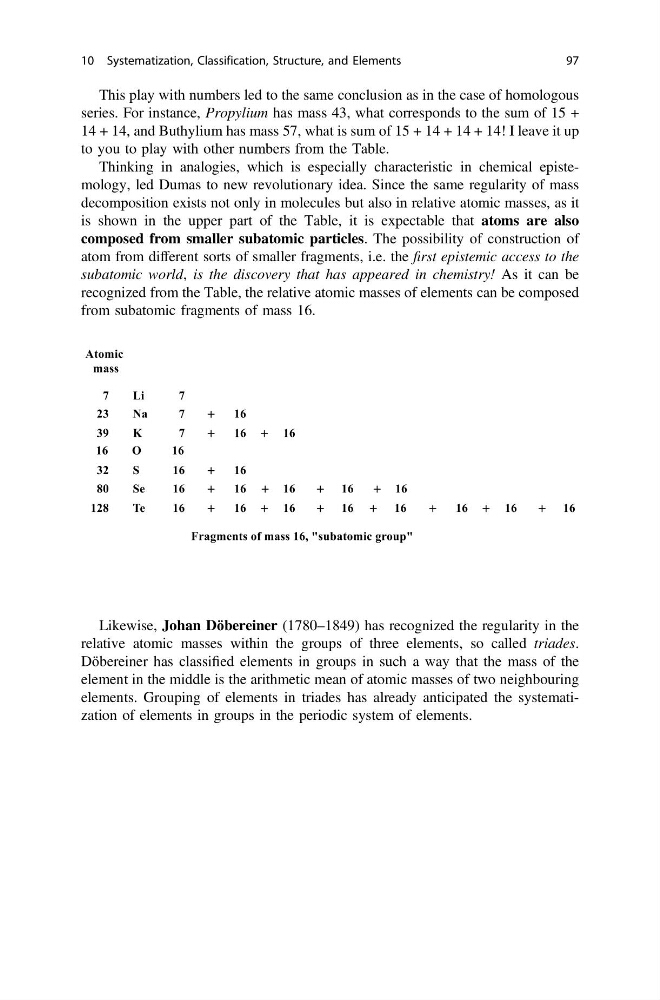
Thinking in analogies, which is especially characteristic in chemical epistemology, led Dumas to new revolutionary idea. Since the same regularity of mass
decomposition exists not only in molecules but also in relative atomic masses, as it
is shown in the upper part of the Table, it is expectable that atoms are also
composed from smaller subatomic particles. The possibility of construction of
atom from different sorts of smaller fragments, i.e. the first epistemic access to the
subatomic world, is the discovery that has appeared in chemistry! As it can be
recognized from the Table, the relative atomic masses of elements can be composed
from subatomic fragments of mass 16.
Likewise, Johan Döbereiner (1780–1849) has recognized the regularity in the
relative atomic masses within the groups of three elements, so called triades.
Döbereiner has classified elements in groups in such a way that the mass of the
element in the middle is the arithmetic mean of atomic masses of two neighbouring
elements. Grouping of elements in triades has already anticipated the systematization of elements in groups in the periodic system of elements.
Composition of relative atomic masses from smaller fragments
10 Systematization, Classification, Structure, and Elements
97
series. For instance, Propylium has mass 43, what corresponds to the sum of 15 +
14 + 14, and Buthylium has mass 57, what is sum of 15 + 14 + 14 + 14! I leave it up
to you to play with other numbers from the Table.
Thinking in analogies, which is especially characteristic in chemical epistemology, led Dumas to new revolutionary idea. Since the same regularity of mass
decomposition exists not only in molecules but also in relative atomic masses, as it
is shown in the upper part of the Table, it is expectable that atoms are also
composed from smaller subatomic particles. The possibility of construction of
atom from different sorts of smaller fragments, i.e. the first epistemic access to the
subatomic world, is the discovery that has appeared in chemistry! As it can be
recognized from the Table, the relative atomic masses of elements can be composed
from subatomic fragments of mass 16.
Likewise, Johan Döbereiner (1780–1849) has recognized the regularity in the
relative atomic masses within the groups of three elements, so called triades.
Döbereiner has classified elements in groups in such a way that the mass of the
element in the middle is the arithmetic mean of atomic masses of two neighbouring
elements. Grouping of elements in triades has already anticipated the systematization of elements in groups in the periodic system of elements.
Composition of relative atomic masses from smaller fragments
10 Systematization, Classification, Structure, and Elements
97