

2.5 Threats to Coral Reefs
37
phytoplankton for photosynthesis. Once absorbed into the ocean, CO 2 undergoes a
series of chemical reactions producing a weak acid; which creates a CO 2 - carbonate
equilibrium (discussed in the next section). An increase in the flux of CO 2 into the
ocean waters as a result of increasing anthropogenic atmospheric CO 2 concentrations
shifts this CO 2 -carbonate balance leading to a phenomenon referred to as ‘ocean
acidification’ (discussed in detail below).
Ocean Acidification
The release of carbon dioxide (CO 2 ) into the atmosphere by human activities leads
to an increased flux of CO 2 into a mildly alkaline ocean, thus leading to an increased
concentration of inorganic carbon and a reduction in pH, carbonate ion concentration,
and the capacity of seawater to buffer changes in its chemistry (Wang et al. 2015;
Yang et al. 2016); resulting in a phenomenon known as ocean acidification.
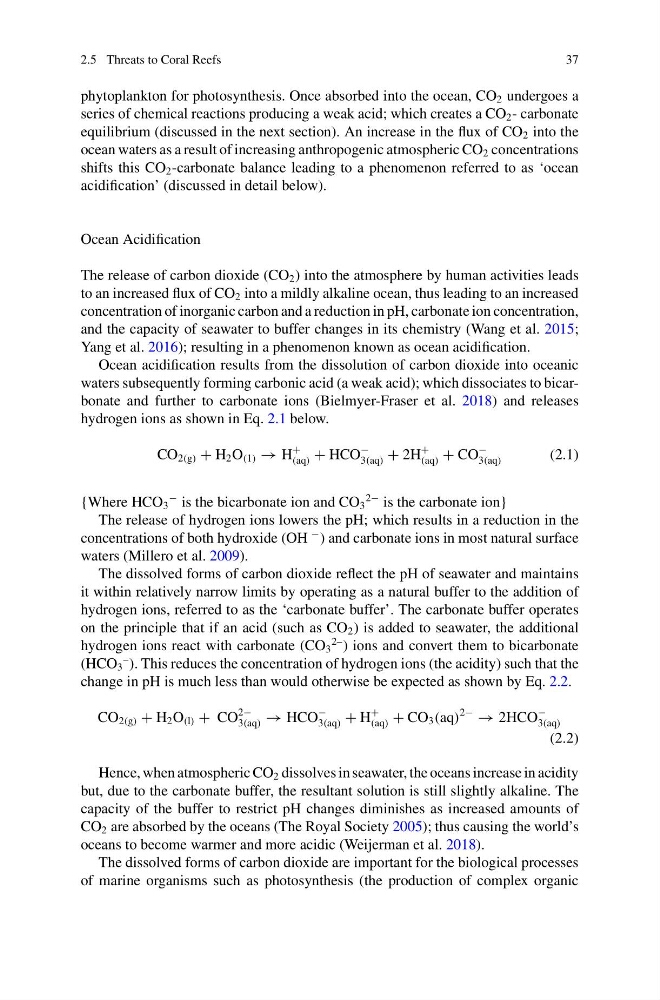
Ocean acidification results from the dissolution of carbon dioxide into oceanic
waters subsequently forming carbonic acid (a weak acid); which dissociates to bicarbonate and further to carbonate ions (Bielmyer-Fraser et al. 2018) and releases
hydrogen ions as shown in Eq. 2.1 below.
CO 2(g) + H 2 O (1) → H
+
(aq) + HCO
−
3(aq) + 2H
+
(aq) + CO
−
3(aq)
(2.1)
{Where HCO 3
− is the bicarbonate ion and CO 3
2− is the carbonate ion}
The release of hydrogen ions lowers the pH; which results in a reduction in the
concentrations of both hydroxide (OH
− ) and carbonate ions in most natural surface
waters (Millero et al. 2009).
The dissolved forms of carbon dioxide reflect the pH of seawater and maintains
it within relatively narrow limits by operating as a natural buffer to the addition of
hydrogen ions, referred to as the ‘carbonate buffer’. The carbonate buffer operates
on the principle that if an acid (such as CO 2 ) is added to seawater, the additional
hydrogen ions react with carbonate (CO 3
2– ) ions and convert them to bicarbonate
(HCO 3
– ). This reduces the concentration of hydrogen ions (the acidity) such that the
change in pH is much less than would otherwise be expected as shown by Eq. 2.2.
CO 2(g) + H 2 O (l) + CO
2−
3(aq) → HCO
−
3(aq) + H
+
(aq) + CO 3 (aq)
2−
→ 2HCO
−
3(aq)
(2.2)
Hence, when atmospheric CO 2 dissolves in seawater, the oceans increase in acidity
but, due to the carbonate buffer, the resultant solution is still slightly alkaline. The
capacity of the buffer to restrict pH changes diminishes as increased amounts of
CO 2 are absorbed by the oceans (The Royal Society 2005); thus causing the world’s
oceans to become warmer and more acidic (Weijerman et al. 2018).
The dissolved forms of carbon dioxide are important for the biological processes
of marine organisms such as photosynthesis (the production of complex organic
37
phytoplankton for photosynthesis. Once absorbed into the ocean, CO 2 undergoes a
series of chemical reactions producing a weak acid; which creates a CO 2 - carbonate
equilibrium (discussed in the next section). An increase in the flux of CO 2 into the
ocean waters as a result of increasing anthropogenic atmospheric CO 2 concentrations
shifts this CO 2 -carbonate balance leading to a phenomenon referred to as ‘ocean
acidification’ (discussed in detail below).
Ocean Acidification
The release of carbon dioxide (CO 2 ) into the atmosphere by human activities leads
to an increased flux of CO 2 into a mildly alkaline ocean, thus leading to an increased
concentration of inorganic carbon and a reduction in pH, carbonate ion concentration,
and the capacity of seawater to buffer changes in its chemistry (Wang et al. 2015;
Yang et al. 2016); resulting in a phenomenon known as ocean acidification.
Ocean acidification results from the dissolution of carbon dioxide into oceanic
waters subsequently forming carbonic acid (a weak acid); which dissociates to bicarbonate and further to carbonate ions (Bielmyer-Fraser et al. 2018) and releases
hydrogen ions as shown in Eq. 2.1 below.
CO 2(g) + H 2 O (1) → H
+
(aq) + HCO
−
3(aq) + 2H
+
(aq) + CO
−
3(aq)
(2.1)
{Where HCO 3
− is the bicarbonate ion and CO 3
2− is the carbonate ion}
The release of hydrogen ions lowers the pH; which results in a reduction in the
concentrations of both hydroxide (OH
− ) and carbonate ions in most natural surface
waters (Millero et al. 2009).
The dissolved forms of carbon dioxide reflect the pH of seawater and maintains
it within relatively narrow limits by operating as a natural buffer to the addition of
hydrogen ions, referred to as the ‘carbonate buffer’. The carbonate buffer operates
on the principle that if an acid (such as CO 2 ) is added to seawater, the additional
hydrogen ions react with carbonate (CO 3
2– ) ions and convert them to bicarbonate
(HCO 3
– ). This reduces the concentration of hydrogen ions (the acidity) such that the
change in pH is much less than would otherwise be expected as shown by Eq. 2.2.
CO 2(g) + H 2 O (l) + CO
2−
3(aq) → HCO
−
3(aq) + H
+
(aq) + CO 3 (aq)
2−
→ 2HCO
−
3(aq)
(2.2)
Hence, when atmospheric CO 2 dissolves in seawater, the oceans increase in acidity
but, due to the carbonate buffer, the resultant solution is still slightly alkaline. The
capacity of the buffer to restrict pH changes diminishes as increased amounts of
CO 2 are absorbed by the oceans (The Royal Society 2005); thus causing the world’s
oceans to become warmer and more acidic (Weijerman et al. 2018).
The dissolved forms of carbon dioxide are important for the biological processes
of marine organisms such as photosynthesis (the production of complex organic