

3 Truth and Beauty
55
However, we come here to a point of contention. How do we count the
number of assumptions in the alternative explanations of a scientific observation? Is an individual assumption required for every fossil and artefact,
or will one overriding assumption for creation as a whole be sufficient? Do
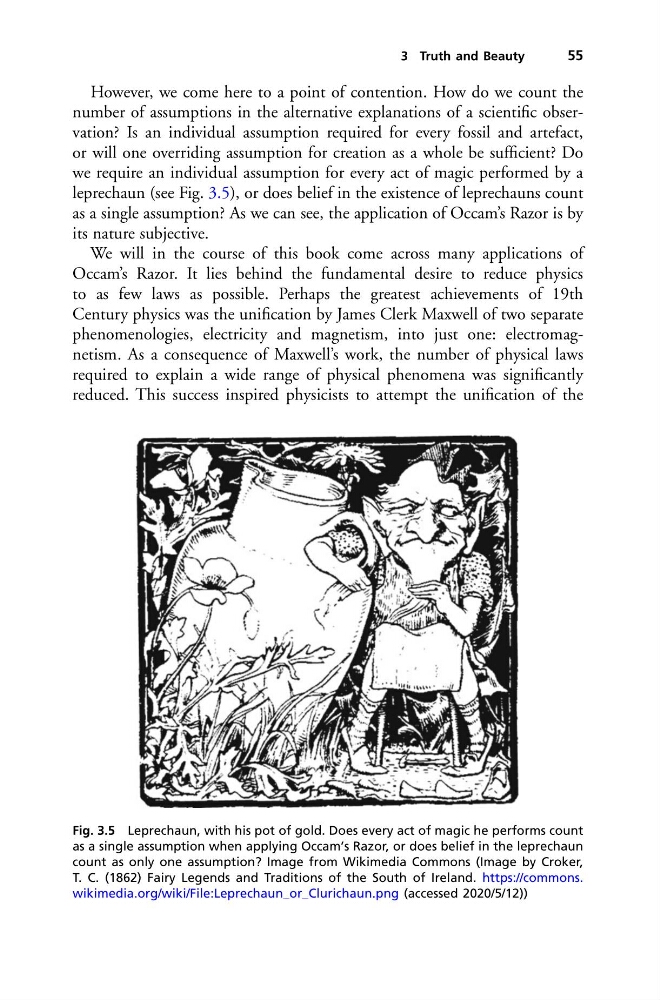
we require an individual assumption for every act of magic performed by a
leprechaun (see Fig. 3.5), or does belief in the existence of leprechauns count
as a single assumption? As we can see, the application of Occam’s Razor is by
its nature subjective.
We will in the course of this book come across many applications of
Occam’s Razor. It lies behind the fundamental desire to reduce physics
to as few laws as possible. Perhaps the greatest achievements of 19th
Century physics was the unification by James Clerk Maxwell of two separate
phenomenologies, electricity and magnetism, into just one: electromagnetism. As a consequence of Maxwell’s work, the number of physical laws
required to explain a wide range of physical phenomena was significantly
reduced. This success inspired physicists to attempt the unification of the
Fig. 3.5 Leprechaun, with his pot of gold. Does every act of magic he performs count
as a single assumption when applying Occam’s Razor, or does belief in the leprechaun
count as only one assumption? Image from Wikimedia Commons (Image by Croker,
T. C. (1862) Fairy Legends and Traditions of the South of Ireland. https://commons.
wikimedia.org/wiki/File:Leprechaun_or_Clurichaun.png (accessed 2020/5/12))
55
However, we come here to a point of contention. How do we count the
number of assumptions in the alternative explanations of a scientific observation? Is an individual assumption required for every fossil and artefact,
or will one overriding assumption for creation as a whole be sufficient? Do
we require an individual assumption for every act of magic performed by a
leprechaun (see Fig. 3.5), or does belief in the existence of leprechauns count
as a single assumption? As we can see, the application of Occam’s Razor is by
its nature subjective.
We will in the course of this book come across many applications of
Occam’s Razor. It lies behind the fundamental desire to reduce physics
to as few laws as possible. Perhaps the greatest achievements of 19th
Century physics was the unification by James Clerk Maxwell of two separate
phenomenologies, electricity and magnetism, into just one: electromagnetism. As a consequence of Maxwell’s work, the number of physical laws
required to explain a wide range of physical phenomena was significantly
reduced. This success inspired physicists to attempt the unification of the
Fig. 3.5 Leprechaun, with his pot of gold. Does every act of magic he performs count
as a single assumption when applying Occam’s Razor, or does belief in the leprechaun
count as only one assumption? Image from Wikimedia Commons (Image by Croker,
T. C. (1862) Fairy Legends and Traditions of the South of Ireland. https://commons.
wikimedia.org/wiki/File:Leprechaun_or_Clurichaun.png (accessed 2020/5/12))