

3 Truth and Beauty
47
If Hardy was a mathematician who, like Whitehead and Russell, stressed
the importance of formal proofs, Srinivasa Ramanujan was the exact opposite.
Self-taught and a 23-year old shipping clerk from Madras (now Chennai),
India, he wrote to Hardy in 1913, claiming that he had discovered some
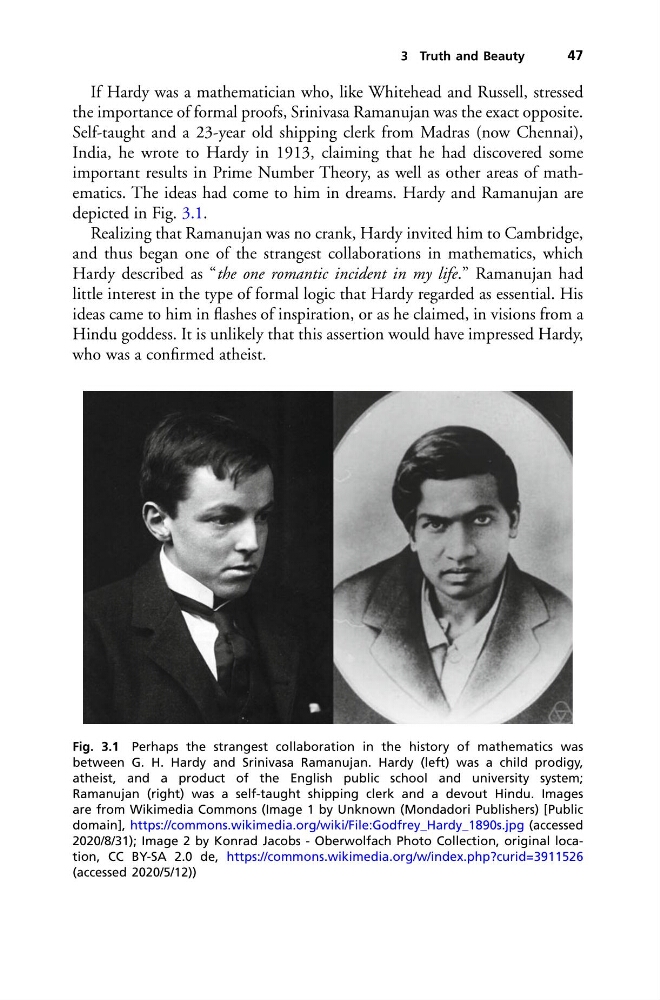
important results in Prime Number Theory, as well as other areas of mathematics. The ideas had come to him in dreams. Hardy and Ramanujan are
depicted in Fig. 3.1.
Realizing that Ramanujan was no crank, Hardy invited him to Cambridge,
and thus began one of the strangest collaborations in mathematics, which
Hardy described as “the one romantic incident in my life.” Ramanujan had
little interest in the type of formal logic that Hardy regarded as essential. His
ideas came to him in flashes of inspiration, or as he claimed, in visions from a
Hindu goddess. It is unlikely that this assertion would have impressed Hardy,
who was a confirmed atheist.
Fig. 3.1 Perhaps the strangest collaboration in the history of mathematics was
between G. H. Hardy and Srinivasa Ramanujan. Hardy (left) was a child prodigy,
atheist, and a product of the English public school and university system;
Ramanujan (right) was a self-taught shipping clerk and a devout Hindu. Images
are from Wikimedia Commons (Image 1 by Unknown (Mondadori Publishers) [Public
domain], https://commons.wikimedia.org/wiki/File:Godfrey_Hardy_1890s.jpg (accessed
2020/8/31); Image 2 by Konrad Jacobs - Oberwolfach Photo Collection, original location, CC BY-SA 2.0 de, https://commons.wikimedia.org/w/index.php?curid=3911526
(accessed 2020/5/12))
47
If Hardy was a mathematician who, like Whitehead and Russell, stressed
the importance of formal proofs, Srinivasa Ramanujan was the exact opposite.
Self-taught and a 23-year old shipping clerk from Madras (now Chennai),
India, he wrote to Hardy in 1913, claiming that he had discovered some
important results in Prime Number Theory, as well as other areas of mathematics. The ideas had come to him in dreams. Hardy and Ramanujan are
depicted in Fig. 3.1.
Realizing that Ramanujan was no crank, Hardy invited him to Cambridge,
and thus began one of the strangest collaborations in mathematics, which
Hardy described as “the one romantic incident in my life.” Ramanujan had
little interest in the type of formal logic that Hardy regarded as essential. His
ideas came to him in flashes of inspiration, or as he claimed, in visions from a
Hindu goddess. It is unlikely that this assertion would have impressed Hardy,
who was a confirmed atheist.
Fig. 3.1 Perhaps the strangest collaboration in the history of mathematics was
between G. H. Hardy and Srinivasa Ramanujan. Hardy (left) was a child prodigy,
atheist, and a product of the English public school and university system;
Ramanujan (right) was a self-taught shipping clerk and a devout Hindu. Images
are from Wikimedia Commons (Image 1 by Unknown (Mondadori Publishers) [Public
domain], https://commons.wikimedia.org/wiki/File:Godfrey_Hardy_1890s.jpg (accessed
2020/8/31); Image 2 by Konrad Jacobs - Oberwolfach Photo Collection, original location, CC BY-SA 2.0 de, https://commons.wikimedia.org/w/index.php?curid=3911526
(accessed 2020/5/12))