

44
R. Barrett and P. P. Delsanto
his Theory of Relativity, Riemannian geometry was already there, waiting for
him to use as a framework for space–time.
The laws of physics, on the other hand, are a property of nature. They
represent the physicist’s attempt to understand the working of the cosmos.
From these laws, the use of mathematics leads to predictions of the behaviour
of interacting bodies that can be tested by experiments carried out in a laboratory, or by observations made through a telescope, or similar instrument. If
these predictions do not agree with what is actually observed, it is assumed
that the original laws are inaccurate and must be modified in some way, or
abandoned altogether.
Strictly speaking we might alternatively say that the rules of logic that we
followed are wrong, and some new logic must be devised. However, this alternative is seldom seriously considered. One might say that it is part of the
“faith” of the physicist that the logic used by mathematicians is adhered to by
nature. We will discuss this proposition further in Sect. 3.3 of this Chapter,
and in Part 3 of this book we shall also examine the possibility of non-classical
logics.
As soon as we mention experiments, we encounter the major difference
between physics (or indeed any science) and mathematics. Every experiment, or observation, has associated with it a measurement error. For a
well-designed and executed experiment, this error can be relatively small (say
0.1%), but it is always there. The consequence is that we can never verify
our underlying physical laws once and for all time, because sometime in
the future a more accurate experiment may reveal a small but significant
difference between the predictions of our theory and the actual observations.
Thus we have finally arrived at the real difference between “truth” in mathematics and in physics. In mathematics, if a conclusion can be deduced as the
logical outcome of a chain of reasoning traced back to the original axioms, it
is considered true, and is announced to the world as a “theorem”. In physics,
there is no such thing as “truth”: the best one can say is that within the bounds
of current measurement error, the predicted result is correct.
3.3 Is Near Enough Good Enough?
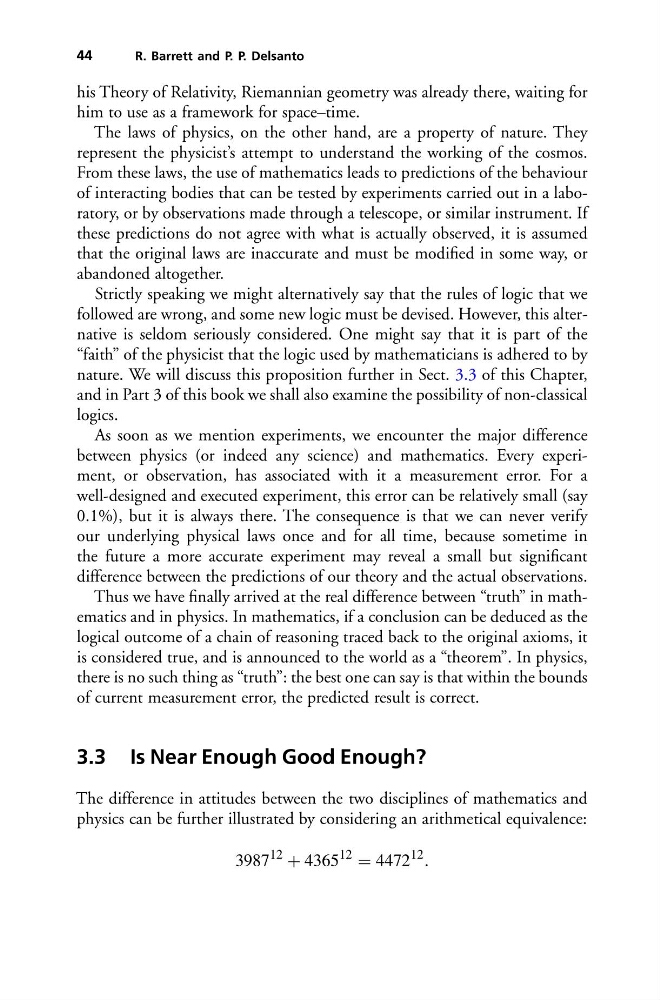
The difference in attitudes between the two disciplines of mathematics and
physics can be further illustrated by considering an arithmetical equivalence:
3987
12
+ 4365
12
= 4472
12
.
R. Barrett and P. P. Delsanto
his Theory of Relativity, Riemannian geometry was already there, waiting for
him to use as a framework for space–time.
The laws of physics, on the other hand, are a property of nature. They
represent the physicist’s attempt to understand the working of the cosmos.
From these laws, the use of mathematics leads to predictions of the behaviour
of interacting bodies that can be tested by experiments carried out in a laboratory, or by observations made through a telescope, or similar instrument. If
these predictions do not agree with what is actually observed, it is assumed
that the original laws are inaccurate and must be modified in some way, or
abandoned altogether.
Strictly speaking we might alternatively say that the rules of logic that we
followed are wrong, and some new logic must be devised. However, this alternative is seldom seriously considered. One might say that it is part of the
“faith” of the physicist that the logic used by mathematicians is adhered to by
nature. We will discuss this proposition further in Sect. 3.3 of this Chapter,
and in Part 3 of this book we shall also examine the possibility of non-classical
logics.
As soon as we mention experiments, we encounter the major difference
between physics (or indeed any science) and mathematics. Every experiment, or observation, has associated with it a measurement error. For a
well-designed and executed experiment, this error can be relatively small (say
0.1%), but it is always there. The consequence is that we can never verify
our underlying physical laws once and for all time, because sometime in
the future a more accurate experiment may reveal a small but significant
difference between the predictions of our theory and the actual observations.
Thus we have finally arrived at the real difference between “truth” in mathematics and in physics. In mathematics, if a conclusion can be deduced as the
logical outcome of a chain of reasoning traced back to the original axioms, it
is considered true, and is announced to the world as a “theorem”. In physics,
there is no such thing as “truth”: the best one can say is that within the bounds
of current measurement error, the predicted result is correct.
3.3 Is Near Enough Good Enough?
The difference in attitudes between the two disciplines of mathematics and
physics can be further illustrated by considering an arithmetical equivalence:
3987
12
+ 4365
12
= 4472
12
.