

2 The Meaning of Understanding
33
to expect from the heavens. However, that is the best prediction possible at
the present stage of development of meteorology.
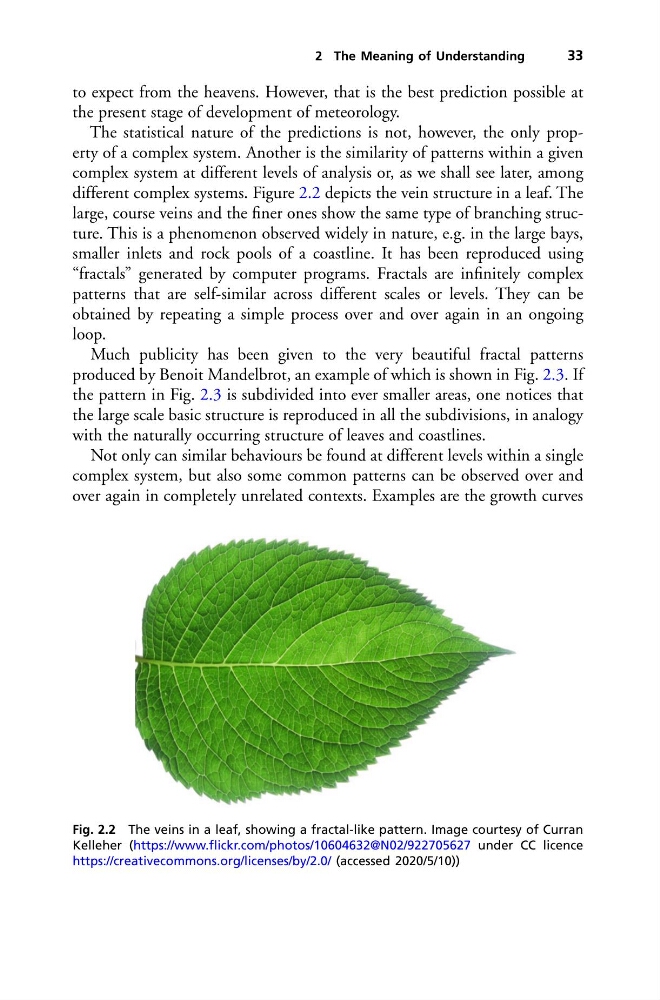
The statistical nature of the predictions is not, however, the only property of a complex system. Another is the similarity of patterns within a given
complex system at different levels of analysis or, as we shall see later, among
different complex systems. Figure 2.2 depicts the vein structure in a leaf. The
large, course veins and the finer ones show the same type of branching structure. This is a phenomenon observed widely in nature, e.g. in the large bays,
smaller inlets and rock pools of a coastline. It has been reproduced using
“fractals” generated by computer programs. Fractals are infinitely complex
patterns that are self-similar across different scales or levels. They can be
obtained by repeating a simple process over and over again in an ongoing
loop.
Much publicity has been given to the very beautiful fractal patterns
produced by Benoit Mandelbrot, an example of which is shown in Fig. 2.3. If
the pattern in Fig. 2.3 is subdivided into ever smaller areas, one notices that
the large scale basic structure is reproduced in all the subdivisions, in analogy
with the naturally occurring structure of leaves and coastlines.
Not only can similar behaviours be found at different levels within a single
complex system, but also some common patterns can be observed over and
over again in completely unrelated contexts. Examples are the growth curves
Fig. 2.2 The veins in a leaf, showing a fractal-like pattern. Image courtesy of Curran
Kelleher (https://www.flickr.com/photos/10604632@N02/922705627 under CC licence
https://creativecommons.org/licenses/by/2.0/ (accessed 2020/5/10))
33
to expect from the heavens. However, that is the best prediction possible at
the present stage of development of meteorology.
The statistical nature of the predictions is not, however, the only property of a complex system. Another is the similarity of patterns within a given
complex system at different levels of analysis or, as we shall see later, among
different complex systems. Figure 2.2 depicts the vein structure in a leaf. The
large, course veins and the finer ones show the same type of branching structure. This is a phenomenon observed widely in nature, e.g. in the large bays,
smaller inlets and rock pools of a coastline. It has been reproduced using
“fractals” generated by computer programs. Fractals are infinitely complex
patterns that are self-similar across different scales or levels. They can be
obtained by repeating a simple process over and over again in an ongoing
loop.
Much publicity has been given to the very beautiful fractal patterns
produced by Benoit Mandelbrot, an example of which is shown in Fig. 2.3. If
the pattern in Fig. 2.3 is subdivided into ever smaller areas, one notices that
the large scale basic structure is reproduced in all the subdivisions, in analogy
with the naturally occurring structure of leaves and coastlines.
Not only can similar behaviours be found at different levels within a single
complex system, but also some common patterns can be observed over and
over again in completely unrelated contexts. Examples are the growth curves
Fig. 2.2 The veins in a leaf, showing a fractal-like pattern. Image courtesy of Curran
Kelleher (https://www.flickr.com/photos/10604632@N02/922705627 under CC licence
https://creativecommons.org/licenses/by/2.0/ (accessed 2020/5/10))