

1 The Ultimate Question
19
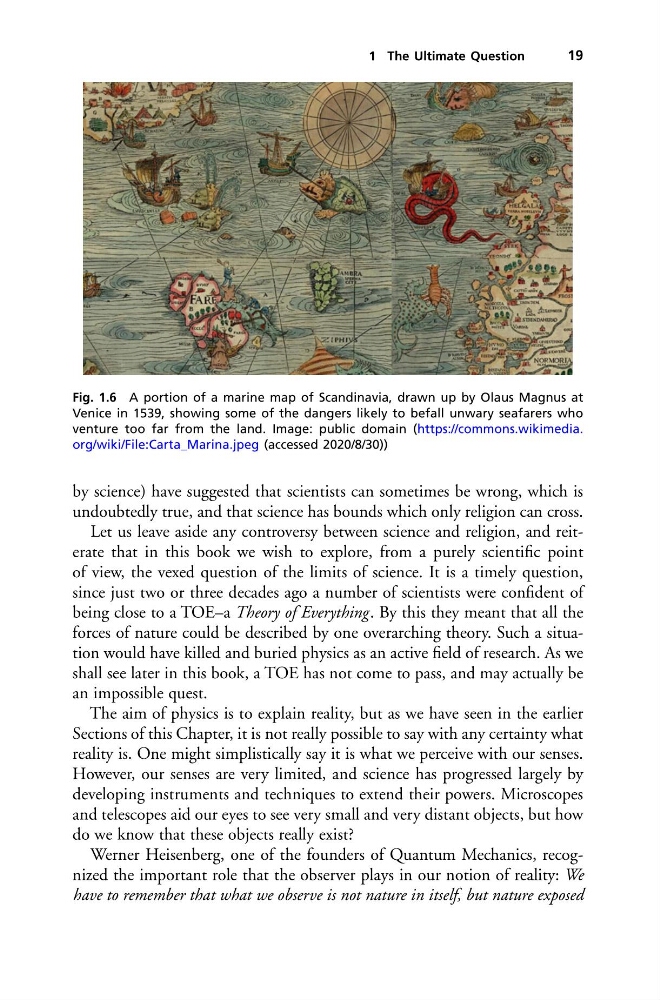
Fig. 1.6 A portion of a marine map of Scandinavia, drawn up by Olaus Magnus at
Venice in 1539, showing some of the dangers likely to befall unwary seafarers who
venture too far from the land. Image: public domain (https://commons.wikimedia.
org/wiki/File:Carta_Marina.jpeg (accessed 2020/8/30))
by science) have suggested that scientists can sometimes be wrong, which is
undoubtedly true, and that science has bounds which only religion can cross.
Let us leave aside any controversy between science and religion, and reiterate that in this book we wish to explore, from a purely scientific point
of view, the vexed question of the limits of science. It is a timely question,
since just two or three decades ago a number of scientists were confident of
being close to a TOE–a Theory of Everything. By this they meant that all the
forces of nature could be described by one overarching theory. Such a situation would have killed and buried physics as an active field of research. As we
shall see later in this book, a TOE has not come to pass, and may actually be
an impossible quest.
The aim of physics is to explain reality, but as we have seen in the earlier
Sections of this Chapter, it is not really possible to say with any certainty what
reality is. One might simplistically say it is what we perceive with our senses.
However, our senses are very limited, and science has progressed largely by
developing instruments and techniques to extend their powers. Microscopes
and telescopes aid our eyes to see very small and very distant objects, but how
do we know that these objects really exist?
Werner Heisenberg, one of the founders of Quantum Mechanics, recognized the important role that the observer plays in our notion of reality: We
have to remember that what we observe is not nature in itself, but nature exposed
19
Fig. 1.6 A portion of a marine map of Scandinavia, drawn up by Olaus Magnus at
Venice in 1539, showing some of the dangers likely to befall unwary seafarers who
venture too far from the land. Image: public domain (https://commons.wikimedia.
org/wiki/File:Carta_Marina.jpeg (accessed 2020/8/30))
by science) have suggested that scientists can sometimes be wrong, which is
undoubtedly true, and that science has bounds which only religion can cross.
Let us leave aside any controversy between science and religion, and reiterate that in this book we wish to explore, from a purely scientific point
of view, the vexed question of the limits of science. It is a timely question,
since just two or three decades ago a number of scientists were confident of
being close to a TOE–a Theory of Everything. By this they meant that all the
forces of nature could be described by one overarching theory. Such a situation would have killed and buried physics as an active field of research. As we
shall see later in this book, a TOE has not come to pass, and may actually be
an impossible quest.
The aim of physics is to explain reality, but as we have seen in the earlier
Sections of this Chapter, it is not really possible to say with any certainty what
reality is. One might simplistically say it is what we perceive with our senses.
However, our senses are very limited, and science has progressed largely by
developing instruments and techniques to extend their powers. Microscopes
and telescopes aid our eyes to see very small and very distant objects, but how
do we know that these objects really exist?
Werner Heisenberg, one of the founders of Quantum Mechanics, recognized the important role that the observer plays in our notion of reality: We
have to remember that what we observe is not nature in itself, but nature exposed