

280
Appendices
A.9.1 Relationship Between Range of a Force
and the Mass of Its Carrier Particle
The force between two particles at a distance is visualised, in Quantum Field
Theory, as arising from the exchange of carrier particles, which carry information between the two interacting particles. The situation is illustrated, for
example, in Chap. 9, Fig. 9.5c. The emission of the carrier particle from
the proton is clearly a violation of the law of conservation of mass/energy.
Such violations are possible according to Heisenberg’s Uncertainty Principle,
but only if they occur for a sufficiently short time. Indeed, a violation of
mass/energy by an amount E for a time t is possible if t is approximately
Planck’s constant h divided by 4π and E. During this time, the violation
cannot be detected.
This process allows the temporary creation of a carrier particle of mass m,
where m is obtained, according to Einstein and the one formula in this book,
from E = mc 2 . Hence, the larger the mass of the carrier particle, the greater
is E , and the shorter is the time it can exist. Such particles are said to be
virtual .
The finite lifetime of the carrier particle limits its range, which is given
by t multiplied by the velocity of light. If the particle has no mass, e.g., it
is a photon, its range, and hence that of the corresponding force is infinite.
As the mass of the carrier particle increases, its range decreases. Short range
forces therefore have heavy carrier particles.
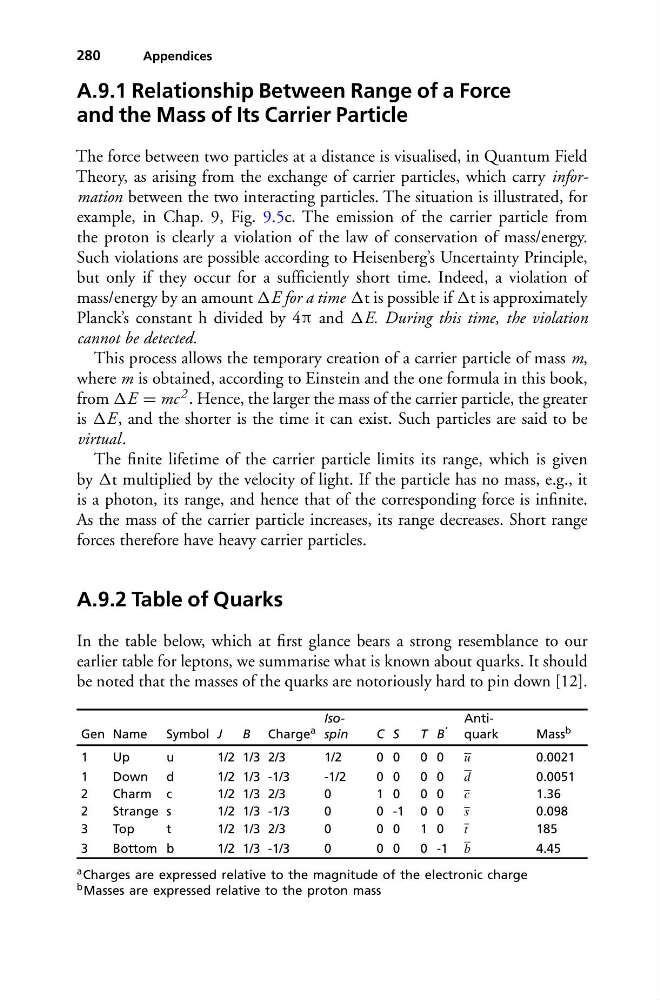
A.9.2 Table of Quarks
In the table below, which at first glance bears a strong resemblance to our
earlier table for leptons, we summarise what is known about quarks. It should
be noted that the masses of the quarks are notoriously hard to pin down [12].
Gen Name Symbol J
B Charge a
Isospin
C S
T B ’
Antiquark
Mass b
1
Up
u
1/2 1/3 2/3
1/2
0 0
0 0
u
0.0021
1
Down d
1/2 1/3 -1/3
-1/2
0 0
0 0
d
0.0051
2
Charm c
1/2 1/3 2/3
0
1 0
0 0
c
1.36
2
Strange s
1/2 1/3 -1/3
0
0 -1 0 0
s
0.098
3
T op
t
1/2 1/3 2/3
0
0 0
1 0
t
185
3
Bottom b
1/2 1/3 -1/3
0
0 0
0 -1 b
4.45
a Charges are expressed relative to the magnitude of the electronic charge
b Masses are expressed relative to the proton mass
Appendices
A.9.1 Relationship Between Range of a Force
and the Mass of Its Carrier Particle
The force between two particles at a distance is visualised, in Quantum Field
Theory, as arising from the exchange of carrier particles, which carry information between the two interacting particles. The situation is illustrated, for
example, in Chap. 9, Fig. 9.5c. The emission of the carrier particle from
the proton is clearly a violation of the law of conservation of mass/energy.
Such violations are possible according to Heisenberg’s Uncertainty Principle,
but only if they occur for a sufficiently short time. Indeed, a violation of
mass/energy by an amount E for a time t is possible if t is approximately
Planck’s constant h divided by 4π and E. During this time, the violation
cannot be detected.
This process allows the temporary creation of a carrier particle of mass m,
where m is obtained, according to Einstein and the one formula in this book,
from E = mc 2 . Hence, the larger the mass of the carrier particle, the greater
is E , and the shorter is the time it can exist. Such particles are said to be
virtual .
The finite lifetime of the carrier particle limits its range, which is given
by t multiplied by the velocity of light. If the particle has no mass, e.g., it
is a photon, its range, and hence that of the corresponding force is infinite.
As the mass of the carrier particle increases, its range decreases. Short range
forces therefore have heavy carrier particles.
A.9.2 Table of Quarks
In the table below, which at first glance bears a strong resemblance to our
earlier table for leptons, we summarise what is known about quarks. It should
be noted that the masses of the quarks are notoriously hard to pin down [12].
Gen Name Symbol J
B Charge a
Isospin
C S
T B ’
Antiquark
Mass b
1
Up
u
1/2 1/3 2/3
1/2
0 0
0 0
u
0.0021
1
Down d
1/2 1/3 -1/3
-1/2
0 0
0 0
d
0.0051
2
Charm c
1/2 1/3 2/3
0
1 0
0 0
c
1.36
2
Strange s
1/2 1/3 -1/3
0
0 -1 0 0
s
0.098
3
T op
t
1/2 1/3 2/3
0
0 0
1 0
t
185
3
Bottom b
1/2 1/3 -1/3
0
0 0
0 -1 b
4.45
a Charges are expressed relative to the magnitude of the electronic charge
b Masses are expressed relative to the proton mass