

278
Appendices
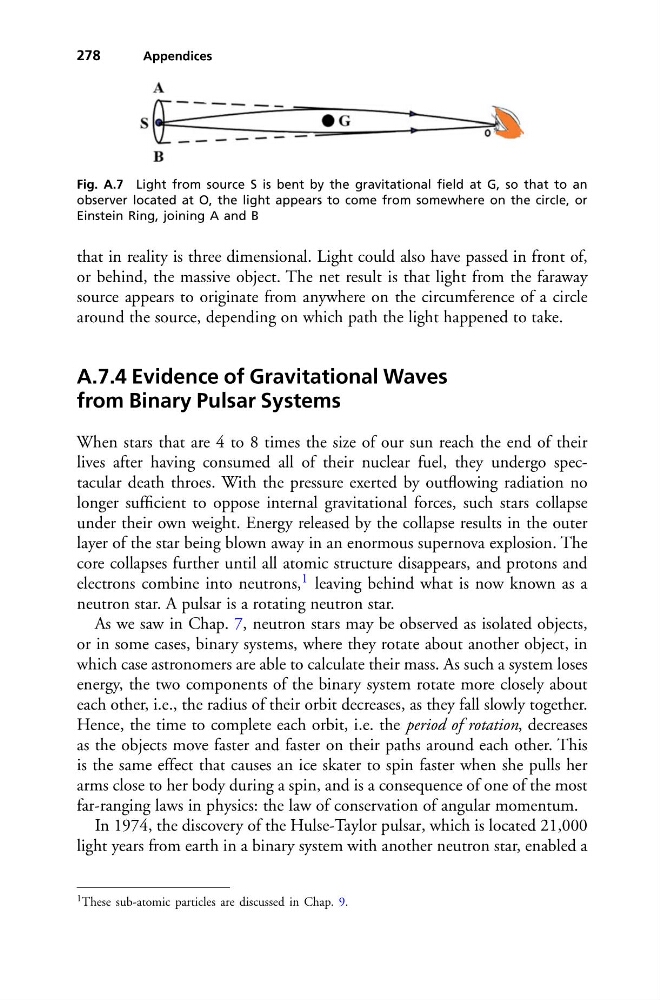
Fig. A.7 Light from source S is bent by the gravitational field at G, so that to an
observer located at O, the light appears to come from somewhere on the circle, or
Einstein Ring, joining A and B
that in reality is three dimensional. Light could also have passed in front of,
or behind, the massive object. The net result is that light from the faraway
source appears to originate from anywhere on the circumference of a circle
around the source, depending on which path the light happened to take.
A.7.4 Evidence of Gravitational Waves
from Binary Pulsar Systems
When stars that are 4 to 8 times the size of our sun reach the end of their
lives after having consumed all of their nuclear fuel, they undergo spectacular death throes. With the pressure exerted by outflowing radiation no
longer sufficient to oppose internal gravitational forces, such stars collapse
under their own weight. Energy released by the collapse results in the outer
layer of the star being blown away in an enormous supernova explosion. The
core collapses further until all atomic structure disappears, and protons and
electrons combine into neutrons, 1 leaving behind what is now known as a
neutron star. A pulsar is a rotating neutron star.
As we saw in Chap. 7, neutron stars may be observed as isolated objects,
or in some cases, binary systems, where they rotate about another object, in
which case astronomers are able to calculate their mass. As such a system loses
energy, the two components of the binary system rotate more closely about
each other, i.e., the radius of their orbit decreases, as they fall slowly together.
Hence, the time to complete each orbit, i.e. the period of rotation, decreases
as the objects move faster and faster on their paths around each other. This
is the same effect that causes an ice skater to spin faster when she pulls her
arms close to her body during a spin, and is a consequence of one of the most
far-ranging laws in physics: the law of conservation of angular momentum.
In 1974, the discovery of the Hulse-Taylor pulsar, which is located 21,000
light years from earth in a binary system with another neutron star, enabled a
1 These sub-atomic particles are discussed in Chap. 9.
Appendices
Fig. A.7 Light from source S is bent by the gravitational field at G, so that to an
observer located at O, the light appears to come from somewhere on the circle, or
Einstein Ring, joining A and B
that in reality is three dimensional. Light could also have passed in front of,
or behind, the massive object. The net result is that light from the faraway
source appears to originate from anywhere on the circumference of a circle
around the source, depending on which path the light happened to take.
A.7.4 Evidence of Gravitational Waves
from Binary Pulsar Systems
When stars that are 4 to 8 times the size of our sun reach the end of their
lives after having consumed all of their nuclear fuel, they undergo spectacular death throes. With the pressure exerted by outflowing radiation no
longer sufficient to oppose internal gravitational forces, such stars collapse
under their own weight. Energy released by the collapse results in the outer
layer of the star being blown away in an enormous supernova explosion. The
core collapses further until all atomic structure disappears, and protons and
electrons combine into neutrons, 1 leaving behind what is now known as a
neutron star. A pulsar is a rotating neutron star.
As we saw in Chap. 7, neutron stars may be observed as isolated objects,
or in some cases, binary systems, where they rotate about another object, in
which case astronomers are able to calculate their mass. As such a system loses
energy, the two components of the binary system rotate more closely about
each other, i.e., the radius of their orbit decreases, as they fall slowly together.
Hence, the time to complete each orbit, i.e. the period of rotation, decreases
as the objects move faster and faster on their paths around each other. This
is the same effect that causes an ice skater to spin faster when she pulls her
arms close to her body during a spin, and is a consequence of one of the most
far-ranging laws in physics: the law of conservation of angular momentum.
In 1974, the discovery of the Hulse-Taylor pulsar, which is located 21,000
light years from earth in a binary system with another neutron star, enabled a
1 These sub-atomic particles are discussed in Chap. 9.