

270
Appendices
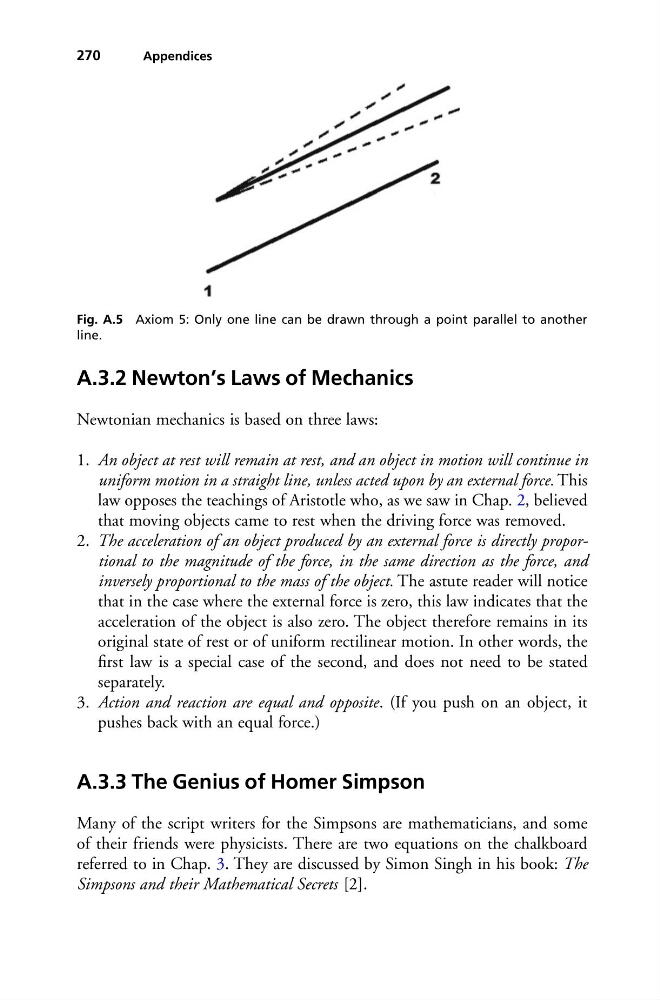
Fig. A.5 Axiom 5: Only one line can be drawn through a point parallel to another
line.
A.3.2 Newton’s Laws of Mechanics
Newtonian mechanics is based on three laws:
1. An object at rest will remain at rest, and an object in motion will continue in
uniform motion in a straight line, unless acted upon by an external force. This
law opposes the teachings of Aristotle who, as we saw in Chap. 2, believed
that moving objects came to rest when the driving force was removed.
2. The acceleration of an object produced by an external force is directly proportional to the magnitude of the force, in the same direction as the force, and
inversely proportional to the mass of the object. The astute reader will notice
that in the case where the external force is zero, this law indicates that the
acceleration of the object is also zero. The object therefore remains in its
original state of rest or of uniform rectilinear motion. In other words, the
first law is a special case of the second, and does not need to be stated
separately.
3. Action and reaction are equal and opposite. (If you push on an object, it
pushes back with an equal force.)
A.3.3 The Genius of Homer Simpson
Many of the script writers for the Simpsons are mathematicians, and some
of their friends were physicists. There are two equations on the chalkboard
referred to in Chap. 3. They are discussed by Simon Singh in his book: The
Simpsons and their Mathematical Secrets [2].
Appendices
Fig. A.5 Axiom 5: Only one line can be drawn through a point parallel to another
line.
A.3.2 Newton’s Laws of Mechanics
Newtonian mechanics is based on three laws:
1. An object at rest will remain at rest, and an object in motion will continue in
uniform motion in a straight line, unless acted upon by an external force. This
law opposes the teachings of Aristotle who, as we saw in Chap. 2, believed
that moving objects came to rest when the driving force was removed.
2. The acceleration of an object produced by an external force is directly proportional to the magnitude of the force, in the same direction as the force, and
inversely proportional to the mass of the object. The astute reader will notice
that in the case where the external force is zero, this law indicates that the
acceleration of the object is also zero. The object therefore remains in its
original state of rest or of uniform rectilinear motion. In other words, the
first law is a special case of the second, and does not need to be stated
separately.
3. Action and reaction are equal and opposite. (If you push on an object, it
pushes back with an equal force.)
A.3.3 The Genius of Homer Simpson
Many of the script writers for the Simpsons are mathematicians, and some
of their friends were physicists. There are two equations on the chalkboard
referred to in Chap. 3. They are discussed by Simon Singh in his book: The
Simpsons and their Mathematical Secrets [2].