

11 Modern Cosmology
229
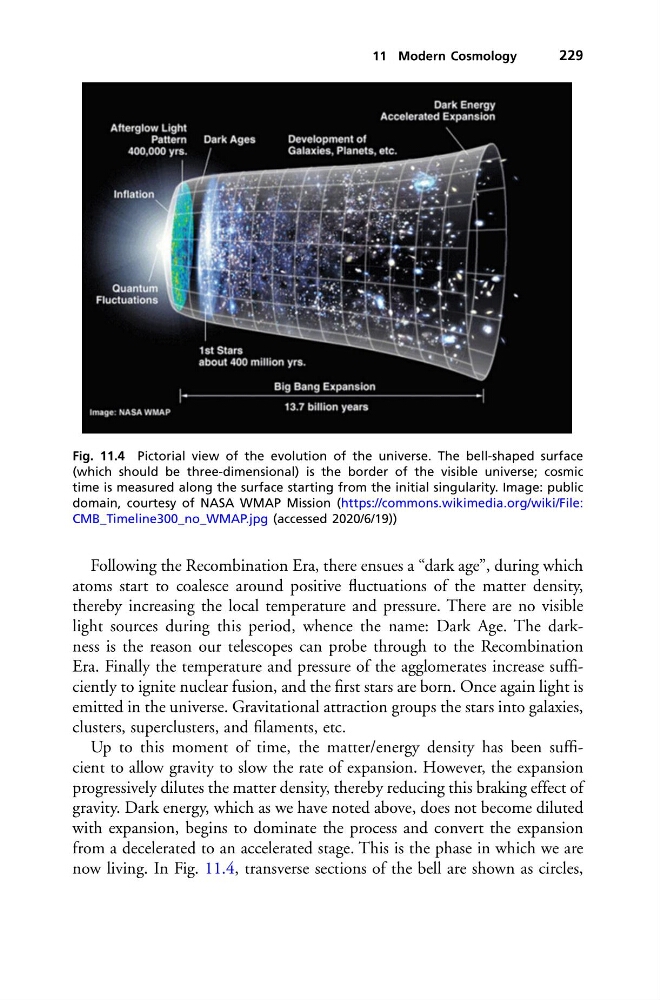
Fig. 11.4 Pictorial view of the evolution of the universe. The bell-shaped surface
(which should be three-dimensional) is the border of the visible universe; cosmic
time is measured along the surface starting from the initial singularity. Image: public
domain, courtesy of NASA WMAP Mission (https://commons.wikimedia.org/wiki/File:
CMB_Timeline300_no_WMAP.jpg (accessed 2020/6/19))
Following the Recombination Era, there ensues a “dark age”, during which
atoms start to coalesce around positive fluctuations of the matter density,
thereby increasing the local temperature and pressure. There are no visible
light sources during this period, whence the name: Dark Age. The darkness is the reason our telescopes can probe through to the Recombination
Era. Finally the temperature and pressure of the agglomerates increase sufficiently to ignite nuclear fusion, and the first stars are born. Once again light is
emitted in the universe. Gravitational attraction groups the stars into galaxies,
clusters, superclusters, and filaments, etc.
Up to this moment of time, the matter/energy density has been sufficient to allow gravity to slow the rate of expansion. However, the expansion
progressively dilutes the matter density, thereby reducing this braking effect of
gravity. Dark energy, which as we have noted above, does not become diluted
with expansion, begins to dominate the process and convert the expansion
from a decelerated to an accelerated stage. This is the phase in which we are
now living. In Fig. 11.4, transverse sections of the bell are shown as circles,
229
Fig. 11.4 Pictorial view of the evolution of the universe. The bell-shaped surface
(which should be three-dimensional) is the border of the visible universe; cosmic
time is measured along the surface starting from the initial singularity. Image: public
domain, courtesy of NASA WMAP Mission (https://commons.wikimedia.org/wiki/File:
CMB_Timeline300_no_WMAP.jpg (accessed 2020/6/19))
Following the Recombination Era, there ensues a “dark age”, during which
atoms start to coalesce around positive fluctuations of the matter density,
thereby increasing the local temperature and pressure. There are no visible
light sources during this period, whence the name: Dark Age. The darkness is the reason our telescopes can probe through to the Recombination
Era. Finally the temperature and pressure of the agglomerates increase sufficiently to ignite nuclear fusion, and the first stars are born. Once again light is
emitted in the universe. Gravitational attraction groups the stars into galaxies,
clusters, superclusters, and filaments, etc.
Up to this moment of time, the matter/energy density has been sufficient to allow gravity to slow the rate of expansion. However, the expansion
progressively dilutes the matter density, thereby reducing this braking effect of
gravity. Dark energy, which as we have noted above, does not become diluted
with expansion, begins to dominate the process and convert the expansion
from a decelerated to an accelerated stage. This is the phase in which we are
now living. In Fig. 11.4, transverse sections of the bell are shown as circles,