

11 Modern Cosmology
225
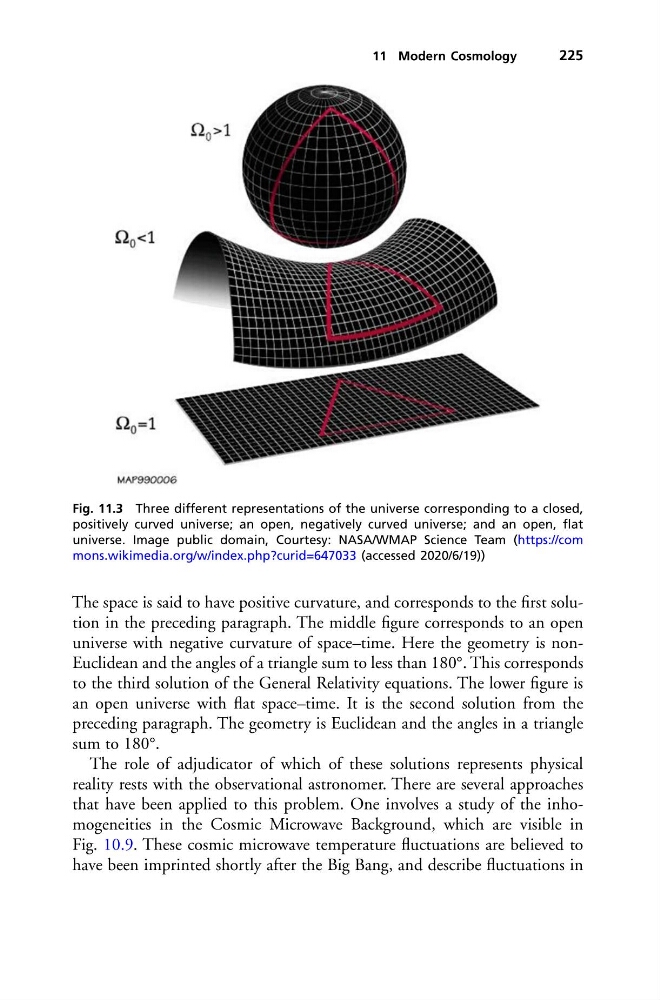
Fig. 11.3 Three different representations of the universe corresponding to a closed,
positively curved universe; an open, negatively curved universe; and an open, flat
universe. Image public domain, Courtesy: NASA/WMAP Science Team (https://com
mons.wikimedia.org/w/index.php?curid=647033 (accessed 2020/6/19))
The space is said to have positive curvature, and corresponds to the first solution in the preceding paragraph. The middle figure corresponds to an open
universe with negative curvature of space–time. Here the geometry is nonEuclidean and the angles of a triangle sum to less than 180°. This corresponds
to the third solution of the General Relativity equations. The lower figure is
an open universe with flat space–time. It is the second solution from the
preceding paragraph. The geometry is Euclidean and the angles in a triangle
sum to 180°.
The role of adjudicator of which of these solutions represents physical
reality rests with the observational astronomer. There are several approaches
that have been applied to this problem. One involves a study of the inhomogeneities in the Cosmic Microwave Background, which are visible in
Fig. 10.9. These cosmic microwave temperature fluctuations are believed to
have been imprinted shortly after the Big Bang, and describe fluctuations in
225
Fig. 11.3 Three different representations of the universe corresponding to a closed,
positively curved universe; an open, negatively curved universe; and an open, flat
universe. Image public domain, Courtesy: NASA/WMAP Science Team (https://com
mons.wikimedia.org/w/index.php?curid=647033 (accessed 2020/6/19))
The space is said to have positive curvature, and corresponds to the first solution in the preceding paragraph. The middle figure corresponds to an open
universe with negative curvature of space–time. Here the geometry is nonEuclidean and the angles of a triangle sum to less than 180°. This corresponds
to the third solution of the General Relativity equations. The lower figure is
an open universe with flat space–time. It is the second solution from the
preceding paragraph. The geometry is Euclidean and the angles in a triangle
sum to 180°.
The role of adjudicator of which of these solutions represents physical
reality rests with the observational astronomer. There are several approaches
that have been applied to this problem. One involves a study of the inhomogeneities in the Cosmic Microwave Background, which are visible in
Fig. 10.9. These cosmic microwave temperature fluctuations are believed to
have been imprinted shortly after the Big Bang, and describe fluctuations in