

184
R. Barrett and P. P. Delsanto
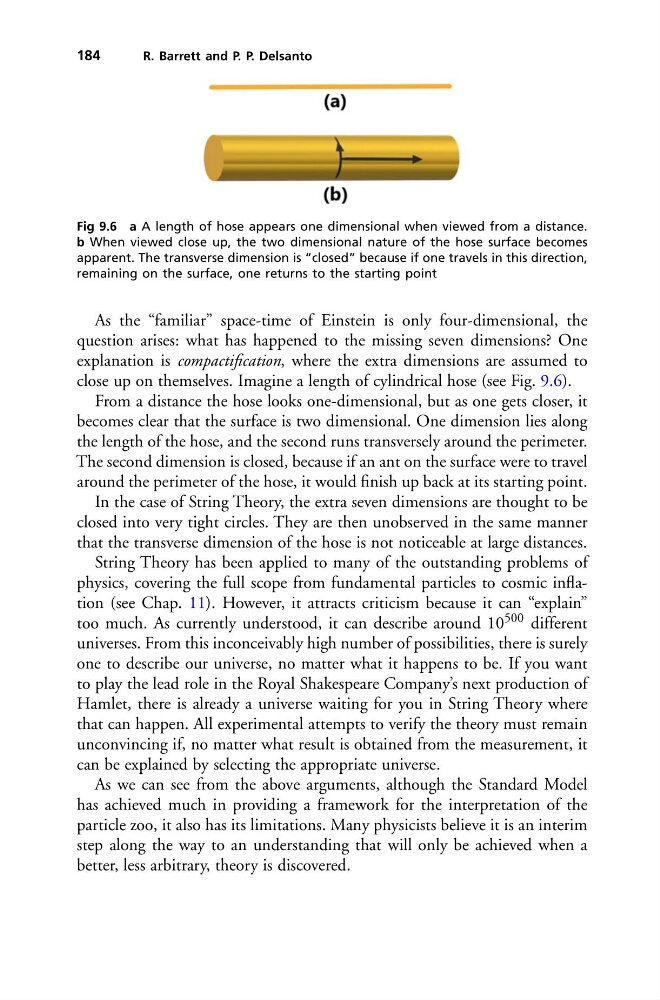
Fig 9.6 a A length of hose appears one dimensional when viewed from a distance.
b When viewed close up, the two dimensional nature of the hose surface becomes
apparent. The transverse dimension is “closed” because if one travels in this direction,
remaining on the surface, one returns to the starting point
As the “familiar” space-time of Einstein is only four-dimensional, the
question arises: what has happened to the missing seven dimensions? One
explanation is compactification, where the extra dimensions are assumed to
close up on themselves. Imagine a length of cylindrical hose (see Fig. 9.6).
From a distance the hose looks one-dimensional, but as one gets closer, it
becomes clear that the surface is two dimensional. One dimension lies along
the length of the hose, and the second runs transversely around the perimeter.
The second dimension is closed, because if an ant on the surface were to travel
around the perimeter of the hose, it would finish up back at its starting point.
In the case of String Theory, the extra seven dimensions are thought to be
closed into very tight circles. They are then unobserved in the same manner
that the transverse dimension of the hose is not noticeable at large distances.
String Theory has been applied to many of the outstanding problems of
physics, covering the full scope from fundamental particles to cosmic inflation (see Chap. 11). However, it attracts criticism because it can “explain”
too much. As currently understood, it can describe around 10 500 different
universes. From this inconceivably high number of possibilities, there is surely
one to describe our universe, no matter what it happens to be. If you want
to play the lead role in the Royal Shakespeare Company’s next production of
Hamlet, there is already a universe waiting for you in String Theory where
that can happen. All experimental attempts to verify the theory must remain
unconvincing if, no matter what result is obtained from the measurement, it
can be explained by selecting the appropriate universe.
As we can see from the above arguments, although the Standard Model
has achieved much in providing a framework for the interpretation of the
particle zoo, it also has its limitations. Many physicists believe it is an interim
step along the way to an understanding that will only be achieved when a
better, less arbitrary, theory is discovered.
R. Barrett and P. P. Delsanto
Fig 9.6 a A length of hose appears one dimensional when viewed from a distance.
b When viewed close up, the two dimensional nature of the hose surface becomes
apparent. The transverse dimension is “closed” because if one travels in this direction,
remaining on the surface, one returns to the starting point
As the “familiar” space-time of Einstein is only four-dimensional, the
question arises: what has happened to the missing seven dimensions? One
explanation is compactification, where the extra dimensions are assumed to
close up on themselves. Imagine a length of cylindrical hose (see Fig. 9.6).
From a distance the hose looks one-dimensional, but as one gets closer, it
becomes clear that the surface is two dimensional. One dimension lies along
the length of the hose, and the second runs transversely around the perimeter.
The second dimension is closed, because if an ant on the surface were to travel
around the perimeter of the hose, it would finish up back at its starting point.
In the case of String Theory, the extra seven dimensions are thought to be
closed into very tight circles. They are then unobserved in the same manner
that the transverse dimension of the hose is not noticeable at large distances.
String Theory has been applied to many of the outstanding problems of
physics, covering the full scope from fundamental particles to cosmic inflation (see Chap. 11). However, it attracts criticism because it can “explain”
too much. As currently understood, it can describe around 10 500 different
universes. From this inconceivably high number of possibilities, there is surely
one to describe our universe, no matter what it happens to be. If you want
to play the lead role in the Royal Shakespeare Company’s next production of
Hamlet, there is already a universe waiting for you in String Theory where
that can happen. All experimental attempts to verify the theory must remain
unconvincing if, no matter what result is obtained from the measurement, it
can be explained by selecting the appropriate universe.
As we can see from the above arguments, although the Standard Model
has achieved much in providing a framework for the interpretation of the
particle zoo, it also has its limitations. Many physicists believe it is an interim
step along the way to an understanding that will only be achieved when a
better, less arbitrary, theory is discovered.