

9 The Standard Model of Fundamental Particles
181
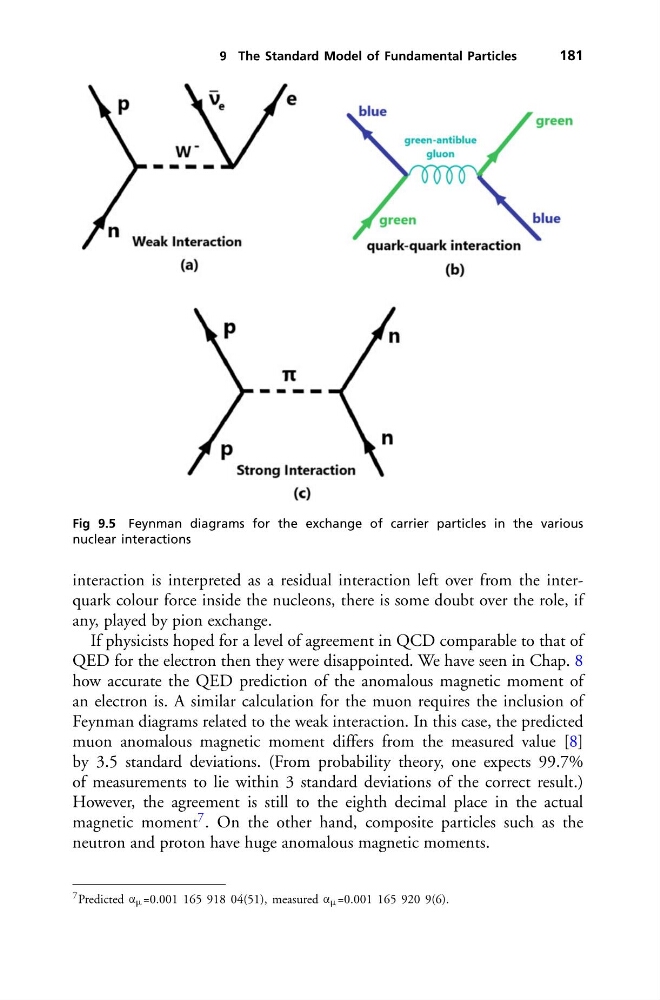
Fig 9.5 Feynman diagrams for the exchange of carrier particles in the various
nuclear interactions
interaction is interpreted as a residual interaction left over from the interquark colour force inside the nucleons, there is some doubt over the role, if
any, played by pion exchange.
If physicists hoped for a level of agreement in QCD comparable to that of
QED for the electron then they were disappointed. We have seen in Chap. 8
how accurate the QED prediction of the anomalous magnetic moment of
an electron is. A similar calculation for the muon requires the inclusion of
Feynman diagrams related to the weak interaction. In this case, the predicted
muon anomalous magnetic moment differs from the measured value [8]
by 3.5 standard deviations. (From probability theory, one expects 99.7%
of measurements to lie within 3 standard deviations of the correct result.)
However, the agreement is still to the eighth decimal place in the actual
magnetic moment 7 . On the other hand, composite particles such as the
neutron and proton have huge anomalous magnetic moments.
7 Predicted α μ =0.001 165 918 04(51), measured α μ =0.001 165 920 9(6).
181
Fig 9.5 Feynman diagrams for the exchange of carrier particles in the various
nuclear interactions
interaction is interpreted as a residual interaction left over from the interquark colour force inside the nucleons, there is some doubt over the role, if
any, played by pion exchange.
If physicists hoped for a level of agreement in QCD comparable to that of
QED for the electron then they were disappointed. We have seen in Chap. 8
how accurate the QED prediction of the anomalous magnetic moment of
an electron is. A similar calculation for the muon requires the inclusion of
Feynman diagrams related to the weak interaction. In this case, the predicted
muon anomalous magnetic moment differs from the measured value [8]
by 3.5 standard deviations. (From probability theory, one expects 99.7%
of measurements to lie within 3 standard deviations of the correct result.)
However, the agreement is still to the eighth decimal place in the actual
magnetic moment 7 . On the other hand, composite particles such as the
neutron and proton have huge anomalous magnetic moments.
7 Predicted α μ =0.001 165 918 04(51), measured α μ =0.001 165 920 9(6).