

9 The Standard Model of Fundamental Particles
177
quarks together inside a baryon, e.g. inside a proton or neutron. The mediating carriers for this force are the gluons. They are called gluons because they
are the source of the glue binding the quarks together.
So how does all this impact on the strong interaction which, as we saw
in Sect. 9.3, binds the protons and neutrons together inside a nucleus, and
is responsible for the energy of the atomic bomb? An analogy can be drawn
with Van der Waals forces in chemistry. As two atoms approach together,
their electron clouds repel each other. Hence, although the atoms are electrically neutral, their negatively charged electrons and positively charged nuclei
do not remain coincident. As a consequence, the atoms experience a weak
attractive force, which is a residual interaction left over from the imperfect
cancellation of the negative and positive fields of the electrons and nuclei. As
the atoms come closer together, their electron clouds begin to overlap, and
the attractive force turns into a strong repulsive one. Van der Waals forces
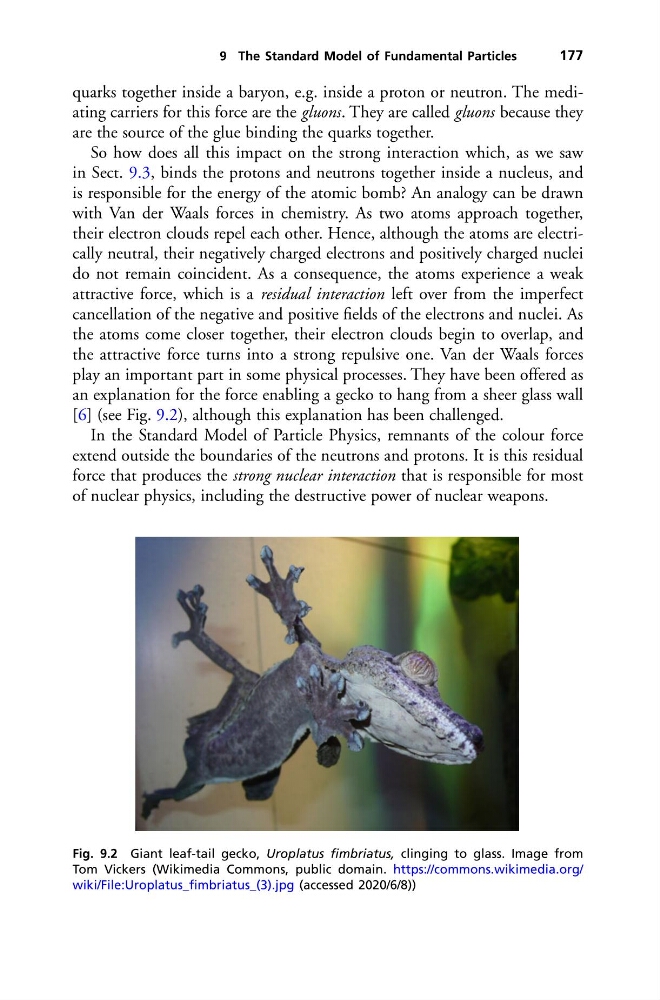
play an important part in some physical processes. They have been offered as
an explanation for the force enabling a gecko to hang from a sheer glass wall
[6] (see Fig. 9.2), although this explanation has been challenged.
In the Standard Model of Particle Physics, remnants of the colour force
extend outside the boundaries of the neutrons and protons. It is this residual
force that produces the strong nuclear interaction that is responsible for most
of nuclear physics, including the destructive power of nuclear weapons.
Fig. 9.2 Giant leaf-tail gecko, Uroplatus fimbriatus, clinging to glass. Image from
Tom Vickers (Wikimedia Commons, public domain. https://commons.wikimedia.org/
wiki/File:Uroplatus_fimbriatus_(3).jpg (accessed 2020/6/8))
177
quarks together inside a baryon, e.g. inside a proton or neutron. The mediating carriers for this force are the gluons. They are called gluons because they
are the source of the glue binding the quarks together.
So how does all this impact on the strong interaction which, as we saw
in Sect. 9.3, binds the protons and neutrons together inside a nucleus, and
is responsible for the energy of the atomic bomb? An analogy can be drawn
with Van der Waals forces in chemistry. As two atoms approach together,
their electron clouds repel each other. Hence, although the atoms are electrically neutral, their negatively charged electrons and positively charged nuclei
do not remain coincident. As a consequence, the atoms experience a weak
attractive force, which is a residual interaction left over from the imperfect
cancellation of the negative and positive fields of the electrons and nuclei. As
the atoms come closer together, their electron clouds begin to overlap, and
the attractive force turns into a strong repulsive one. Van der Waals forces
play an important part in some physical processes. They have been offered as
an explanation for the force enabling a gecko to hang from a sheer glass wall
[6] (see Fig. 9.2), although this explanation has been challenged.
In the Standard Model of Particle Physics, remnants of the colour force
extend outside the boundaries of the neutrons and protons. It is this residual
force that produces the strong nuclear interaction that is responsible for most
of nuclear physics, including the destructive power of nuclear weapons.
Fig. 9.2 Giant leaf-tail gecko, Uroplatus fimbriatus, clinging to glass. Image from
Tom Vickers (Wikimedia Commons, public domain. https://commons.wikimedia.org/
wiki/File:Uroplatus_fimbriatus_(3).jpg (accessed 2020/6/8))