

174
R. Barrett and P. P. Delsanto
Table 9.1 Table of Leptons
Generation
Name
Symbol
Antiparticle
Charge a
Mass b
1
Electron
e −
e +
−1
1 . 0
1
Electron
neutrino
ν e
ν e
0
Small, but
non-zero
2
Muon
μ −
μ +
−1
206.8
2
Muon
neutrino
ν μ
ν μ
0
Small, but
non-zero
3
T a u
τ −
τ +
−1
3477.5
3
T a u
neutrino
ν τ
ν τ
0
Small, but
non-zero
a Charges are expressed relative to the magnitude of the electronic charge
b Masses are expressed relative to the electron mass
in rather a scornful tone, “it means just what I choose it to mean — neither more
nor less” [3].) A flavour is akin to the species of an animal in a normal zoo,
and has nothing to do with our sense of taste.
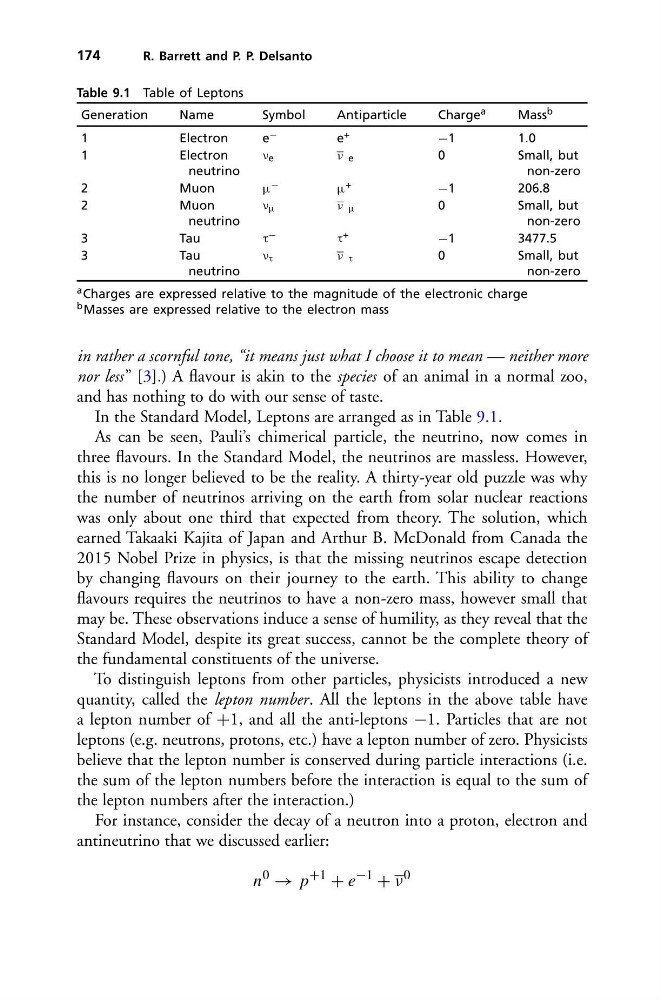
In the Standard Model, Leptons are arranged as in Table 9.1.
As can be seen, Pauli’s chimerical particle, the neutrino, now comes in
three flavours. In the Standard Model, the neutrinos are massless. However,
this is no longer believed to be the reality. A thirty-year old puzzle was why
the number of neutrinos arriving on the earth from solar nuclear reactions
was only about one third that expected from theory. The solution, which
earned Takaaki Kajita of Japan and Arthur B. McDonald from Canada the
2015 Nobel Prize in physics, is that the missing neutrinos escape detection
by changing flavours on their journey to the earth. This ability to change
flavours requires the neutrinos to have a non-zero mass, however small that
may be. These observations induce a sense of humility, as they reveal that the
Standard Model, despite its great success, cannot be the complete theory of
the fundamental constituents of the universe.
To distinguish leptons from other particles, physicists introduced a new
quantity, called the lepton number. All the leptons in the above table have
a lepton number of +1, and all the anti-leptons −1. Particles that are not
leptons (e.g. neutrons, protons, etc.) have a lepton number of zero. Physicists
believe that the lepton number is conserved during particle interactions (i.e.
the sum of the lepton numbers before the interaction is equal to the sum of
the lepton numbers after the interaction.)
For instance, consider the decay of a neutron into a proton, electron and
antineutrino that we discussed earlier:
n
0
→ p
+1
+ e
−1
+ ν
0
R. Barrett and P. P. Delsanto
Table 9.1 Table of Leptons
Generation
Name
Symbol
Antiparticle
Charge a
Mass b
1
Electron
e −
e +
−1
1 . 0
1
Electron
neutrino
ν e
ν e
0
Small, but
non-zero
2
Muon
μ −
μ +
−1
206.8
2
Muon
neutrino
ν μ
ν μ
0
Small, but
non-zero
3
T a u
τ −
τ +
−1
3477.5
3
T a u
neutrino
ν τ
ν τ
0
Small, but
non-zero
a Charges are expressed relative to the magnitude of the electronic charge
b Masses are expressed relative to the electron mass
in rather a scornful tone, “it means just what I choose it to mean — neither more
nor less” [3].) A flavour is akin to the species of an animal in a normal zoo,
and has nothing to do with our sense of taste.
In the Standard Model, Leptons are arranged as in Table 9.1.
As can be seen, Pauli’s chimerical particle, the neutrino, now comes in
three flavours. In the Standard Model, the neutrinos are massless. However,
this is no longer believed to be the reality. A thirty-year old puzzle was why
the number of neutrinos arriving on the earth from solar nuclear reactions
was only about one third that expected from theory. The solution, which
earned Takaaki Kajita of Japan and Arthur B. McDonald from Canada the
2015 Nobel Prize in physics, is that the missing neutrinos escape detection
by changing flavours on their journey to the earth. This ability to change
flavours requires the neutrinos to have a non-zero mass, however small that
may be. These observations induce a sense of humility, as they reveal that the
Standard Model, despite its great success, cannot be the complete theory of
the fundamental constituents of the universe.
To distinguish leptons from other particles, physicists introduced a new
quantity, called the lepton number. All the leptons in the above table have
a lepton number of +1, and all the anti-leptons −1. Particles that are not
leptons (e.g. neutrons, protons, etc.) have a lepton number of zero. Physicists
believe that the lepton number is conserved during particle interactions (i.e.
the sum of the lepton numbers before the interaction is equal to the sum of
the lepton numbers after the interaction.)
For instance, consider the decay of a neutron into a proton, electron and
antineutrino that we discussed earlier:
n
0
→ p
+1
+ e
−1
+ ν
0