

9 The Standard Model of Fundamental Particles
171
Four massless carrier particles are required for the new interaction. Three
of them were given the name Intermediate Vector Bosons and are represented
by the symbols W + , W - , and Z 0 . The fourth is the photon. A problem immediately arose in that the short range of the weak interaction implied that the
carriers W + , W - , and Z 0 had to be very massive, of the order of 650 times the
mass of the pion. Some mechanism is therefore required that gives mass to
the three intermediate vector bosons, but not to the photon. This process
was resolved by the assumption of another unseen field, the Higgs field,
that is assumed to pervade all space. Interaction of the Higgs field and the
electroweak force results in mass being attributed to the intermediate vector
bosons. The Higgs field also has a carrier particle of its own, the Higgs boson.
With these extra assumptions, the electroweak theory seemed complete, and
experimental physicists began their search for all four bosons.
The intermediate vector bosons were discovered experimentally two
decades later in 1983 at the Super Proton Synchrotron in the European Organization for Nuclear Research (CERN), Switzerland, and the Higgs boson
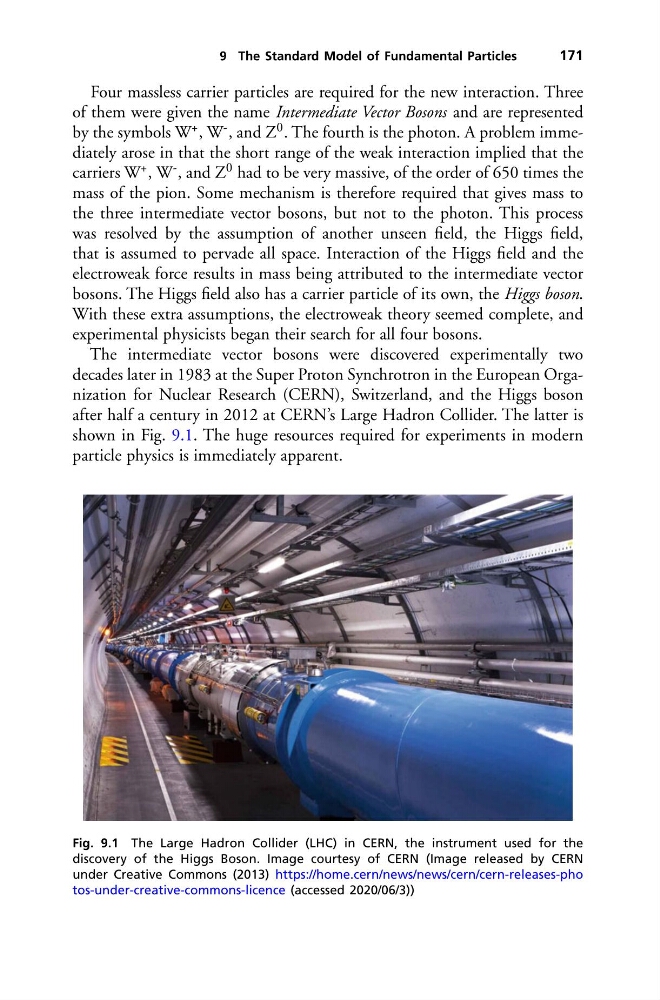
after half a century in 2012 at CERN’s Large Hadron Collider. The latter is
shown in Fig. 9.1. The huge resources required for experiments in modern
particle physics is immediately apparent.
Fig. 9.1 The Large Hadron Collider (LHC) in CERN, the instrument used for the
discovery of the Higgs Boson. Image courtesy of CERN (Image released by CERN
under Creative Commons (2013) https://home.cern/news/news/cern/cern-releases-pho
tos-under-creative-commons-licence (accessed 2020/06/3))
171
Four massless carrier particles are required for the new interaction. Three
of them were given the name Intermediate Vector Bosons and are represented
by the symbols W + , W - , and Z 0 . The fourth is the photon. A problem immediately arose in that the short range of the weak interaction implied that the
carriers W + , W - , and Z 0 had to be very massive, of the order of 650 times the
mass of the pion. Some mechanism is therefore required that gives mass to
the three intermediate vector bosons, but not to the photon. This process
was resolved by the assumption of another unseen field, the Higgs field,
that is assumed to pervade all space. Interaction of the Higgs field and the
electroweak force results in mass being attributed to the intermediate vector
bosons. The Higgs field also has a carrier particle of its own, the Higgs boson.
With these extra assumptions, the electroweak theory seemed complete, and
experimental physicists began their search for all four bosons.
The intermediate vector bosons were discovered experimentally two
decades later in 1983 at the Super Proton Synchrotron in the European Organization for Nuclear Research (CERN), Switzerland, and the Higgs boson
after half a century in 2012 at CERN’s Large Hadron Collider. The latter is
shown in Fig. 9.1. The huge resources required for experiments in modern
particle physics is immediately apparent.
Fig. 9.1 The Large Hadron Collider (LHC) in CERN, the instrument used for the
discovery of the Higgs Boson. Image courtesy of CERN (Image released by CERN
under Creative Commons (2013) https://home.cern/news/news/cern/cern-releases-pho
tos-under-creative-commons-licence (accessed 2020/06/3))