

156
R. Barrett and P. P. Delsanto
at C is the only one, for which the angle of incidence is equal to the angle
of reflection, and is the only one we would consider in a classical physics
treatment. However, the probabilistic nature of quantum mechanics implies
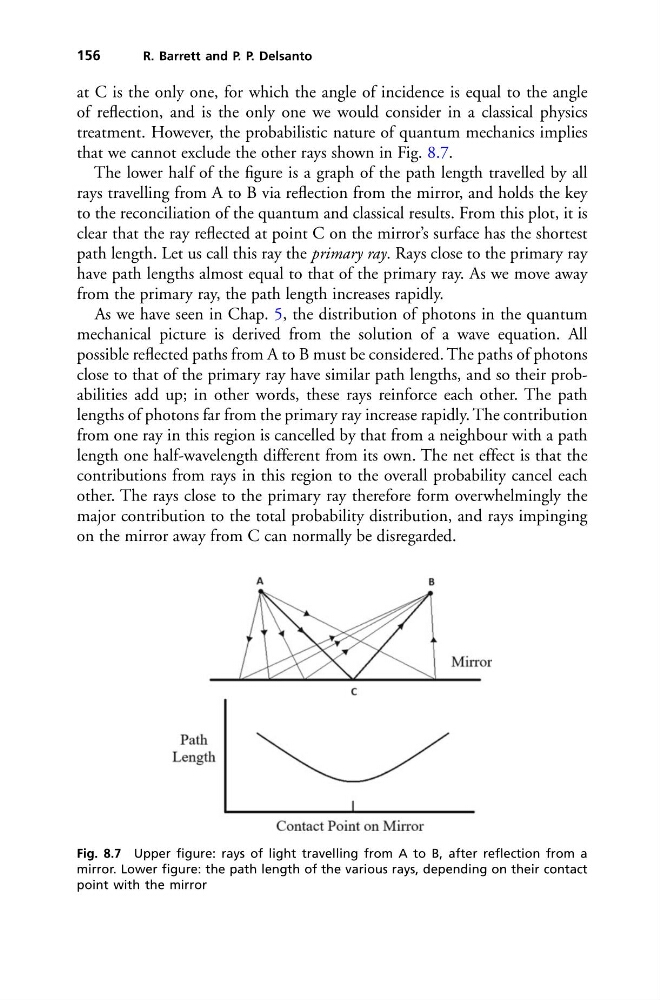
that we cannot exclude the other rays shown in Fig. 8.7.
The lower half of the figure is a graph of the path length travelled by all
rays travelling from A to B via reflection from the mirror, and holds the key
to the reconciliation of the quantum and classical results. From this plot, it is
clear that the ray reflected at point C on the mirror’s surface has the shortest
path length. Let us call this ray the primary ray. Rays close to the primary ray
have path lengths almost equal to that of the primary ray. As we move away
from the primary ray, the path length increases rapidly.
As we have seen in Chap. 5, the distribution of photons in the quantum
mechanical picture is derived from the solution of a wave equation. All
possible reflected paths from A to B must be considered. The paths of photons
close to that of the primary ray have similar path lengths, and so their probabilities add up; in other words, these rays reinforce each other. The path
lengths of photons far from the primary ray increase rapidly. The contribution
from one ray in this region is cancelled by that from a neighbour with a path
length one half-wavelength different from its own. The net effect is that the
contributions from rays in this region to the overall probability cancel each
other. The rays close to the primary ray therefore form overwhelmingly the
major contribution to the total probability distribution, and rays impinging
on the mirror away from C can normally be disregarded.
Fig. 8.7 Upper figure: rays of light travelling from A to B, after reflection from a
mirror. Lower figure: the path length of the various rays, depending on their contact
point with the mirror
R. Barrett and P. P. Delsanto
at C is the only one, for which the angle of incidence is equal to the angle
of reflection, and is the only one we would consider in a classical physics
treatment. However, the probabilistic nature of quantum mechanics implies
that we cannot exclude the other rays shown in Fig. 8.7.
The lower half of the figure is a graph of the path length travelled by all
rays travelling from A to B via reflection from the mirror, and holds the key
to the reconciliation of the quantum and classical results. From this plot, it is
clear that the ray reflected at point C on the mirror’s surface has the shortest
path length. Let us call this ray the primary ray. Rays close to the primary ray
have path lengths almost equal to that of the primary ray. As we move away
from the primary ray, the path length increases rapidly.
As we have seen in Chap. 5, the distribution of photons in the quantum
mechanical picture is derived from the solution of a wave equation. All
possible reflected paths from A to B must be considered. The paths of photons
close to that of the primary ray have similar path lengths, and so their probabilities add up; in other words, these rays reinforce each other. The path
lengths of photons far from the primary ray increase rapidly. The contribution
from one ray in this region is cancelled by that from a neighbour with a path
length one half-wavelength different from its own. The net effect is that the
contributions from rays in this region to the overall probability cancel each
other. The rays close to the primary ray therefore form overwhelmingly the
major contribution to the total probability distribution, and rays impinging
on the mirror away from C can normally be disregarded.
Fig. 8.7 Upper figure: rays of light travelling from A to B, after reflection from a
mirror. Lower figure: the path length of the various rays, depending on their contact
point with the mirror