

8 The Most Accurate Theory in Physics
147
radioactive decay), the fundamental building blocks of matter are atoms. Such
a belief did not survive for very long. Indulging in a pursuit that is fairly
common among curious children, physicists began smashing objects together
to see what lay inside.
Ernest Rutherford, together with Hans Geiger and Ernest Marsden,
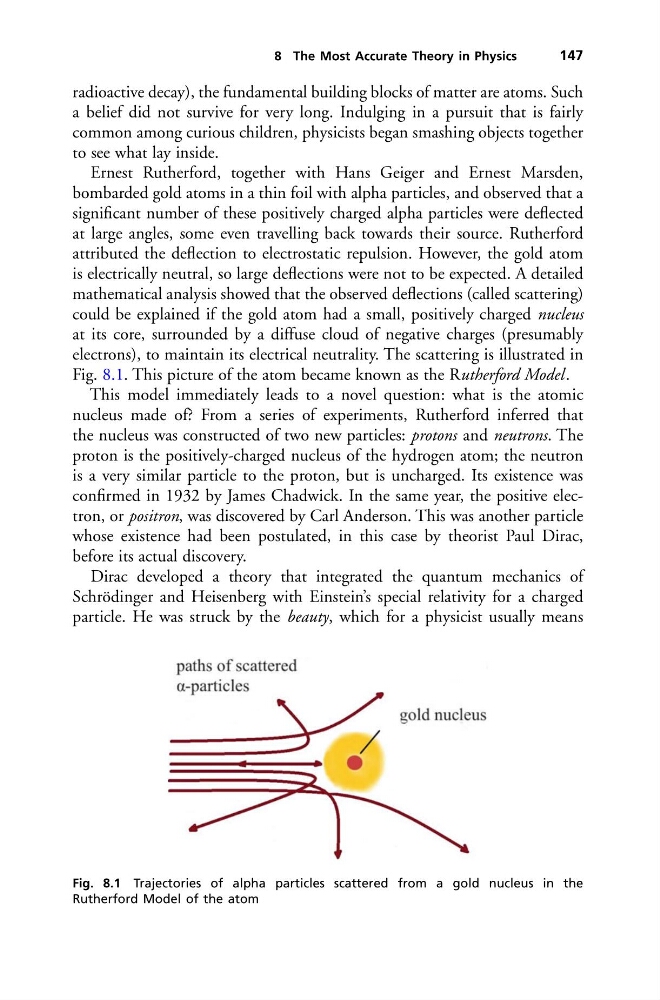
bombarded gold atoms in a thin foil with alpha particles, and observed that a
significant number of these positively charged alpha particles were deflected
at large angles, some even travelling back towards their source. Rutherford
attributed the deflection to electrostatic repulsion. However, the gold atom
is electrically neutral, so large deflections were not to be expected. A detailed
mathematical analysis showed that the observed deflections (called scattering)
could be explained if the gold atom had a small, positively charged nucleus
at its core, surrounded by a diffuse cloud of negative charges (presumably
electrons), to maintain its electrical neutrality. The scattering is illustrated in
Fig. 8.1. This picture of the atom became known as the Rutherford Model .
This model immediately leads to a novel question: what is the atomic
nucleus made of? From a series of experiments, Rutherford inferred that
the nucleus was constructed of two new particles: protons and neutrons. The
proton is the positively-charged nucleus of the hydrogen atom; the neutron
is a very similar particle to the proton, but is uncharged. Its existence was
confirmed in 1932 by James Chadwick. In the same year, the positive electron, or positron, was discovered by Carl Anderson. This was another particle
whose existence had been postulated, in this case by theorist Paul Dirac,
before its actual discovery.
Dirac developed a theory that integrated the quantum mechanics of
Schrödinger and Heisenberg with Einstein’s special relativity for a charged
particle. He was struck by the beauty, which for a physicist usually means
Fig. 8.1 Trajectories of alpha particles scattered from a gold nucleus in the
Rutherford Model of the atom
147
radioactive decay), the fundamental building blocks of matter are atoms. Such
a belief did not survive for very long. Indulging in a pursuit that is fairly
common among curious children, physicists began smashing objects together
to see what lay inside.
Ernest Rutherford, together with Hans Geiger and Ernest Marsden,
bombarded gold atoms in a thin foil with alpha particles, and observed that a
significant number of these positively charged alpha particles were deflected
at large angles, some even travelling back towards their source. Rutherford
attributed the deflection to electrostatic repulsion. However, the gold atom
is electrically neutral, so large deflections were not to be expected. A detailed
mathematical analysis showed that the observed deflections (called scattering)
could be explained if the gold atom had a small, positively charged nucleus
at its core, surrounded by a diffuse cloud of negative charges (presumably
electrons), to maintain its electrical neutrality. The scattering is illustrated in
Fig. 8.1. This picture of the atom became known as the Rutherford Model .
This model immediately leads to a novel question: what is the atomic
nucleus made of? From a series of experiments, Rutherford inferred that
the nucleus was constructed of two new particles: protons and neutrons. The
proton is the positively-charged nucleus of the hydrogen atom; the neutron
is a very similar particle to the proton, but is uncharged. Its existence was
confirmed in 1932 by James Chadwick. In the same year, the positive electron, or positron, was discovered by Carl Anderson. This was another particle
whose existence had been postulated, in this case by theorist Paul Dirac,
before its actual discovery.
Dirac developed a theory that integrated the quantum mechanics of
Schrödinger and Heisenberg with Einstein’s special relativity for a charged
particle. He was struck by the beauty, which for a physicist usually means
Fig. 8.1 Trajectories of alpha particles scattered from a gold nucleus in the
Rutherford Model of the atom