

7 General Relativity
127
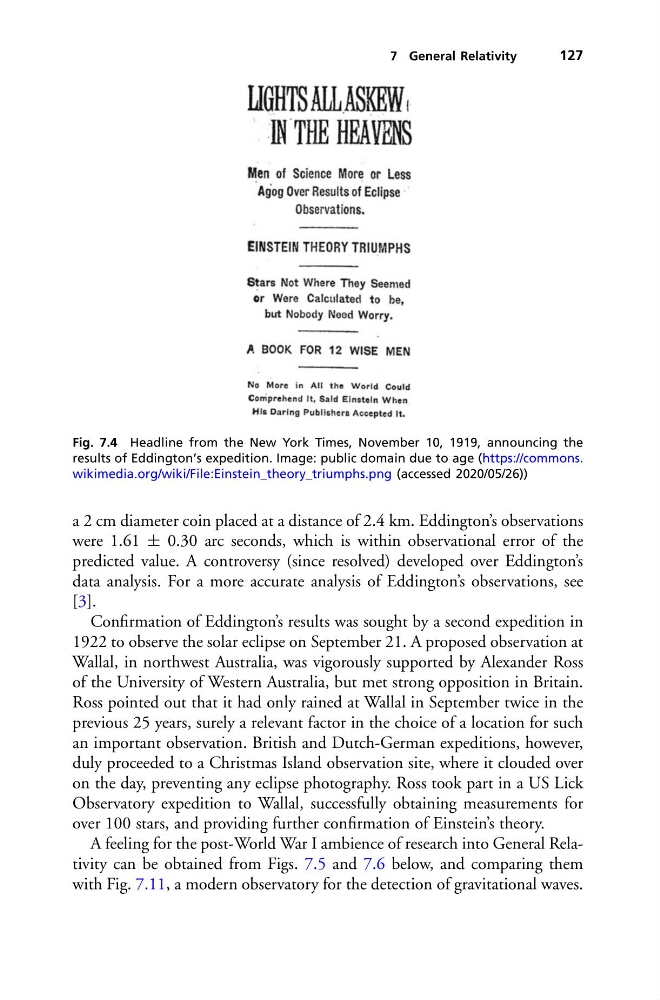
Fig. 7.4 Headline from the New York Times, November 10, 1919, announcing the
results of Eddington’s expedition. Image: public domain due to age (https://commons.
wikimedia.org/wiki/File:Einstein_theory_triumphs.png (accessed 2020/05/26))
a 2 cm diameter coin placed at a distance of 2.4 km. Eddington’s observations
were 1.61 ± 0.30 arc seconds, which is within observational error of the
predicted value. A controversy (since resolved) developed over Eddington’s
data analysis. For a more accurate analysis of Eddington’s observations, see
[3].
Confirmation of Eddington’s results was sought by a second expedition in
1922 to observe the solar eclipse on September 21. A proposed observation at
Wallal, in northwest Australia, was vigorously supported by Alexander Ross
of the University of Western Australia, but met strong opposition in Britain.
Ross pointed out that it had only rained at Wallal in September twice in the
previous 25 years, surely a relevant factor in the choice of a location for such
an important observation. British and Dutch-German expeditions, however,
duly proceeded to a Christmas Island observation site, where it clouded over
on the day, preventing any eclipse photography. Ross took part in a US Lick
Observatory expedition to Wallal, successfully obtaining measurements for
over 100 stars, and providing further confirmation of Einstein’s theory.
A feeling for the post-World War I ambience of research into General Relativity can be obtained from Figs. 7.5 and 7.6 below, and comparing them
with Fig. 7.11, a modern observatory for the detection of gravitational waves.
127
Fig. 7.4 Headline from the New York Times, November 10, 1919, announcing the
results of Eddington’s expedition. Image: public domain due to age (https://commons.
wikimedia.org/wiki/File:Einstein_theory_triumphs.png (accessed 2020/05/26))
a 2 cm diameter coin placed at a distance of 2.4 km. Eddington’s observations
were 1.61 ± 0.30 arc seconds, which is within observational error of the
predicted value. A controversy (since resolved) developed over Eddington’s
data analysis. For a more accurate analysis of Eddington’s observations, see
[3].
Confirmation of Eddington’s results was sought by a second expedition in
1922 to observe the solar eclipse on September 21. A proposed observation at
Wallal, in northwest Australia, was vigorously supported by Alexander Ross
of the University of Western Australia, but met strong opposition in Britain.
Ross pointed out that it had only rained at Wallal in September twice in the
previous 25 years, surely a relevant factor in the choice of a location for such
an important observation. British and Dutch-German expeditions, however,
duly proceeded to a Christmas Island observation site, where it clouded over
on the day, preventing any eclipse photography. Ross took part in a US Lick
Observatory expedition to Wallal, successfully obtaining measurements for
over 100 stars, and providing further confirmation of Einstein’s theory.
A feeling for the post-World War I ambience of research into General Relativity can be obtained from Figs. 7.5 and 7.6 below, and comparing them
with Fig. 7.11, a modern observatory for the detection of gravitational waves.