

124
R. Barrett and P. P. Delsanto
With a small elevator, the difference in the gravitational field between the
top and bottom of a normal elevator is too small to be measurable, and
Einstein’s hypothesis holds. It is analogous to the assertion that a football
field is flat, even though we know it to be a part of the earth’s curved surface.
The curvature over the length of the field is too small to measure easily.
7.4 Bending of Rays of Light Under Gravity
As an example of the application of Einstein’s hypothesis, let us now explore
the question, raised by Newton, of whether light is deflected by a gravitational
field: “Do not Bodies act upon Light at a distance, and by their action bend its
Rays, and is not this action … strongest at the least distance? [1]” We know
that, when we throw a ball, it falls to the ground, no matter how hard we try
to throw it. What about the beam of light from our flashlight? Does it fall to
the ground too?
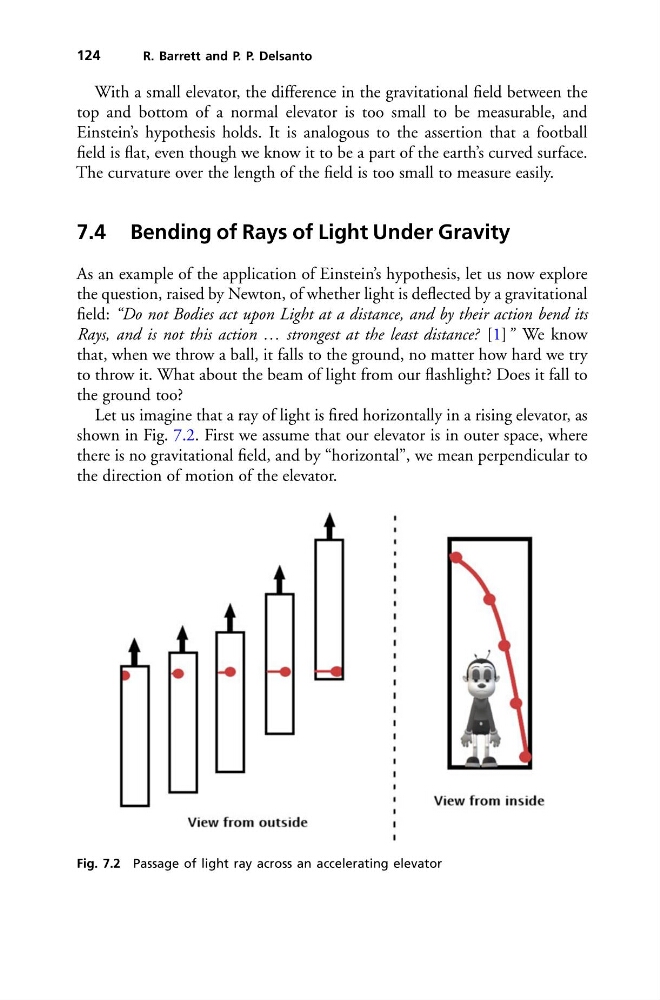
Let us imagine that a ray of light is fired horizontally in a rising elevator, as
shown in Fig. 7.2. First we assume that our elevator is in outer space, where
there is no gravitational field, and by “horizontal”, we mean perpendicular to
the direction of motion of the elevator.
Fig. 7.2 Passage of light ray across an accelerating elevator
R. Barrett and P. P. Delsanto
With a small elevator, the difference in the gravitational field between the
top and bottom of a normal elevator is too small to be measurable, and
Einstein’s hypothesis holds. It is analogous to the assertion that a football
field is flat, even though we know it to be a part of the earth’s curved surface.
The curvature over the length of the field is too small to measure easily.
7.4 Bending of Rays of Light Under Gravity
As an example of the application of Einstein’s hypothesis, let us now explore
the question, raised by Newton, of whether light is deflected by a gravitational
field: “Do not Bodies act upon Light at a distance, and by their action bend its
Rays, and is not this action … strongest at the least distance? [1]” We know
that, when we throw a ball, it falls to the ground, no matter how hard we try
to throw it. What about the beam of light from our flashlight? Does it fall to
the ground too?
Let us imagine that a ray of light is fired horizontally in a rising elevator, as
shown in Fig. 7.2. First we assume that our elevator is in outer space, where
there is no gravitational field, and by “horizontal”, we mean perpendicular to
the direction of motion of the elevator.
Fig. 7.2 Passage of light ray across an accelerating elevator