

114
R. Barrett and P. P. Delsanto
paper, it was asserted by Croatian mathematician and theoretical physicist,
Vladimir Varicak, trying to come to grips with the new theory, that the
length contraction is real according to Lorentz, while it is only apparent, or
subjective, according to Einstein. Einstein “clarified” the situation, as follows:
“The author unjustifiably states a difference between Lorentz’s view and mine
concerning the physical facts. The question as to whether length contraction really
exists or not is misleading. It doesn’t “really” exist, in so far as it doesn’t exist for
a co-moving observer, though it “really” exists, i.e. in such a way that it could be
demonstrated in principle by physical means by a non co-moving observer” [5].
6.8 Simultaneity
Let us use our newfound knowledge of the principles of Relativity to carry out
a thought experiment, along the lines that we employed in the last Chapter
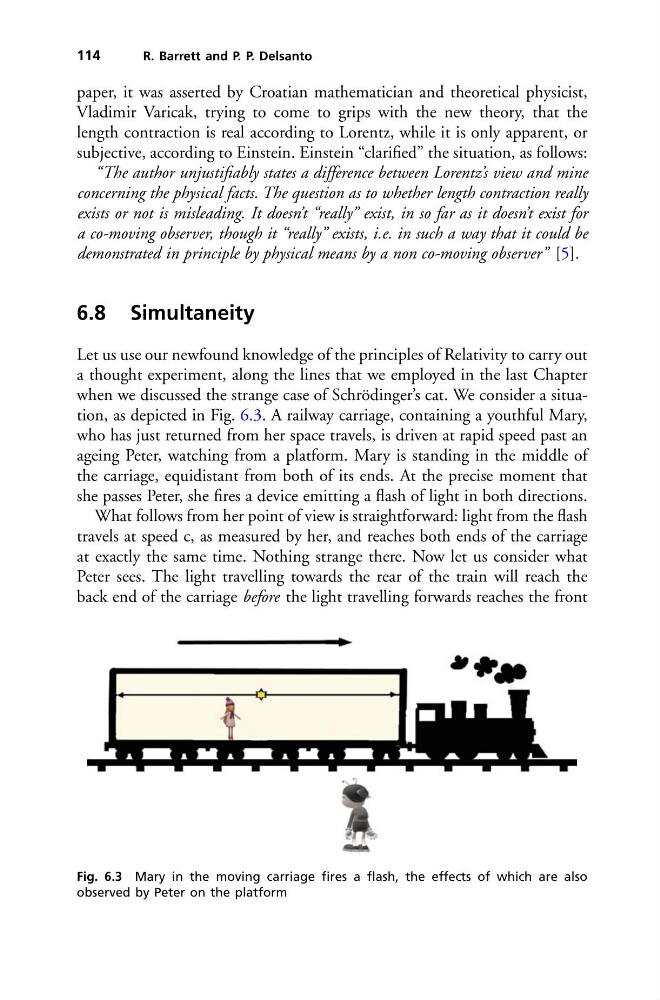
when we discussed the strange case of Schrödinger’s cat. We consider a situation, as depicted in Fig. 6.3. A railway carriage, containing a youthful Mary,
who has just returned from her space travels, is driven at rapid speed past an
ageing Peter, watching from a platform. Mary is standing in the middle of
the carriage, equidistant from both of its ends. At the precise moment that
she passes Peter, she fires a device emitting a flash of light in both directions.
What follows from her point of view is straightforward: light from the flash
travels at speed c, as measured by her, and reaches both ends of the carriage
at exactly the same time. Nothing strange there. Now let us consider what
Peter sees. The light travelling towards the rear of the train will reach the
back end of the carriage before the light travelling forwards reaches the front
Fig. 6.3 Mary in the moving carriage fires a flash, the effects of which are also
observed by Peter on the platform
R. Barrett and P. P. Delsanto
paper, it was asserted by Croatian mathematician and theoretical physicist,
Vladimir Varicak, trying to come to grips with the new theory, that the
length contraction is real according to Lorentz, while it is only apparent, or
subjective, according to Einstein. Einstein “clarified” the situation, as follows:
“The author unjustifiably states a difference between Lorentz’s view and mine
concerning the physical facts. The question as to whether length contraction really
exists or not is misleading. It doesn’t “really” exist, in so far as it doesn’t exist for
a co-moving observer, though it “really” exists, i.e. in such a way that it could be
demonstrated in principle by physical means by a non co-moving observer” [5].
6.8 Simultaneity
Let us use our newfound knowledge of the principles of Relativity to carry out
a thought experiment, along the lines that we employed in the last Chapter
when we discussed the strange case of Schrödinger’s cat. We consider a situation, as depicted in Fig. 6.3. A railway carriage, containing a youthful Mary,
who has just returned from her space travels, is driven at rapid speed past an
ageing Peter, watching from a platform. Mary is standing in the middle of
the carriage, equidistant from both of its ends. At the precise moment that
she passes Peter, she fires a device emitting a flash of light in both directions.
What follows from her point of view is straightforward: light from the flash
travels at speed c, as measured by her, and reaches both ends of the carriage
at exactly the same time. Nothing strange there. Now let us consider what
Peter sees. The light travelling towards the rear of the train will reach the
back end of the carriage before the light travelling forwards reaches the front
Fig. 6.3 Mary in the moving carriage fires a flash, the effects of which are also
observed by Peter on the platform