

6 Special Relativity
111
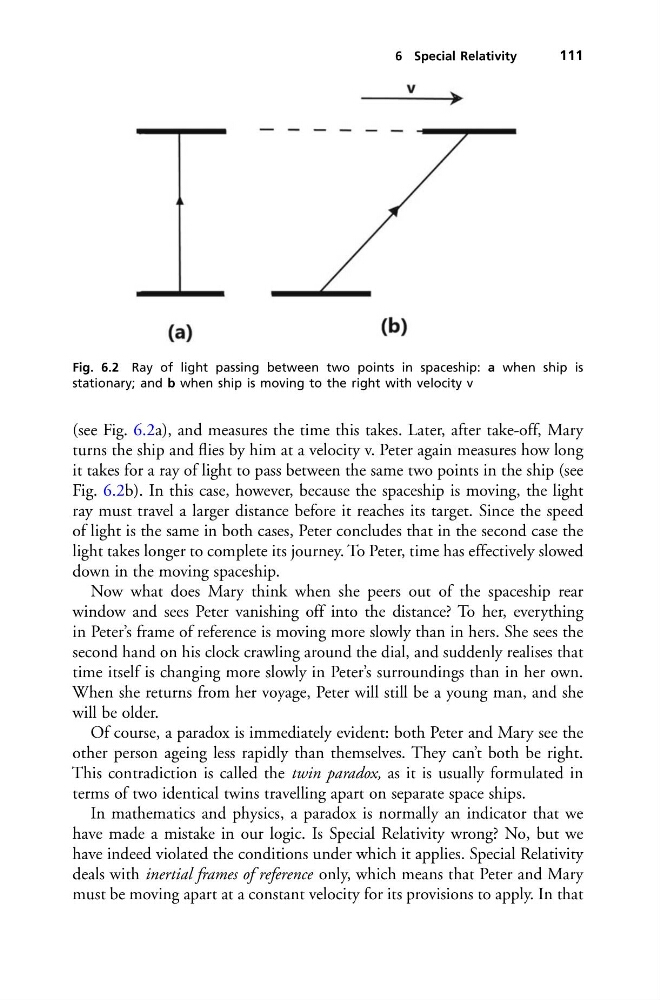
Fig. 6.2 Ray of light passing between two points in spaceship: a when ship is
stationary; and b when ship is moving to the right with velocity v
(see Fig. 6.2a), and measures the time this takes. Later, after take-off, Mary
turns the ship and flies by him at a velocity v. Peter again measures how long
it takes for a ray of light to pass between the same two points in the ship (see
Fig. 6.2b). In this case, however, because the spaceship is moving, the light
ray must travel a larger distance before it reaches its target. Since the speed
of light is the same in both cases, Peter concludes that in the second case the
light takes longer to complete its journey. To Peter, time has effectively slowed
down in the moving spaceship.
Now what does Mary think when she peers out of the spaceship rear
window and sees Peter vanishing off into the distance? To her, everything
in Peter’s frame of reference is moving more slowly than in hers. She sees the
second hand on his clock crawling around the dial, and suddenly realises that
time itself is changing more slowly in Peter’s surroundings than in her own.
When she returns from her voyage, Peter will still be a young man, and she
will be older.
Of course, a paradox is immediately evident: both Peter and Mary see the
other person ageing less rapidly than themselves. They can’t both be right.
This contradiction is called the twin paradox, as it is usually formulated in
terms of two identical twins travelling apart on separate space ships.
In mathematics and physics, a paradox is normally an indicator that we
have made a mistake in our logic. Is Special Relativity wrong? No, but we
have indeed violated the conditions under which it applies. Special Relativity
deals with inertial frames of reference only, which means that Peter and Mary
must be moving apart at a constant velocity for its provisions to apply. In that
111
Fig. 6.2 Ray of light passing between two points in spaceship: a when ship is
stationary; and b when ship is moving to the right with velocity v
(see Fig. 6.2a), and measures the time this takes. Later, after take-off, Mary
turns the ship and flies by him at a velocity v. Peter again measures how long
it takes for a ray of light to pass between the same two points in the ship (see
Fig. 6.2b). In this case, however, because the spaceship is moving, the light
ray must travel a larger distance before it reaches its target. Since the speed
of light is the same in both cases, Peter concludes that in the second case the
light takes longer to complete its journey. To Peter, time has effectively slowed
down in the moving spaceship.
Now what does Mary think when she peers out of the spaceship rear
window and sees Peter vanishing off into the distance? To her, everything
in Peter’s frame of reference is moving more slowly than in hers. She sees the
second hand on his clock crawling around the dial, and suddenly realises that
time itself is changing more slowly in Peter’s surroundings than in her own.
When she returns from her voyage, Peter will still be a young man, and she
will be older.
Of course, a paradox is immediately evident: both Peter and Mary see the
other person ageing less rapidly than themselves. They can’t both be right.
This contradiction is called the twin paradox, as it is usually formulated in
terms of two identical twins travelling apart on separate space ships.
In mathematics and physics, a paradox is normally an indicator that we
have made a mistake in our logic. Is Special Relativity wrong? No, but we
have indeed violated the conditions under which it applies. Special Relativity
deals with inertial frames of reference only, which means that Peter and Mary
must be moving apart at a constant velocity for its provisions to apply. In that