

6 Special Relativity
105
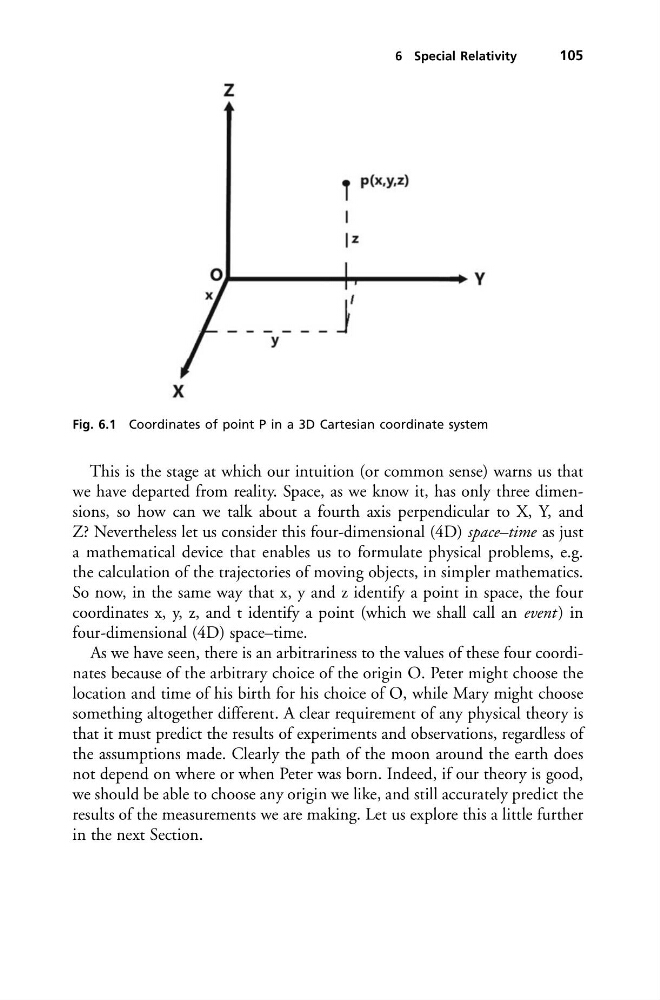
Fig. 6.1 Coordinates of point P in a 3D Cartesian coordinate system
This is the stage at which our intuition (or common sense) warns us that
we have departed from reality. Space, as we know it, has only three dimensions, so how can we talk about a fourth axis perpendicular to X, Y, and
Z? Nevertheless let us consider this four-dimensional (4D) space–time as just
a mathematical device that enables us to formulate physical problems, e.g.
the calculation of the trajectories of moving objects, in simpler mathematics.
So now, in the same way that x, y and z identify a point in space, the four
coordinates x, y, z, and t identify a point (which we shall call an event ) in
four-dimensional (4D) space–time.
As we have seen, there is an arbitrariness to the values of these four coordinates because of the arbitrary choice of the origin O. Peter might choose the
location and time of his birth for his choice of O, while Mary might choose
something altogether different. A clear requirement of any physical theory is
that it must predict the results of experiments and observations, regardless of
the assumptions made. Clearly the path of the moon around the earth does
not depend on where or when Peter was born. Indeed, if our theory is good,
we should be able to choose any origin we like, and still accurately predict the
results of the measurements we are making. Let us explore this a little further
in the next Section.
105
Fig. 6.1 Coordinates of point P in a 3D Cartesian coordinate system
This is the stage at which our intuition (or common sense) warns us that
we have departed from reality. Space, as we know it, has only three dimensions, so how can we talk about a fourth axis perpendicular to X, Y, and
Z? Nevertheless let us consider this four-dimensional (4D) space–time as just
a mathematical device that enables us to formulate physical problems, e.g.
the calculation of the trajectories of moving objects, in simpler mathematics.
So now, in the same way that x, y and z identify a point in space, the four
coordinates x, y, z, and t identify a point (which we shall call an event ) in
four-dimensional (4D) space–time.
As we have seen, there is an arbitrariness to the values of these four coordinates because of the arbitrary choice of the origin O. Peter might choose the
location and time of his birth for his choice of O, while Mary might choose
something altogether different. A clear requirement of any physical theory is
that it must predict the results of experiments and observations, regardless of
the assumptions made. Clearly the path of the moon around the earth does
not depend on where or when Peter was born. Indeed, if our theory is good,
we should be able to choose any origin we like, and still accurately predict the
results of the measurements we are making. Let us explore this a little further
in the next Section.