

90
R. Barrett and P. P. Delsanto
As we have already learned earlier, diffraction is the intrusion of waves
into the shadow regions behind obstacles, and is a basic phenomenon, well
explained by Maxwell’s theory, associated with all wave motion. In the case
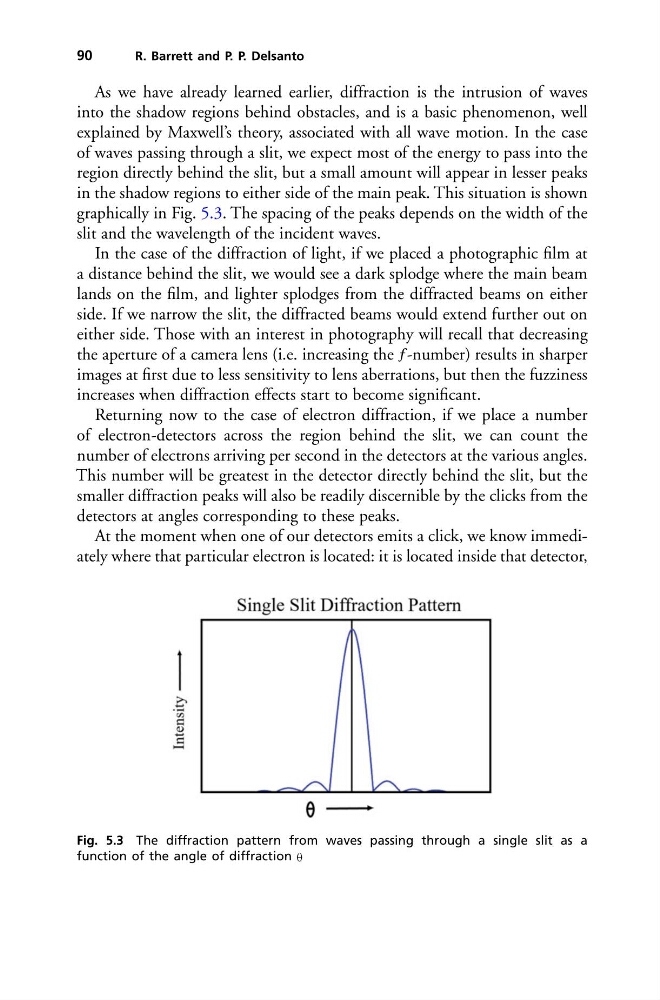
of waves passing through a slit, we expect most of the energy to pass into the
region directly behind the slit, but a small amount will appear in lesser peaks
in the shadow regions to either side of the main peak. This situation is shown
graphically in Fig. 5.3. The spacing of the peaks depends on the width of the
slit and the wavelength of the incident waves.
In the case of the diffraction of light, if we placed a photographic film at
a distance behind the slit, we would see a dark splodge where the main beam
lands on the film, and lighter splodges from the diffracted beams on either
side. If we narrow the slit, the diffracted beams would extend further out on
either side. Those with an interest in photography will recall that decreasing
the aperture of a camera lens (i.e. increasing the ƒ-number) results in sharper
images at first due to less sensitivity to lens aberrations, but then the fuzziness
increases when diffraction effects start to become significant.
Returning now to the case of electron diffraction, if we place a number
of electron-detectors across the region behind the slit, we can count the
number of electrons arriving per second in the detectors at the various angles.
This number will be greatest in the detector directly behind the slit, but the
smaller diffraction peaks will also be readily discernible by the clicks from the
detectors at angles corresponding to these peaks.
At the moment when one of our detectors emits a click, we know immediately where that particular electron is located: it is located inside that detector,
Fig. 5.3 The diffraction pattern from waves passing through a single slit as a
function of the angle of diffraction θ
R. Barrett and P. P. Delsanto
As we have already learned earlier, diffraction is the intrusion of waves
into the shadow regions behind obstacles, and is a basic phenomenon, well
explained by Maxwell’s theory, associated with all wave motion. In the case
of waves passing through a slit, we expect most of the energy to pass into the
region directly behind the slit, but a small amount will appear in lesser peaks
in the shadow regions to either side of the main peak. This situation is shown
graphically in Fig. 5.3. The spacing of the peaks depends on the width of the
slit and the wavelength of the incident waves.
In the case of the diffraction of light, if we placed a photographic film at
a distance behind the slit, we would see a dark splodge where the main beam
lands on the film, and lighter splodges from the diffracted beams on either
side. If we narrow the slit, the diffracted beams would extend further out on
either side. Those with an interest in photography will recall that decreasing
the aperture of a camera lens (i.e. increasing the ƒ-number) results in sharper
images at first due to less sensitivity to lens aberrations, but then the fuzziness
increases when diffraction effects start to become significant.
Returning now to the case of electron diffraction, if we place a number
of electron-detectors across the region behind the slit, we can count the
number of electrons arriving per second in the detectors at the various angles.
This number will be greatest in the detector directly behind the slit, but the
smaller diffraction peaks will also be readily discernible by the clicks from the
detectors at angles corresponding to these peaks.
At the moment when one of our detectors emits a click, we know immediately where that particular electron is located: it is located inside that detector,
Fig. 5.3 The diffraction pattern from waves passing through a single slit as a
function of the angle of diffraction θ