

reaction), dialkyl ketones B96 (52%, 24 h) and B103 (65%, 3 h), and cycloaliphatic
ketones B117 (85%, 3 h), B118 (99%, 3 h) and B119 (63%, 3 h) [76].
The same iridium pyridinesulfonamide complexes 28–34 are active for the TH of
a variety of aryl (A1, A3, A4, A12, A13, A22-A24, A27, A30, A32, A38, A43),
alkyl (A56) and heterocyclic (A64, A65) aldehydes (Scheme 3) [77]. Reductions
occur with moderate to high conversions (39–100%), under base-free conditions and
at high rates. Thus, for example, benzaldehyde derivatives are hydrogenated within
30 min in 2-propanol at 85
C, at 1 mol% of catalyst loading. As observed for
substituted acetophenones, the combination of electron-donating groups on the
ligand of the precatalysts with substrates possessing electron-withdrawing moieties
entailed the highest rate of conversion to the alcohol. Decylaldehyde was quantitatively reduced in the presence of complex 30 in 12 h, under the above-mentioned
conditions. The heterocyclic substrates 2-furfural A64 and 5-hydroxymethylfurfural
A65 were selectively reduced to the corresponding alcohol in 95 and 100% conversion, respectively, in 30 min. A metal-ligand cooperative mechanism has been
proposed for the catalytic TH reaction, the trihydride bridged dimer [Cp*Ir(μH) 3 IrCp*]
+ being the resting state [77].
Methyl aryl (B1, B3, B18, B20-B22, B27, B36), methyl alkyl (B94, B96-B98,
B101, B107) and alkyl aryl (B51) ketones (Scheme 4) are reduced using chiral Cp*Ir
compounds 35 and 36 (Scheme 7) containing C 2 -symmetric ferrocenyl bis
(phosphinite) ligands [78–81]. At 82
C, using 2-propanol as hydrogen source and
solvent, with KOH (5 mol%) as a base and at 1 mol% of catalyst loading, almost
quantitative conversions and moderate-to-good e.r.’s (from 68/32 to 99.5/0.5) were
obtained, after 0.25–8 h of reaction.
Chiral cyclometallated 1-naphthylethaneamine iridium complexes featuring up to
three stereogenic centres displayed excellent activity for asymmetric TH, albeit with
modest enantioselectivities [82]. Complex 37 (Scheme 9), at 2 mol% catalyst
N
Ir
Cp*
20
21
H
N
Ir
Cp*
H
N
Ir
Cp*
H
N
Ir
Cp*
H
OH
O
+
O
+
+
OH
+
A
B
H
H
H
H
excess
excess
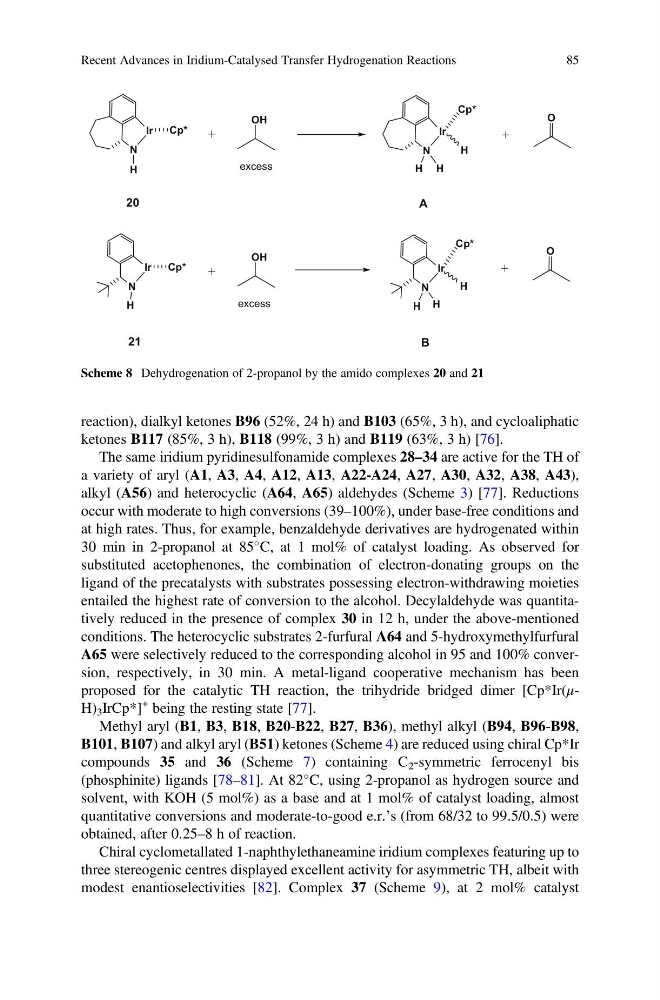
Scheme 8 Dehydrogenation of 2-propanol by the amido complexes 20 and 21
Recent Advances in Iridium-Catalysed Transfer Hydrogenation Reactions
85
ketones B117 (85%, 3 h), B118 (99%, 3 h) and B119 (63%, 3 h) [76].
The same iridium pyridinesulfonamide complexes 28–34 are active for the TH of
a variety of aryl (A1, A3, A4, A12, A13, A22-A24, A27, A30, A32, A38, A43),
alkyl (A56) and heterocyclic (A64, A65) aldehydes (Scheme 3) [77]. Reductions
occur with moderate to high conversions (39–100%), under base-free conditions and
at high rates. Thus, for example, benzaldehyde derivatives are hydrogenated within
30 min in 2-propanol at 85
C, at 1 mol% of catalyst loading. As observed for
substituted acetophenones, the combination of electron-donating groups on the
ligand of the precatalysts with substrates possessing electron-withdrawing moieties
entailed the highest rate of conversion to the alcohol. Decylaldehyde was quantitatively reduced in the presence of complex 30 in 12 h, under the above-mentioned
conditions. The heterocyclic substrates 2-furfural A64 and 5-hydroxymethylfurfural
A65 were selectively reduced to the corresponding alcohol in 95 and 100% conversion, respectively, in 30 min. A metal-ligand cooperative mechanism has been
proposed for the catalytic TH reaction, the trihydride bridged dimer [Cp*Ir(μH) 3 IrCp*]
+ being the resting state [77].
Methyl aryl (B1, B3, B18, B20-B22, B27, B36), methyl alkyl (B94, B96-B98,
B101, B107) and alkyl aryl (B51) ketones (Scheme 4) are reduced using chiral Cp*Ir
compounds 35 and 36 (Scheme 7) containing C 2 -symmetric ferrocenyl bis
(phosphinite) ligands [78–81]. At 82
C, using 2-propanol as hydrogen source and
solvent, with KOH (5 mol%) as a base and at 1 mol% of catalyst loading, almost
quantitative conversions and moderate-to-good e.r.’s (from 68/32 to 99.5/0.5) were
obtained, after 0.25–8 h of reaction.
Chiral cyclometallated 1-naphthylethaneamine iridium complexes featuring up to
three stereogenic centres displayed excellent activity for asymmetric TH, albeit with
modest enantioselectivities [82]. Complex 37 (Scheme 9), at 2 mol% catalyst
N
Ir
Cp*
20
21
H
N
Ir
Cp*
H
N
Ir
Cp*
H
N
Ir
Cp*
H
OH
O
+
O
+
+
OH
+
A
B
H
H
H
H
excess
excess
Scheme 8 Dehydrogenation of 2-propanol by the amido complexes 20 and 21
Recent Advances in Iridium-Catalysed Transfer Hydrogenation Reactions
85