

complex 17d, after 2 h) probably due to the increase of the electron density at the
iridium centre. However, in the presence of a third methoxy group, complex 17e, the
conversion drops even below that of the unsubstituted complex 17a (30% conversion, at 24 h of reaction). The relative low activity of 17e has been tentatively
attributed to steric reasons [72].
Complex 17d has been tested as the catalyst precursor in the TH of ketones B1,
B18, B20, B38-B40 and B118 (Scheme 4). Under standard conditions good conversions were achieved in all cases. Electron-withdrawing substituents on the aromatic ring (B20, B38-B40) increased the reduction rate, and electro-donating
substituents (B18) had the opposite effect.
Imines were also investigated as substrates for TH under the standard conditions.
Complexes 17a–17e catalysed the hydrogenation of N-benzylideneaniline to the
corresponding amine in 80–94% conversion after 4 h of treatment. With these
substrates, the different degree of substitution at the phenyl ring of the PYA ligand
does not affect significantly the catalytic activity. Complex 17b hydrogenates
aldimines C4, C8, C9, C12 and C14 (Scheme 5) in yields up to 90%, after 24 h
of reaction. Notably, ketimine C15 was not converted at all, and it was suggested
that substitution at the α carbon may hamper or even prevent substrate binding due to
steric constraints.
The iridium complex 17e was investigated in the TH of aldehydes. Under
standard conditions, i.e. refluxing 2-propanol, 1 mol% catalyst loading and 10 mol%
KOH, essentially full conversion of benzaldehyde was achieved within 5 min;
however the yield of benzyl alcohol was only 50%, and benzoic acid and benzoate
were also obtained. When this reaction was carried out without a base, aldehyde
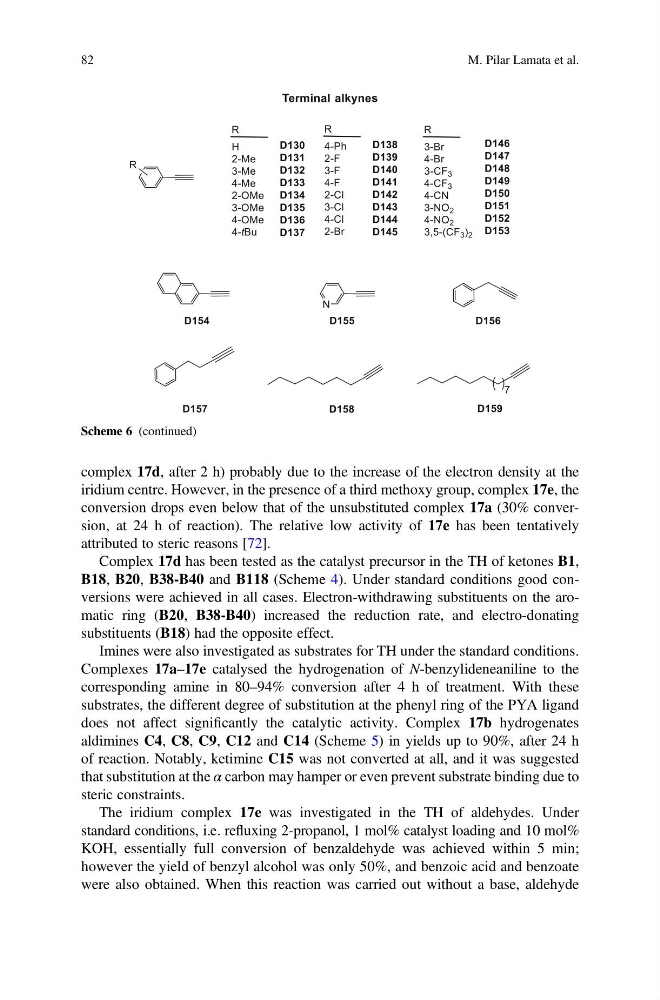
Scheme 6 (continued)
82
M. Pilar Lamata et al.
iridium centre. However, in the presence of a third methoxy group, complex 17e, the
conversion drops even below that of the unsubstituted complex 17a (30% conversion, at 24 h of reaction). The relative low activity of 17e has been tentatively
attributed to steric reasons [72].
Complex 17d has been tested as the catalyst precursor in the TH of ketones B1,
B18, B20, B38-B40 and B118 (Scheme 4). Under standard conditions good conversions were achieved in all cases. Electron-withdrawing substituents on the aromatic ring (B20, B38-B40) increased the reduction rate, and electro-donating
substituents (B18) had the opposite effect.
Imines were also investigated as substrates for TH under the standard conditions.
Complexes 17a–17e catalysed the hydrogenation of N-benzylideneaniline to the
corresponding amine in 80–94% conversion after 4 h of treatment. With these
substrates, the different degree of substitution at the phenyl ring of the PYA ligand
does not affect significantly the catalytic activity. Complex 17b hydrogenates
aldimines C4, C8, C9, C12 and C14 (Scheme 5) in yields up to 90%, after 24 h
of reaction. Notably, ketimine C15 was not converted at all, and it was suggested
that substitution at the α carbon may hamper or even prevent substrate binding due to
steric constraints.
The iridium complex 17e was investigated in the TH of aldehydes. Under
standard conditions, i.e. refluxing 2-propanol, 1 mol% catalyst loading and 10 mol%
KOH, essentially full conversion of benzaldehyde was achieved within 5 min;
however the yield of benzyl alcohol was only 50%, and benzoic acid and benzoate
were also obtained. When this reaction was carried out without a base, aldehyde
Scheme 6 (continued)
82
M. Pilar Lamata et al.