

after 4 h of reaction. Activity generally increases with the length of the linker.
Bimetallic complex 12 is among the least active species [70].
The catalytic activity of complexes 13–16 was evaluated in TH under standard
conditions, i.e. refluxing 2-propanol as the sacrificial hydrogen source and KOH
(10 mol%) and at 2 mol% of catalyst loading. Benzophenone was taken as the model
substrate. In general, good conversions (35–97%) were obtained after 8 h of treatment [71]. The presence of the hydroxyl functionality enhances the reactivity of 13
and 14 with respect to that of the unfunctionalised triazolylidene ligand in 15. It has
been suggested [71] that, in basic medium, a metal-bound alkoxide could be formed.
Such alkoxide would increase the electron density at the iridium centre and enhance
the activity in TH. Alternatively, the alkoxy group may facilitate the dihydrogen
abstraction from 2-propanol through an outer sphere mechanism.
A set of aryl-substituted pyridylideneamide (PYA) compounds has been used as
ligands in combination with the Cp*Ir moiety affording complexes 17 and 18
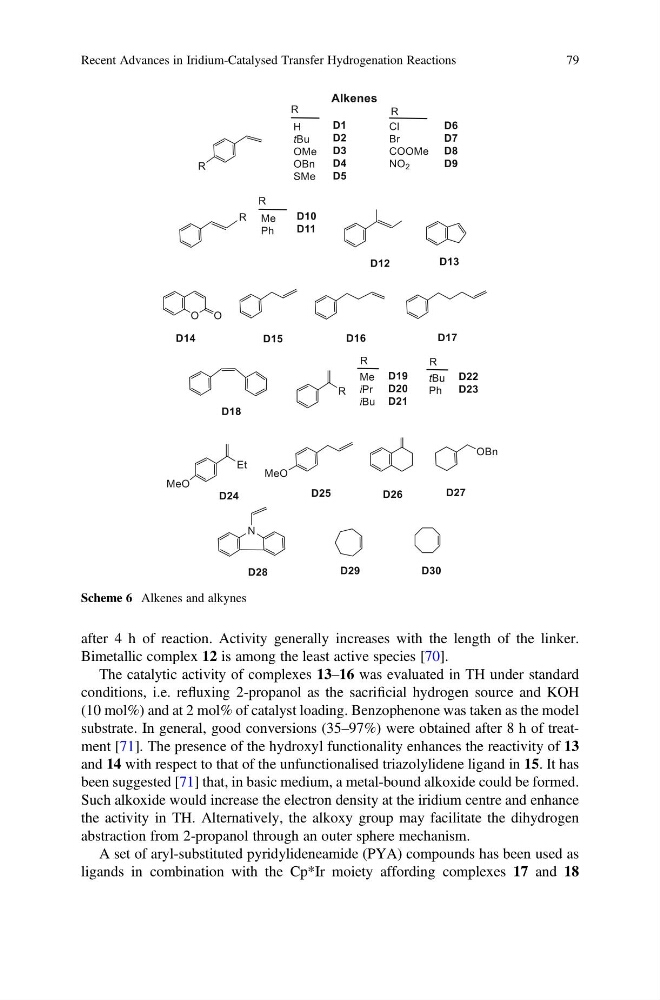
Scheme 6 Alkenes and alkynes
Recent Advances in Iridium-Catalysed Transfer Hydrogenation Reactions
79
Bimetallic complex 12 is among the least active species [70].
The catalytic activity of complexes 13–16 was evaluated in TH under standard
conditions, i.e. refluxing 2-propanol as the sacrificial hydrogen source and KOH
(10 mol%) and at 2 mol% of catalyst loading. Benzophenone was taken as the model
substrate. In general, good conversions (35–97%) were obtained after 8 h of treatment [71]. The presence of the hydroxyl functionality enhances the reactivity of 13
and 14 with respect to that of the unfunctionalised triazolylidene ligand in 15. It has
been suggested [71] that, in basic medium, a metal-bound alkoxide could be formed.
Such alkoxide would increase the electron density at the iridium centre and enhance
the activity in TH. Alternatively, the alkoxy group may facilitate the dihydrogen
abstraction from 2-propanol through an outer sphere mechanism.
A set of aryl-substituted pyridylideneamide (PYA) compounds has been used as
ligands in combination with the Cp*Ir moiety affording complexes 17 and 18
Scheme 6 Alkenes and alkynes
Recent Advances in Iridium-Catalysed Transfer Hydrogenation Reactions
79