

2 Half-Sandwich Iridium Complexes
After the application of η
6 -arene ruthenium complexes containing the chiral (S,S)TsDPEN ligand in TH reactions developed by Noyori, Tani, Mashima and Abe
demonstrated that pentamethylcyclopentadienyl (Cp*) rhodium and iridium complexes bearing the same chiral ligand are also excellent catalyst precursors for the
asymmetric reduction of ketonic substrates [61]. Since then, a number of Cp*iridium complexes have been successfully applied as TH catalysts, and the class of
hydrogenated substrates has been widely extended.
2.1 Transfer Hydrogenation of C=O, C=N and C=C Bonds
Transfer hydrogenation of aldehydes, ketones and imines with molecular metallic
catalysts is one of the most powerful and versatile tool to access alcohols and amines.
Asymmetric versions complete the potential of this methodology. Although much
less studied, alkenes can also be hydrogenated by TH. TH in water of the double
bonds indicated in the Sect. 2.1 will be treated in Sect. 2.3 of this work.
Sarkar’s group reported that mononuclear 1 [62, 63], dinuclear 2, 3 [64, 65] and
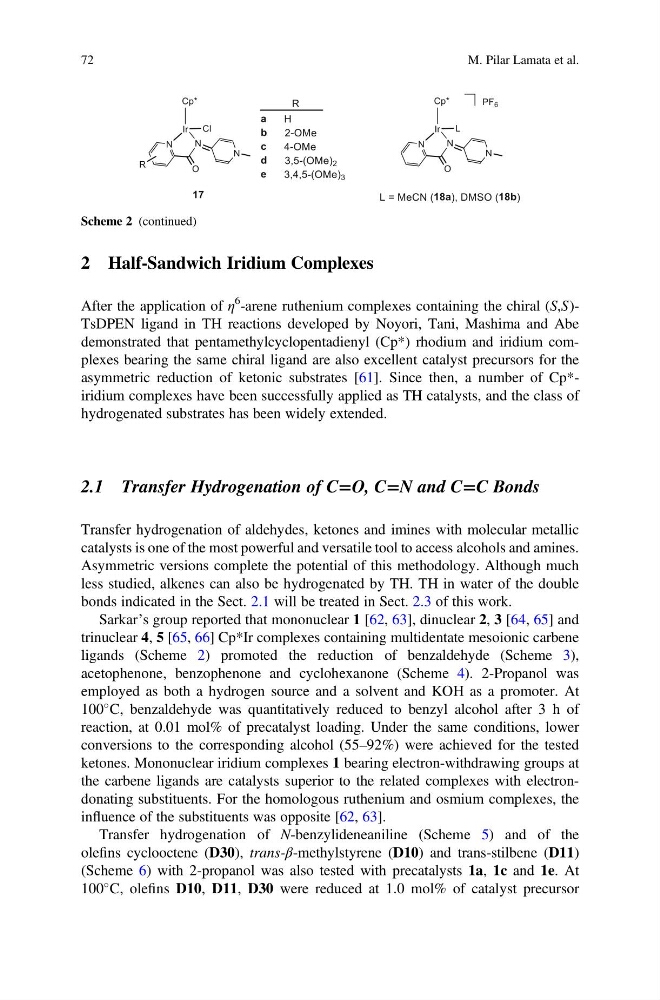
trinuclear 4, 5 [65, 66] Cp*Ir complexes containing multidentate mesoionic carbene
ligands (Scheme 2) promoted the reduction of benzaldehyde (Scheme 3),
acetophenone, benzophenone and cyclohexanone (Scheme 4). 2-Propanol was
employed as both a hydrogen source and a solvent and KOH as a promoter. At
100
C, benzaldehyde was quantitatively reduced to benzyl alcohol after 3 h of
reaction, at 0.01 mol% of precatalyst loading. Under the same conditions, lower
conversions to the corresponding alcohol (55–92%) were achieved for the tested
ketones. Mononuclear iridium complexes 1 bearing electron-withdrawing groups at
the carbene ligands are catalysts superior to the related complexes with electrondonating substituents. For the homologous ruthenium and osmium complexes, the
influence of the substituents was opposite [62, 63].
Transfer hydrogenation of N-benzylideneaniline (Scheme 5) and of the
olefins cyclooctene (D30), trans-β-methylstyrene (D10) and trans-stilbene (D11)
(Scheme 6) with 2-propanol was also tested with precatalysts 1a, 1c and 1e. At
100
C, olefins D10, D11, D30 were reduced at 1.0 mol% of catalyst precursor
Scheme 2 (continued)
72
M. Pilar Lamata et al.
After the application of η
6 -arene ruthenium complexes containing the chiral (S,S)TsDPEN ligand in TH reactions developed by Noyori, Tani, Mashima and Abe
demonstrated that pentamethylcyclopentadienyl (Cp*) rhodium and iridium complexes bearing the same chiral ligand are also excellent catalyst precursors for the
asymmetric reduction of ketonic substrates [61]. Since then, a number of Cp*iridium complexes have been successfully applied as TH catalysts, and the class of
hydrogenated substrates has been widely extended.
2.1 Transfer Hydrogenation of C=O, C=N and C=C Bonds
Transfer hydrogenation of aldehydes, ketones and imines with molecular metallic
catalysts is one of the most powerful and versatile tool to access alcohols and amines.
Asymmetric versions complete the potential of this methodology. Although much
less studied, alkenes can also be hydrogenated by TH. TH in water of the double
bonds indicated in the Sect. 2.1 will be treated in Sect. 2.3 of this work.
Sarkar’s group reported that mononuclear 1 [62, 63], dinuclear 2, 3 [64, 65] and
trinuclear 4, 5 [65, 66] Cp*Ir complexes containing multidentate mesoionic carbene
ligands (Scheme 2) promoted the reduction of benzaldehyde (Scheme 3),
acetophenone, benzophenone and cyclohexanone (Scheme 4). 2-Propanol was
employed as both a hydrogen source and a solvent and KOH as a promoter. At
100
C, benzaldehyde was quantitatively reduced to benzyl alcohol after 3 h of
reaction, at 0.01 mol% of precatalyst loading. Under the same conditions, lower
conversions to the corresponding alcohol (55–92%) were achieved for the tested
ketones. Mononuclear iridium complexes 1 bearing electron-withdrawing groups at
the carbene ligands are catalysts superior to the related complexes with electrondonating substituents. For the homologous ruthenium and osmium complexes, the
influence of the substituents was opposite [62, 63].
Transfer hydrogenation of N-benzylideneaniline (Scheme 5) and of the
olefins cyclooctene (D30), trans-β-methylstyrene (D10) and trans-stilbene (D11)
(Scheme 6) with 2-propanol was also tested with precatalysts 1a, 1c and 1e. At
100
C, olefins D10, D11, D30 were reduced at 1.0 mol% of catalyst precursor
Scheme 2 (continued)
72
M. Pilar Lamata et al.