

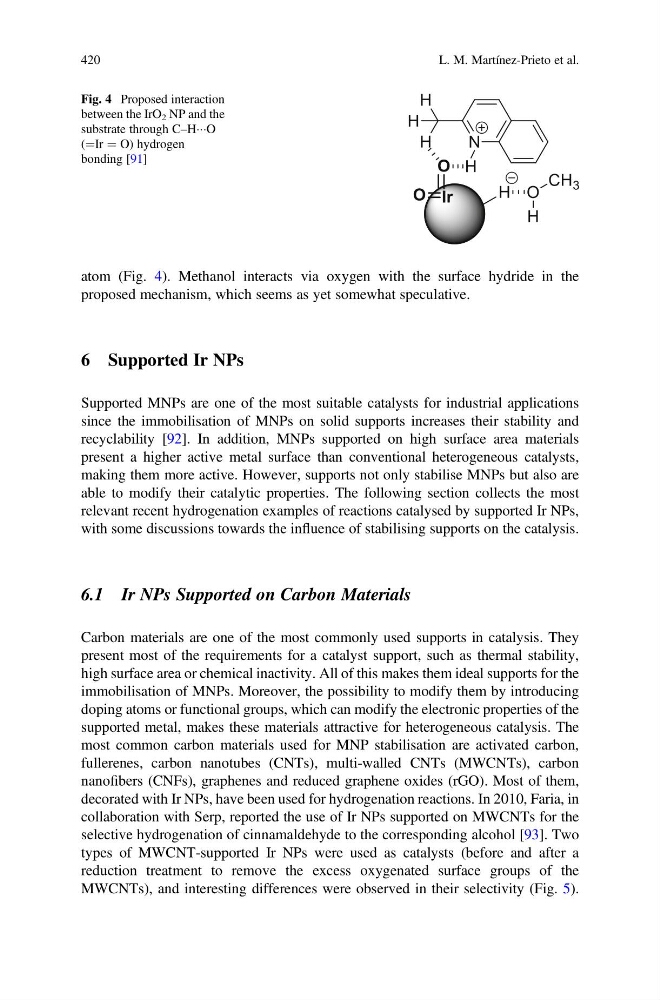
atom (Fig. 4). Methanol interacts via oxygen with the surface hydride in the
proposed mechanism, which seems as yet somewhat speculative.
6 Supported Ir NPs
Supported MNPs are one of the most suitable catalysts for industrial applications
since the immobilisation of MNPs on solid supports increases their stability and
recyclability [92]. In addition, MNPs supported on high surface area materials
present a higher active metal surface than conventional heterogeneous catalysts,
making them more active. However, supports not only stabilise MNPs but also are
able to modify their catalytic properties. The following section collects the most
relevant recent hydrogenation examples of reactions catalysed by supported Ir NPs,
with some discussions towards the influence of stabilising supports on the catalysis.
6.1 Ir NPs Supported on Carbon Materials
Carbon materials are one of the most commonly used supports in catalysis. They
present most of the requirements for a catalyst support, such as thermal stability,
high surface area or chemical inactivity. All of this makes them ideal supports for the
immobilisation of MNPs. Moreover, the possibility to modify them by introducing
doping atoms or functional groups, which can modify the electronic properties of the
supported metal, makes these materials attractive for heterogeneous catalysis. The
most common carbon materials used for MNP stabilisation are activated carbon,
fullerenes, carbon nanotubes (CNTs), multi-walled CNTs (MWCNTs), carbon
nanofibers (CNFs), graphenes and reduced graphene oxides (rGO). Most of them,
decorated with Ir NPs, have been used for hydrogenation reactions. In 2010, Faria, in
collaboration with Serp, reported the use of Ir NPs supported on MWCNTs for the
selective hydrogenation of cinnamaldehyde to the corresponding alcohol [93]. Two
types of MWCNT-supported Ir NPs were used as catalysts (before and after a
reduction treatment to remove the excess oxygenated surface groups of the
MWCNTs), and interesting differences were observed in their selectivity (Fig. 5).
Fig. 4 Proposed interaction
between the IrO 2 NP and the
substrate through C–HÁÁÁO
(¼Ir ¼ O) hydrogen
bonding [91]
420
L. M. Martínez-Prieto et al.
proposed mechanism, which seems as yet somewhat speculative.
6 Supported Ir NPs
Supported MNPs are one of the most suitable catalysts for industrial applications
since the immobilisation of MNPs on solid supports increases their stability and
recyclability [92]. In addition, MNPs supported on high surface area materials
present a higher active metal surface than conventional heterogeneous catalysts,
making them more active. However, supports not only stabilise MNPs but also are
able to modify their catalytic properties. The following section collects the most
relevant recent hydrogenation examples of reactions catalysed by supported Ir NPs,
with some discussions towards the influence of stabilising supports on the catalysis.
6.1 Ir NPs Supported on Carbon Materials
Carbon materials are one of the most commonly used supports in catalysis. They
present most of the requirements for a catalyst support, such as thermal stability,
high surface area or chemical inactivity. All of this makes them ideal supports for the
immobilisation of MNPs. Moreover, the possibility to modify them by introducing
doping atoms or functional groups, which can modify the electronic properties of the
supported metal, makes these materials attractive for heterogeneous catalysis. The
most common carbon materials used for MNP stabilisation are activated carbon,
fullerenes, carbon nanotubes (CNTs), multi-walled CNTs (MWCNTs), carbon
nanofibers (CNFs), graphenes and reduced graphene oxides (rGO). Most of them,
decorated with Ir NPs, have been used for hydrogenation reactions. In 2010, Faria, in
collaboration with Serp, reported the use of Ir NPs supported on MWCNTs for the
selective hydrogenation of cinnamaldehyde to the corresponding alcohol [93]. Two
types of MWCNT-supported Ir NPs were used as catalysts (before and after a
reduction treatment to remove the excess oxygenated surface groups of the
MWCNTs), and interesting differences were observed in their selectivity (Fig. 5).
Fig. 4 Proposed interaction
between the IrO 2 NP and the
substrate through C–HÁÁÁO
(¼Ir ¼ O) hydrogen
bonding [91]
420
L. M. Martínez-Prieto et al.