

This cyclohexene hydrogenation reaction was subsequently employed to investigate the kinetics of the nucleation process that yields the Ir NPs at 22
C, Ir(0) $300 ,
from this polyoxometalate-containing organometallic precursor (abbreviated as
(COD)IrÁPOM
8À ). The study showed that the nucleation is a second-order homogeneous process in the precatalyst ((COD)IrÁPOM
8À
) [89]. Then different nucleation
mechanisms were examined. The results provided evidence for a mechanism named
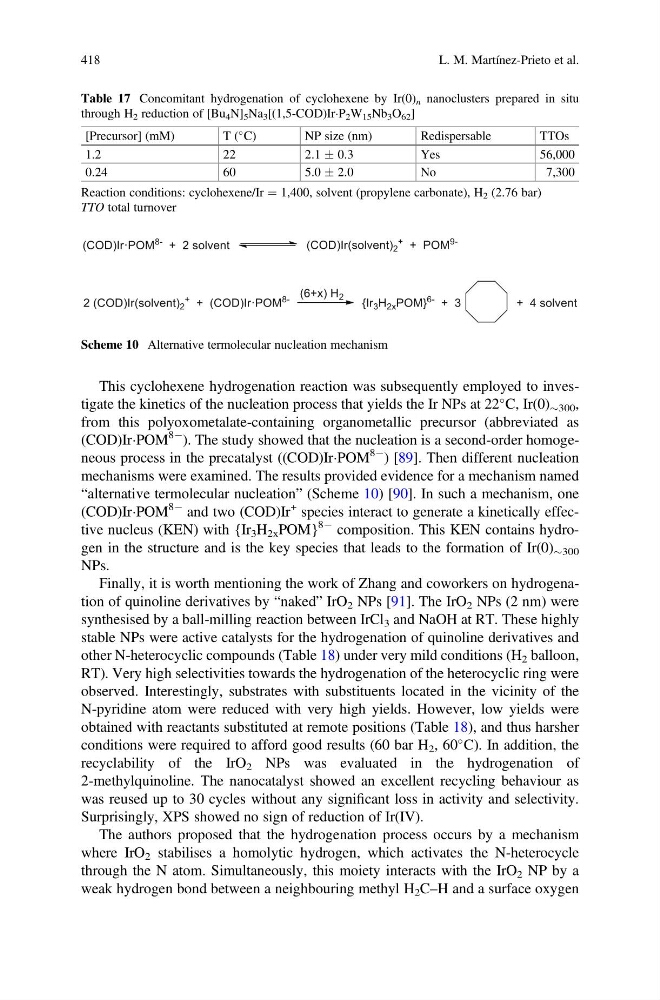
“alternative termolecular nucleation” (Scheme 10) [90]. In such a mechanism, one
(COD)IrÁPOM
8À and two (COD)Ir
+ species interact to generate a kinetically effective nucleus (KEN) with {Ir 3 H 2x POM}
8À composition. This KEN contains hydrogen in the structure and is the key species that leads to the formation of Ir(0) $300
NPs.
Finally, it is worth mentioning the work of Zhang and coworkers on hydrogenation of quinoline derivatives by “naked” IrO 2 NPs [91]. The IrO 2 NPs (2 nm) were
synthesised by a ball-milling reaction between IrCl 3 and NaOH at RT. These highly
stable NPs were active catalysts for the hydrogenation of quinoline derivatives and
other N-heterocyclic compounds (Table 18) under very mild conditions (H 2 balloon,
RT). Very high selectivities towards the hydrogenation of the heterocyclic ring were
observed. Interestingly, substrates with substituents located in the vicinity of the
N-pyridine atom were reduced with very high yields. However, low yields were
obtained with reactants substituted at remote positions (Table 18), and thus harsher
conditions were required to afford good results (60 bar H 2 , 60
C). In addition, the
recyclability of the IrO 2 NPs was evaluated in the hydrogenation of
2-methylquinoline. The nanocatalyst showed an excellent recycling behaviour as
was reused up to 30 cycles without any significant loss in activity and selectivity.
Surprisingly, XPS showed no sign of reduction of Ir(IV).
The authors proposed that the hydrogenation process occurs by a mechanism
where IrO 2 stabilises a homolytic hydrogen, which activates the N-heterocycle
through the N atom. Simultaneously, this moiety interacts with the IrO 2 NP by a
weak hydrogen bond between a neighbouring methyl H 2 C–H and a surface oxygen
Table 17 Concomitant hydrogenation of cyclohexene by Ir(0) n nanoclusters prepared in situ
through H 2 reduction of [Bu 4 N] 5 Na 3 [(1,5-COD)IrÁP 2 W 15 Nb 3 O 62 ]
[Precursor] (mM)
T (
C)
NP size (nm)
Redispersable
TTOs
1.2
22
2.1 Æ 0.3
Yes
56,000
0.24
60
5.0 Æ 2.0
No
7,300
Reaction conditions: cyclohexene/Ir ¼ 1,400, solvent (propylene carbonate), H 2 (2.76 bar)
TTO total turnover
Scheme 10 Alternative termolecular nucleation mechanism
418
L. M. Martínez-Prieto et al.
C, Ir(0) $300 ,
from this polyoxometalate-containing organometallic precursor (abbreviated as
(COD)IrÁPOM
8À ). The study showed that the nucleation is a second-order homogeneous process in the precatalyst ((COD)IrÁPOM
8À
) [89]. Then different nucleation
mechanisms were examined. The results provided evidence for a mechanism named
“alternative termolecular nucleation” (Scheme 10) [90]. In such a mechanism, one
(COD)IrÁPOM
8À and two (COD)Ir
+ species interact to generate a kinetically effective nucleus (KEN) with {Ir 3 H 2x POM}
8À composition. This KEN contains hydrogen in the structure and is the key species that leads to the formation of Ir(0) $300
NPs.
Finally, it is worth mentioning the work of Zhang and coworkers on hydrogenation of quinoline derivatives by “naked” IrO 2 NPs [91]. The IrO 2 NPs (2 nm) were
synthesised by a ball-milling reaction between IrCl 3 and NaOH at RT. These highly
stable NPs were active catalysts for the hydrogenation of quinoline derivatives and
other N-heterocyclic compounds (Table 18) under very mild conditions (H 2 balloon,
RT). Very high selectivities towards the hydrogenation of the heterocyclic ring were
observed. Interestingly, substrates with substituents located in the vicinity of the
N-pyridine atom were reduced with very high yields. However, low yields were
obtained with reactants substituted at remote positions (Table 18), and thus harsher
conditions were required to afford good results (60 bar H 2 , 60
C). In addition, the
recyclability of the IrO 2 NPs was evaluated in the hydrogenation of
2-methylquinoline. The nanocatalyst showed an excellent recycling behaviour as
was reused up to 30 cycles without any significant loss in activity and selectivity.
Surprisingly, XPS showed no sign of reduction of Ir(IV).
The authors proposed that the hydrogenation process occurs by a mechanism
where IrO 2 stabilises a homolytic hydrogen, which activates the N-heterocycle
through the N atom. Simultaneously, this moiety interacts with the IrO 2 NP by a
weak hydrogen bond between a neighbouring methyl H 2 C–H and a surface oxygen
Table 17 Concomitant hydrogenation of cyclohexene by Ir(0) n nanoclusters prepared in situ
through H 2 reduction of [Bu 4 N] 5 Na 3 [(1,5-COD)IrÁP 2 W 15 Nb 3 O 62 ]
[Precursor] (mM)
T (
C)
NP size (nm)
Redispersable
TTOs
1.2
22
2.1 Æ 0.3
Yes
56,000
0.24
60
5.0 Æ 2.0
No
7,300
Reaction conditions: cyclohexene/Ir ¼ 1,400, solvent (propylene carbonate), H 2 (2.76 bar)
TTO total turnover
Scheme 10 Alternative termolecular nucleation mechanism
418
L. M. Martínez-Prieto et al.