

to methodology to walnut dioxasolv lignin. The content β-O-4 linkages in this type
of lignin was determined to be 45% by 2D HMQC NMR. The theoretical maximum
monomer yield from breaking β-O-4 bonds connected to monomeric units was 10%.
The decarbonylation of lignin yielded 2 wt% of monomers, C1 and C0 phenolics, the
latter are probably derived from vanillin-type aldehydes, which are known to form
during lignin acidolysis.
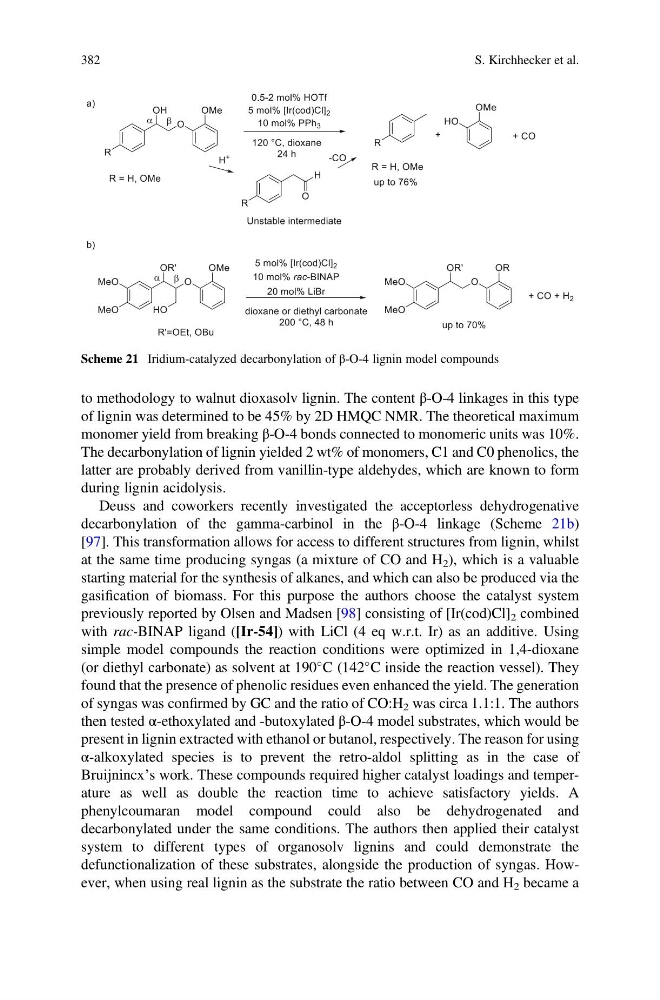
Deuss and coworkers recently investigated the acceptorless dehydrogenative
decarbonylation of the gamma-carbinol in the β-O-4 linkage (Scheme 21b)
[97]. This transformation allows for access to different structures from lignin, whilst
at the same time producing syngas (a mixture of CO and H 2 ), which is a valuable
starting material for the synthesis of alkanes, and which can also be produced via the
gasification of biomass. For this purpose the authors choose the catalyst system
previously reported by Olsen and Madsen [98] consisting of [Ir(cod)Cl] 2 combined
with rac-BINAP ligand ([Ir-54]) with LiCl (4 eq w.r.t. Ir) as an additive. Using
simple model compounds the reaction conditions were optimized in 1,4-dioxane
(or diethyl carbonate) as solvent at 190
C (142
C inside the reaction vessel). They
found that the presence of phenolic residues even enhanced the yield. The generation
of syngas was confirmed by GC and the ratio of CO:H 2 was circa 1.1:1. The authors
then tested α-ethoxylated and -butoxylated β-O-4 model substrates, which would be
present in lignin extracted with ethanol or butanol, respectively. The reason for using
α-alkoxylated species is to prevent the retro-aldol splitting as in the case of
Bruijnincx’s work. These compounds required higher catalyst loadings and temperature as well as double the reaction time to achieve satisfactory yields. A
phenylcoumaran model compound could also be dehydrogenated and
decarbonylated under the same conditions. The authors then applied their catalyst
system to different types of organosolv lignins and could demonstrate the
defunctionalization of these substrates, alongside the production of syngas. However, when using real lignin as the substrate the ratio between CO and H 2 became a
Scheme 21 Iridium-catalyzed decarbonylation of β-O-4 lignin model compounds
382
S. Kirchhecker et al.
of lignin was determined to be 45% by 2D HMQC NMR. The theoretical maximum
monomer yield from breaking β-O-4 bonds connected to monomeric units was 10%.
The decarbonylation of lignin yielded 2 wt% of monomers, C1 and C0 phenolics, the
latter are probably derived from vanillin-type aldehydes, which are known to form
during lignin acidolysis.
Deuss and coworkers recently investigated the acceptorless dehydrogenative
decarbonylation of the gamma-carbinol in the β-O-4 linkage (Scheme 21b)
[97]. This transformation allows for access to different structures from lignin, whilst
at the same time producing syngas (a mixture of CO and H 2 ), which is a valuable
starting material for the synthesis of alkanes, and which can also be produced via the
gasification of biomass. For this purpose the authors choose the catalyst system
previously reported by Olsen and Madsen [98] consisting of [Ir(cod)Cl] 2 combined
with rac-BINAP ligand ([Ir-54]) with LiCl (4 eq w.r.t. Ir) as an additive. Using
simple model compounds the reaction conditions were optimized in 1,4-dioxane
(or diethyl carbonate) as solvent at 190
C (142
C inside the reaction vessel). They
found that the presence of phenolic residues even enhanced the yield. The generation
of syngas was confirmed by GC and the ratio of CO:H 2 was circa 1.1:1. The authors
then tested α-ethoxylated and -butoxylated β-O-4 model substrates, which would be
present in lignin extracted with ethanol or butanol, respectively. The reason for using
α-alkoxylated species is to prevent the retro-aldol splitting as in the case of
Bruijnincx’s work. These compounds required higher catalyst loadings and temperature as well as double the reaction time to achieve satisfactory yields. A
phenylcoumaran model compound could also be dehydrogenated and
decarbonylated under the same conditions. The authors then applied their catalyst
system to different types of organosolv lignins and could demonstrate the
defunctionalization of these substrates, alongside the production of syngas. However, when using real lignin as the substrate the ratio between CO and H 2 became a
Scheme 21 Iridium-catalyzed decarbonylation of β-O-4 lignin model compounds
382
S. Kirchhecker et al.