

polysaccharide component of lignocellulose. Lignin contains several different linkages between several aromatic monomers, the composition and ratios of which differ
a lot depending on the source. The most common linkage is the β-O-4 aryl ether
linkage, which has therefore been the target of most research to date [92]. So far, the
focus has been on the generation of (substituted) phenols, and currently the only
compound that is produced selectively from lignin in about 3% yield is vanillin
[93]. In addition to the variation in composition, the structure and properties of
extracted lignins varies depending on the source, and the structure and properties of
extracted lignins are very different depending on the method by which they are
produced. Due to the mix of monomers and linkages in lignin, the result of lignin
depolymerization is always a mixture of compounds. In the following, four recent
examples of targeting different parts of the β-O-4 linkage with homogeneous iridium
catalysts are discussed.
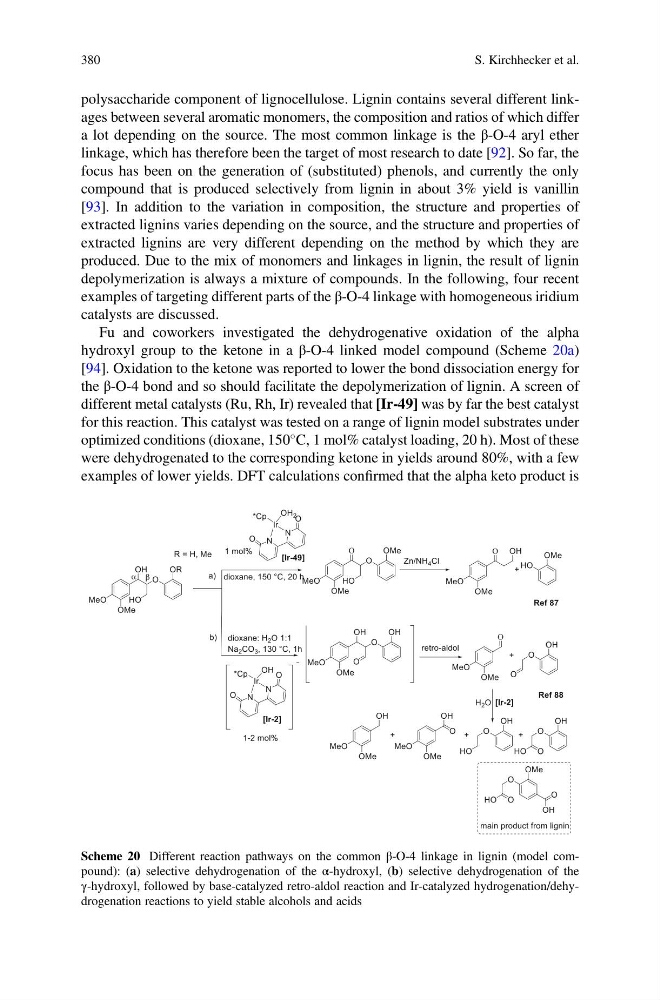
Fu and coworkers investigated the dehydrogenative oxidation of the alpha
hydroxyl group to the ketone in a β-O-4 linked model compound (Scheme 20a)
[94]. Oxidation to the ketone was reported to lower the bond dissociation energy for
the β-O-4 bond and so should facilitate the depolymerization of lignin. A screen of
different metal catalysts (Ru, Rh, Ir) revealed that [Ir-49] was by far the best catalyst
for this reaction. This catalyst was tested on a range of lignin model substrates under
optimized conditions (dioxane, 150
C, 1 mol% catalyst loading, 20 h). Most of these
were dehydrogenated to the corresponding ketone in yields around 80%, with a few
examples of lower yields. DFT calculations confirmed that the alpha keto product is
Scheme 20 Different reaction pathways on the common β-O-4 linkage in lignin (model compound): (a) selective dehydrogenation of the α-hydroxyl, (b) selective dehydrogenation of the
γ-hydroxyl, followed by base-catalyzed retro-aldol reaction and Ir-catalyzed hydrogenation/dehydrogenation reactions to yield stable alcohols and acids
380
S. Kirchhecker et al.
a lot depending on the source. The most common linkage is the β-O-4 aryl ether
linkage, which has therefore been the target of most research to date [92]. So far, the
focus has been on the generation of (substituted) phenols, and currently the only
compound that is produced selectively from lignin in about 3% yield is vanillin
[93]. In addition to the variation in composition, the structure and properties of
extracted lignins varies depending on the source, and the structure and properties of
extracted lignins are very different depending on the method by which they are
produced. Due to the mix of monomers and linkages in lignin, the result of lignin
depolymerization is always a mixture of compounds. In the following, four recent
examples of targeting different parts of the β-O-4 linkage with homogeneous iridium
catalysts are discussed.
Fu and coworkers investigated the dehydrogenative oxidation of the alpha
hydroxyl group to the ketone in a β-O-4 linked model compound (Scheme 20a)
[94]. Oxidation to the ketone was reported to lower the bond dissociation energy for
the β-O-4 bond and so should facilitate the depolymerization of lignin. A screen of
different metal catalysts (Ru, Rh, Ir) revealed that [Ir-49] was by far the best catalyst
for this reaction. This catalyst was tested on a range of lignin model substrates under
optimized conditions (dioxane, 150
C, 1 mol% catalyst loading, 20 h). Most of these
were dehydrogenated to the corresponding ketone in yields around 80%, with a few
examples of lower yields. DFT calculations confirmed that the alpha keto product is
Scheme 20 Different reaction pathways on the common β-O-4 linkage in lignin (model compound): (a) selective dehydrogenation of the α-hydroxyl, (b) selective dehydrogenation of the
γ-hydroxyl, followed by base-catalyzed retro-aldol reaction and Ir-catalyzed hydrogenation/dehydrogenation reactions to yield stable alcohols and acids
380
S. Kirchhecker et al.