

Keywords Carbon dioxide · Carbon monoxide · Electroreduction · Formate ·
Hydride species · Oxalate
1 Introduction
To reduce the carbon dioxide (CO 2 ) emissions associated with the consumption of
fossil fuels [1], it is necessary to utilize various technologies, such as renewable energy
and energy-saving technologies. Recently, the price of renewable energy has drastically decreased, and so its usage is expected to increase [2]. However, the lack of
established methods for the storage and transport of electricity derived from renewable
energy sources remains a challenge that hinders its use. For example, the storage and
transportation of electricity is essential if the electricity generated during the day is to
be used at night, or in places without a power grid. In this context, chemical fuels
produced electrochemically have the potential to address these issues compared to
other methods, such as chemical and photochemical reactions [3, 4]. In particular, one
attractive approach involves the use of electricity derived from renewable energy
sources to produce chemical fuels from CO 2 and H 2 O (an H
+ source) [5].
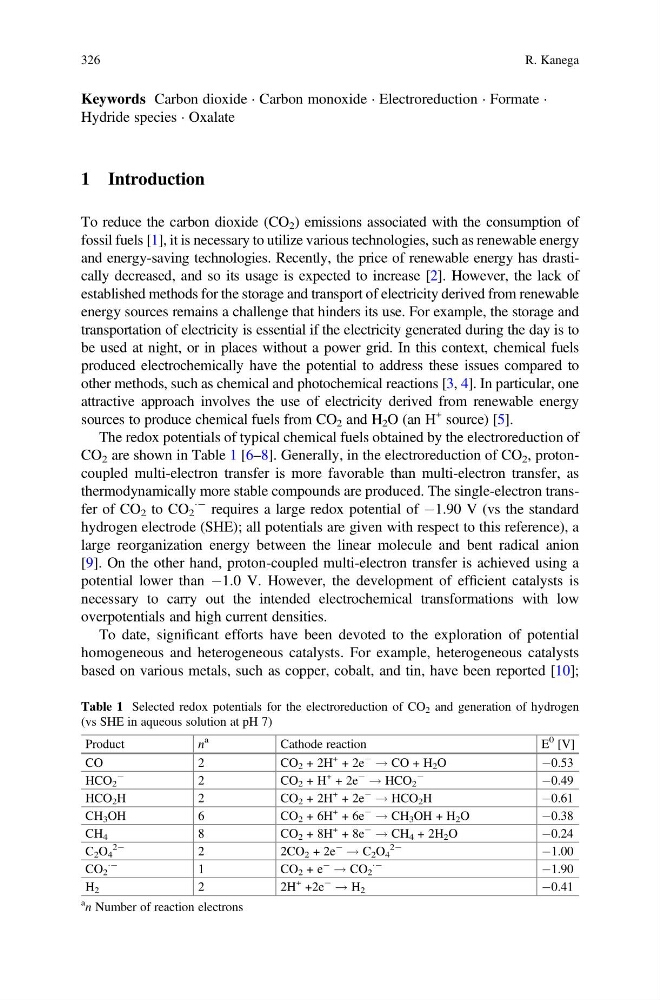
The redox potentials of typical chemical fuels obtained by the electroreduction of
CO 2 are shown in Table 1 [6–8]. Generally, in the electroreduction of CO 2 , protoncoupled multi-electron transfer is more favorable than multi-electron transfer, as
thermodynamically more stable compounds are produced. The single-electron transfer of CO 2 to CO 2
ÁÀ requires a large redox potential of À1.90 V (vs the standard
hydrogen electrode (SHE); all potentials are given with respect to this reference), a
large reorganization energy between the linear molecule and bent radical anion
[9]. On the other hand, proton-coupled multi-electron transfer is achieved using a
potential lower than À1.0 V. However, the development of efficient catalysts is
necessary to carry out the intended electrochemical transformations with low
overpotentials and high current densities.
To date, significant efforts have been devoted to the exploration of potential
homogeneous and heterogeneous catalysts. For example, heterogeneous catalysts
based on various metals, such as copper, cobalt, and tin, have been reported [10];
Table 1 Selected redox potentials for the electroreduction of CO 2 and generation of hydrogen
(vs SHE in aqueous solution at pH 7)
Product
n
a
Cathode reaction
E
0 [V]
CO
2
CO 2 + 2H
+ + 2e
À ! CO + H 2 O
À0.53
HCO 2
À
2
C O 2 + H
+ + 2e
À ! HCO 2
À
À0.49
HCO 2 H
2
C O 2 + 2H
+ + 2e
À ! HCO 2 H
À0.61
CH 3 OH
6
CO 2 + 6H
+ + 6e
À ! CH 3 OH + H 2 O
À0.38
CH 4
8
C O 2 + 8H
+ + 8e
À ! CH 4 + 2H 2 O
À0.24
C 2 O 4
2À
2
2CO 2 + 2e
À ! C 2 O 4
2À
À1.00
CO 2
ÁÀ
1
C O 2 + e
À ! CO 2
ÁÀ
À1.90
H 2
2
2 H
+ +2e
À ! H 2
À0.41
a n Number of reaction electrons
326
R. Kanega
Hydride species · Oxalate
1 Introduction
To reduce the carbon dioxide (CO 2 ) emissions associated with the consumption of
fossil fuels [1], it is necessary to utilize various technologies, such as renewable energy
and energy-saving technologies. Recently, the price of renewable energy has drastically decreased, and so its usage is expected to increase [2]. However, the lack of
established methods for the storage and transport of electricity derived from renewable
energy sources remains a challenge that hinders its use. For example, the storage and
transportation of electricity is essential if the electricity generated during the day is to
be used at night, or in places without a power grid. In this context, chemical fuels
produced electrochemically have the potential to address these issues compared to
other methods, such as chemical and photochemical reactions [3, 4]. In particular, one
attractive approach involves the use of electricity derived from renewable energy
sources to produce chemical fuels from CO 2 and H 2 O (an H
+ source) [5].
The redox potentials of typical chemical fuels obtained by the electroreduction of
CO 2 are shown in Table 1 [6–8]. Generally, in the electroreduction of CO 2 , protoncoupled multi-electron transfer is more favorable than multi-electron transfer, as
thermodynamically more stable compounds are produced. The single-electron transfer of CO 2 to CO 2
ÁÀ requires a large redox potential of À1.90 V (vs the standard
hydrogen electrode (SHE); all potentials are given with respect to this reference), a
large reorganization energy between the linear molecule and bent radical anion
[9]. On the other hand, proton-coupled multi-electron transfer is achieved using a
potential lower than À1.0 V. However, the development of efficient catalysts is
necessary to carry out the intended electrochemical transformations with low
overpotentials and high current densities.
To date, significant efforts have been devoted to the exploration of potential
homogeneous and heterogeneous catalysts. For example, heterogeneous catalysts
based on various metals, such as copper, cobalt, and tin, have been reported [10];
Table 1 Selected redox potentials for the electroreduction of CO 2 and generation of hydrogen
(vs SHE in aqueous solution at pH 7)
Product
n
a
Cathode reaction
E
0 [V]
CO
2
CO 2 + 2H
+ + 2e
À ! CO + H 2 O
À0.53
HCO 2
À
2
C O 2 + H
+ + 2e
À ! HCO 2
À
À0.49
HCO 2 H
2
C O 2 + 2H
+ + 2e
À ! HCO 2 H
À0.61
CH 3 OH
6
CO 2 + 6H
+ + 6e
À ! CH 3 OH + H 2 O
À0.38
CH 4
8
C O 2 + 8H
+ + 8e
À ! CH 4 + 2H 2 O
À0.24
C 2 O 4
2À
2
2CO 2 + 2e
À ! C 2 O 4
2À
À1.00
CO 2
ÁÀ
1
C O 2 + e
À ! CO 2
ÁÀ
À1.90
H 2
2
2 H
+ +2e
À ! H 2
À0.41
a n Number of reaction electrons
326
R. Kanega