

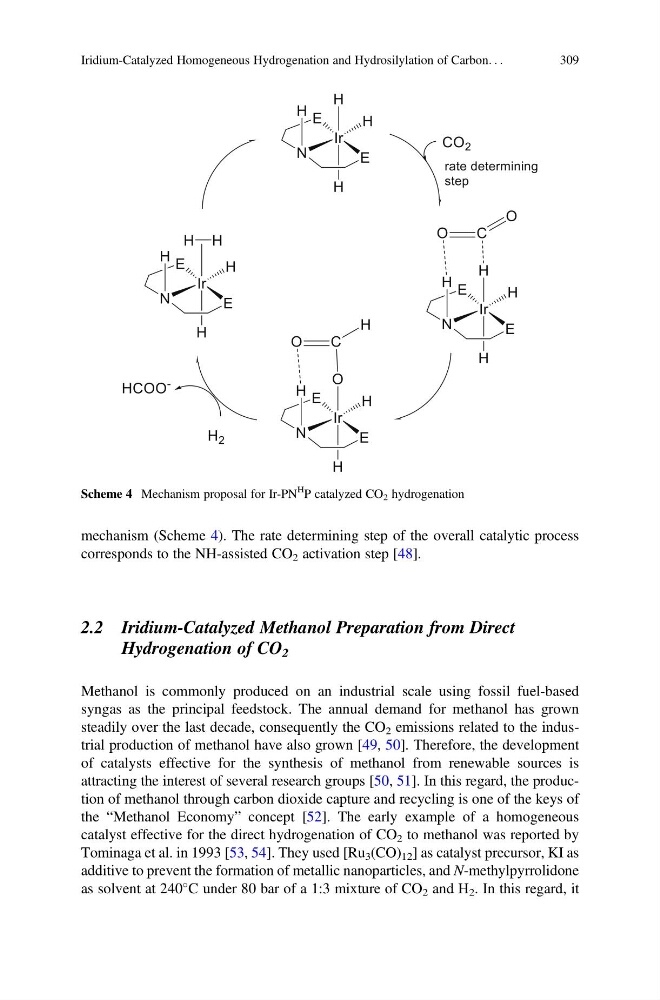
mechanism (Scheme 4). The rate determining step of the overall catalytic process
corresponds to the NH-assisted CO 2 activation step [48].
2.2 Iridium-Catalyzed Methanol Preparation from Direct
Hydrogenation of CO 2
Methanol is commonly produced on an industrial scale using fossil fuel-based
syngas as the principal feedstock. The annual demand for methanol has grown
steadily over the last decade, consequently the CO 2 emissions related to the industrial production of methanol have also grown [49, 50]. Therefore, the development
of catalysts effective for the synthesis of methanol from renewable sources is
attracting the interest of several research groups [50, 51]. In this regard, the production of methanol through carbon dioxide capture and recycling is one of the keys of
the “Methanol Economy” concept [52]. The early example of a homogeneous
catalyst effective for the direct hydrogenation of CO 2 to methanol was reported by
Tominaga et al. in 1993 [53, 54]. They used [Ru 3 (CO) 12 ] as catalyst precursor, KI as
additive to prevent the formation of metallic nanoparticles, and N-methylpyrrolidone
as solvent at 240
C under 80 bar of a 1:3 mixture of CO 2 and H 2 . In this regard, it
Scheme 4 Mechanism proposal for Ir-PN
H
P catalyzed CO 2 hydrogenation
Iridium-Catalyzed Homogeneous Hydrogenation and Hydrosilylation of Carbon. . .
309
corresponds to the NH-assisted CO 2 activation step [48].
2.2 Iridium-Catalyzed Methanol Preparation from Direct
Hydrogenation of CO 2
Methanol is commonly produced on an industrial scale using fossil fuel-based
syngas as the principal feedstock. The annual demand for methanol has grown
steadily over the last decade, consequently the CO 2 emissions related to the industrial production of methanol have also grown [49, 50]. Therefore, the development
of catalysts effective for the synthesis of methanol from renewable sources is
attracting the interest of several research groups [50, 51]. In this regard, the production of methanol through carbon dioxide capture and recycling is one of the keys of
the “Methanol Economy” concept [52]. The early example of a homogeneous
catalyst effective for the direct hydrogenation of CO 2 to methanol was reported by
Tominaga et al. in 1993 [53, 54]. They used [Ru 3 (CO) 12 ] as catalyst precursor, KI as
additive to prevent the formation of metallic nanoparticles, and N-methylpyrrolidone
as solvent at 240
C under 80 bar of a 1:3 mixture of CO 2 and H 2 . In this regard, it
Scheme 4 Mechanism proposal for Ir-PN
H
P catalyzed CO 2 hydrogenation
Iridium-Catalyzed Homogeneous Hydrogenation and Hydrosilylation of Carbon. . .
309