

half-sandwich complexes with 4,4
0 -dihydroxy-bipyridine (DHBP) or 4,7-dihydroxy1,10-phenanthroline (DHPT) ligands, and iridium(III)-PNP pincer complexes have
proven to be excellent catalysts for the hydrogenation of CO 2 to formic acid.
However, Ir(III)-NSiN
Me (NSiN ¼ fac-bis-(4-methylpyridine-2-yloxy)methylsilyl)
and Ir(III)-NSi
Me (NSi
Me
¼ 4-methylpyridine-2-yloxydimethylsilyl) species are not
stable under hydrogen atmosphere but are effective catalysts for the reduction of
CO 2 with hydrosiloxanes to silylformate under solvent-free conditions and moderate
CO 2 pressures and temperatures. Moreover, while using iridium(III)-DHBP halfsandwich complexes, high CO 2 and H 2 pressures are required to achieve the catalytic
CO 2 hydrogenation to methanol; Ir-NSi
Me species catalyze the reduction of CO 2 to
methoxysilane with hydrosiloxanes under low CO 2 pressure.
Keywords CO 2 hydrogenation · CO 2 hydrosilylation · CO 2 reduction ·
Homogenous catalysis · Iridium
1 Introduction
Carbon dioxide is an abundant, easily available, cheap, and low toxic chemical. On the
other hand, during the last decades, the concentration of CO 2 in the earth’s atmosphere
has reached historical values, which is generally considered one of the main reasons
for the global warming. Therefore, both for economic and environmental reasons the
development of sustainable processes that allow the transformation of CO 2 on an
industrial scale into valuable chemicals could be considered one of the most important
tasks for the sustainability of the modern chemical industry [1–5]. In this context, to
achieve the goal of using CO 2 as raw material of the chemical industry there are
several difficulties to face, among which its great thermodynamic stability stands out.
Catalysis has proven to be essential to overcome the challenge of CO 2 stability.
Thus, in recent decades, great advances have been made in the field of catalytic CO 2
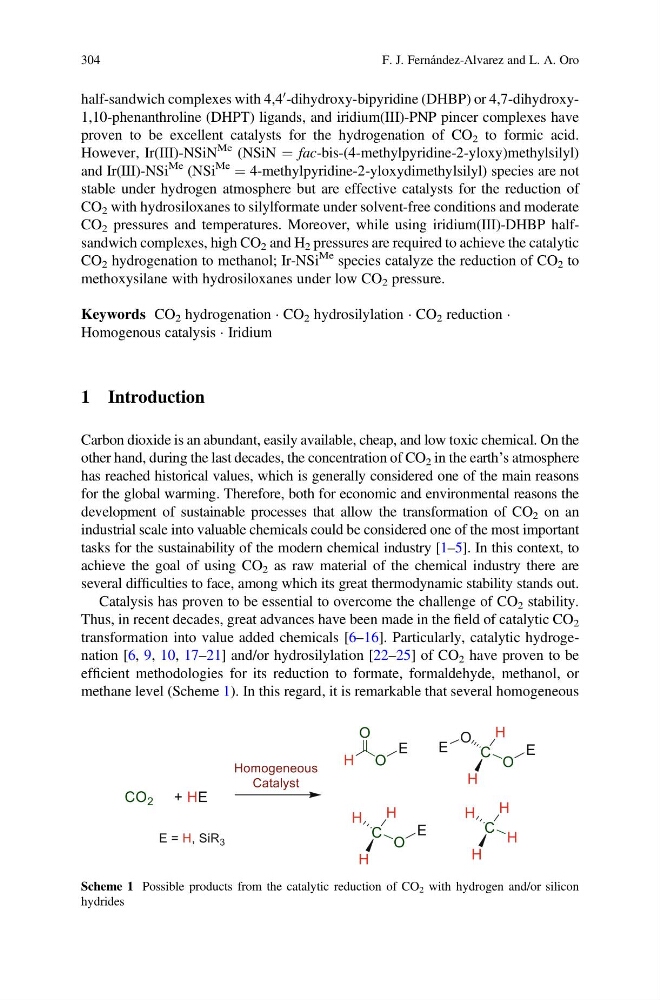
transformation into value added chemicals [6–16]. Particularly, catalytic hydrogenation [6, 9, 10, 17–21] and/or hydrosilylation [22–25] of CO 2 have proven to be
efficient methodologies for its reduction to formate, formaldehyde, methanol, or
methane level (Scheme 1). In this regard, it is remarkable that several homogeneous
Scheme 1 Possible products from the catalytic reduction of CO 2 with hydrogen and/or silicon
hydrides
304
F. J. Fernández-Alvarez and L. A. Oro
0 -dihydroxy-bipyridine (DHBP) or 4,7-dihydroxy1,10-phenanthroline (DHPT) ligands, and iridium(III)-PNP pincer complexes have
proven to be excellent catalysts for the hydrogenation of CO 2 to formic acid.
However, Ir(III)-NSiN
Me (NSiN ¼ fac-bis-(4-methylpyridine-2-yloxy)methylsilyl)
and Ir(III)-NSi
Me (NSi
Me
¼ 4-methylpyridine-2-yloxydimethylsilyl) species are not
stable under hydrogen atmosphere but are effective catalysts for the reduction of
CO 2 with hydrosiloxanes to silylformate under solvent-free conditions and moderate
CO 2 pressures and temperatures. Moreover, while using iridium(III)-DHBP halfsandwich complexes, high CO 2 and H 2 pressures are required to achieve the catalytic
CO 2 hydrogenation to methanol; Ir-NSi
Me species catalyze the reduction of CO 2 to
methoxysilane with hydrosiloxanes under low CO 2 pressure.
Keywords CO 2 hydrogenation · CO 2 hydrosilylation · CO 2 reduction ·
Homogenous catalysis · Iridium
1 Introduction
Carbon dioxide is an abundant, easily available, cheap, and low toxic chemical. On the
other hand, during the last decades, the concentration of CO 2 in the earth’s atmosphere
has reached historical values, which is generally considered one of the main reasons
for the global warming. Therefore, both for economic and environmental reasons the
development of sustainable processes that allow the transformation of CO 2 on an
industrial scale into valuable chemicals could be considered one of the most important
tasks for the sustainability of the modern chemical industry [1–5]. In this context, to
achieve the goal of using CO 2 as raw material of the chemical industry there are
several difficulties to face, among which its great thermodynamic stability stands out.
Catalysis has proven to be essential to overcome the challenge of CO 2 stability.
Thus, in recent decades, great advances have been made in the field of catalytic CO 2
transformation into value added chemicals [6–16]. Particularly, catalytic hydrogenation [6, 9, 10, 17–21] and/or hydrosilylation [22–25] of CO 2 have proven to be
efficient methodologies for its reduction to formate, formaldehyde, methanol, or
methane level (Scheme 1). In this regard, it is remarkable that several homogeneous
Scheme 1 Possible products from the catalytic reduction of CO 2 with hydrogen and/or silicon
hydrides
304
F. J. Fernández-Alvarez and L. A. Oro