

chemoselectivity in iridium-catalyzed olefin hydrogenation reactions [61]. Despite
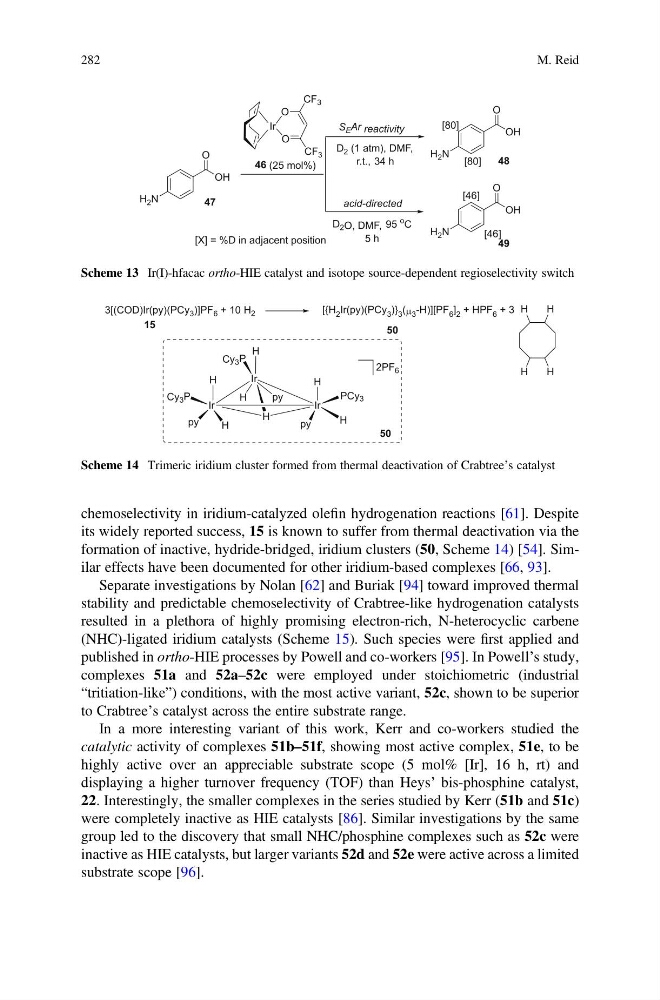
its widely reported success, 15 is known to suffer from thermal deactivation via the
formation of inactive, hydride-bridged, iridium clusters (50, Scheme 14) [54]. Similar effects have been documented for other iridium-based complexes [66, 93].
Separate investigations by Nolan [62] and Buriak [94] toward improved thermal
stability and predictable chemoselectivity of Crabtree-like hydrogenation catalysts
resulted in a plethora of highly promising electron-rich, N-heterocyclic carbene
(NHC)-ligated iridium catalysts (Scheme 15). Such species were first applied and
published in ortho-HIE processes by Powell and co-workers [95]. In Powell’s study,
complexes 51a and 52a–52c were employed under stoichiometric (industrial
“tritiation-like”) conditions, with the most active variant, 52c, shown to be superior
to Crabtree’s catalyst across the entire substrate range.
In a more interesting variant of this work, Kerr and co-workers studied the
catalytic activity of complexes 51b–51f, showing most active complex, 51e, to be
highly active over an appreciable substrate scope (5 mol% [Ir], 16 h, rt) and
displaying a higher turnover frequency (TOF) than Heys’ bis-phosphine catalyst,
22. Interestingly, the smaller complexes in the series studied by Kerr (51b and 51c)
were completely inactive as HIE catalysts [86]. Similar investigations by the same
group led to the discovery that small NHC/phosphine complexes such as 52c were
inactive as HIE catalysts, but larger variants 52d and 52e were active across a limited
substrate scope [96].
Ir
O
O
49
OH
O
[46]
[46]
CF 3
CF 3
H 2 N
48
OH
O
[80]
[80]
H 2 N
46 (25 mol%)
D 2 (1 atm), DMF,
r.t., 34 h
D 2O, DMF, 95
o
C
5 h
OH
O
H 2 N
47
acid-directed
S E Ar reactivity
[X] = %D in adjacent position
Scheme 13 Ir(I)-hfacac ortho-HIE catalyst and isotope source-dependent regioselectivity switch
Ir
Ir
Ir
H
Cy 3 P
py
H
py
H
PCy 3
H
Cy 3 P
H
H
py
H
50
3[(COD)Ir(py)(PCy 3 )]PF 6 + 10 H 2
[{H 2 Ir(py)(PCy 3 )} 3 ( 3 -H)][PF 6 ] 2 + HPF 6 + 3
2PF 6
50
H
H
H
H
15
Scheme 14 Trimeric iridium cluster formed from thermal deactivation of Crabtree’s catalyst
282
M. Reid
its widely reported success, 15 is known to suffer from thermal deactivation via the
formation of inactive, hydride-bridged, iridium clusters (50, Scheme 14) [54]. Similar effects have been documented for other iridium-based complexes [66, 93].
Separate investigations by Nolan [62] and Buriak [94] toward improved thermal
stability and predictable chemoselectivity of Crabtree-like hydrogenation catalysts
resulted in a plethora of highly promising electron-rich, N-heterocyclic carbene
(NHC)-ligated iridium catalysts (Scheme 15). Such species were first applied and
published in ortho-HIE processes by Powell and co-workers [95]. In Powell’s study,
complexes 51a and 52a–52c were employed under stoichiometric (industrial
“tritiation-like”) conditions, with the most active variant, 52c, shown to be superior
to Crabtree’s catalyst across the entire substrate range.
In a more interesting variant of this work, Kerr and co-workers studied the
catalytic activity of complexes 51b–51f, showing most active complex, 51e, to be
highly active over an appreciable substrate scope (5 mol% [Ir], 16 h, rt) and
displaying a higher turnover frequency (TOF) than Heys’ bis-phosphine catalyst,
22. Interestingly, the smaller complexes in the series studied by Kerr (51b and 51c)
were completely inactive as HIE catalysts [86]. Similar investigations by the same
group led to the discovery that small NHC/phosphine complexes such as 52c were
inactive as HIE catalysts, but larger variants 52d and 52e were active across a limited
substrate scope [96].
Ir
O
O
49
OH
O
[46]
[46]
CF 3
CF 3
H 2 N
48
OH
O
[80]
[80]
H 2 N
46 (25 mol%)
D 2 (1 atm), DMF,
r.t., 34 h
D 2O, DMF, 95
o
C
5 h
OH
O
H 2 N
47
acid-directed
S E Ar reactivity
[X] = %D in adjacent position
Scheme 13 Ir(I)-hfacac ortho-HIE catalyst and isotope source-dependent regioselectivity switch
Ir
Ir
Ir
H
Cy 3 P
py
H
py
H
PCy 3
H
Cy 3 P
H
H
py
H
50
3[(COD)Ir(py)(PCy 3 )]PF 6 + 10 H 2
[{H 2 Ir(py)(PCy 3 )} 3 ( 3 -H)][PF 6 ] 2 + HPF 6 + 3
2PF 6
50
H
H
H
H
15
Scheme 14 Trimeric iridium cluster formed from thermal deactivation of Crabtree’s catalyst
282
M. Reid