

also been recently reduced using ZhaoPhos ligand (Fig. 27) achieving excellent
enantioselectivities (up to 99% ee) [278].
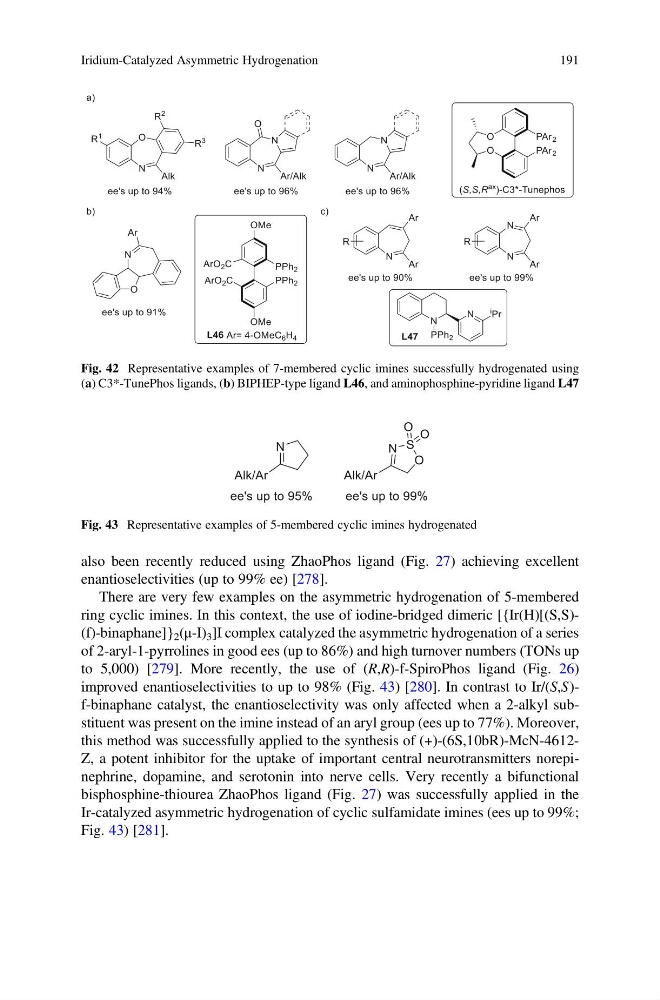
There are very few examples on the asymmetric hydrogenation of 5-membered
ring cyclic imines. In this context, the use of iodine-bridged dimeric [{Ir(H)[(S,S)(f)-binaphane]} 2 (μ-I) 3 ]I complex catalyzed the asymmetric hydrogenation of a series
of 2-aryl-1-pyrrolines in good ees (up to 86%) and high turnover numbers (TONs up
to 5,000) [279]. More recently, the use of (R,R)-f-SpiroPhos ligand (Fig. 26)
improved enantioselectivities to up to 98% (Fig. 43) [280]. In contrast to Ir/(S,S)f-binaphane catalyst, the enantioselectivity was only affected when a 2-alkyl substituent was present on the imine instead of an aryl group (ees up to 77%). Moreover,
this method was successfully applied to the synthesis of (+)-(6S,10bR)-McN-4612Z, a potent inhibitor for the uptake of important central neurotransmitters norepinephrine, dopamine, and serotonin into nerve cells. Very recently a bifunctional
bisphosphine-thiourea ZhaoPhos ligand (Fig. 27) was successfully applied in the
Ir-catalyzed asymmetric hydrogenation of cyclic sulfamidate imines (ees up to 99%;
Fig. 43) [281].
Fig. 42 Representative examples of 7-membered cyclic imines successfully hydrogenated using
(a) C3*-TunePhos ligands, (b) BIPHEP-type ligand L46, and aminophosphine-pyridine ligand L47
Fig. 43 Representative examples of 5-membered cyclic imines hydrogenated
Iridium-Catalyzed Asymmetric Hydrogenation
191
enantioselectivities (up to 99% ee) [278].
There are very few examples on the asymmetric hydrogenation of 5-membered
ring cyclic imines. In this context, the use of iodine-bridged dimeric [{Ir(H)[(S,S)(f)-binaphane]} 2 (μ-I) 3 ]I complex catalyzed the asymmetric hydrogenation of a series
of 2-aryl-1-pyrrolines in good ees (up to 86%) and high turnover numbers (TONs up
to 5,000) [279]. More recently, the use of (R,R)-f-SpiroPhos ligand (Fig. 26)
improved enantioselectivities to up to 98% (Fig. 43) [280]. In contrast to Ir/(S,S)f-binaphane catalyst, the enantioselectivity was only affected when a 2-alkyl substituent was present on the imine instead of an aryl group (ees up to 77%). Moreover,
this method was successfully applied to the synthesis of (+)-(6S,10bR)-McN-4612Z, a potent inhibitor for the uptake of important central neurotransmitters norepinephrine, dopamine, and serotonin into nerve cells. Very recently a bifunctional
bisphosphine-thiourea ZhaoPhos ligand (Fig. 27) was successfully applied in the
Ir-catalyzed asymmetric hydrogenation of cyclic sulfamidate imines (ees up to 99%;
Fig. 43) [281].
Fig. 42 Representative examples of 7-membered cyclic imines successfully hydrogenated using
(a) C3*-TunePhos ligands, (b) BIPHEP-type ligand L46, and aminophosphine-pyridine ligand L47
Fig. 43 Representative examples of 5-membered cyclic imines hydrogenated
Iridium-Catalyzed Asymmetric Hydrogenation
191