

It is worth mentioning that metal-ligand bifunctional catalysts are very competent in the asymmetric transfer hydrogenation (ATH) of either carbonyl compounds or imines. Nonetheless, it has been proposed that the origin of
enantioselection is different for carbonyl compounds or imines. In the case of
carbonyl compounds, it relies on the formation of weak interactions between
ancillary ligands and substituents at the substrate, while in the case of imines, an
ionic outer sphere mechanism could be operative [237].
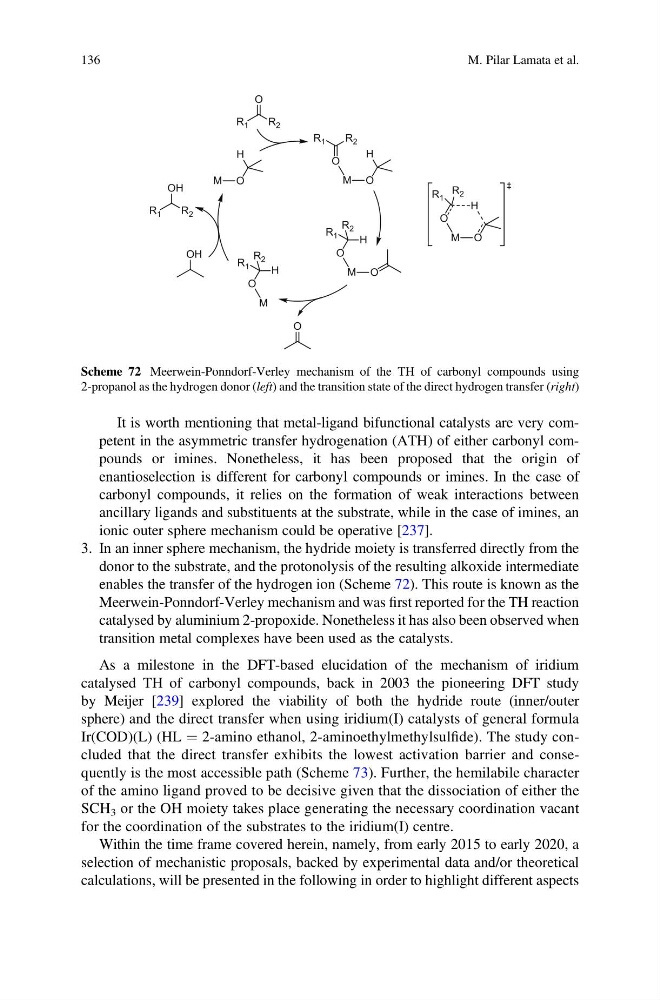
3. In an inner sphere mechanism, the hydride moiety is transferred directly from the
donor to the substrate, and the protonolysis of the resulting alkoxide intermediate
enables the transfer of the hydrogen ion (Scheme 72). This route is known as the
Meerwein-Ponndorf-Verley mechanism and was first reported for the TH reaction
catalysed by aluminium 2-propoxide. Nonetheless it has also been observed when
transition metal complexes have been used as the catalysts.
As a milestone in the DFT-based elucidation of the mechanism of iridium
catalysed TH of carbonyl compounds, back in 2003 the pioneering DFT study
by Meijer [239] explored the viability of both the hydride route (inner/outer
sphere) and the direct transfer when using iridium(I) catalysts of general formula
Ir(COD)(L) (HL ¼ 2-amino ethanol, 2-aminoethylmethylsulfide). The study concluded that the direct transfer exhibits the lowest activation barrier and consequently is the most accessible path (Scheme 73). Further, the hemilabile character
of the amino ligand proved to be decisive given that the dissociation of either the
SCH 3 or the OH moiety takes place generating the necessary coordination vacant
for the coordination of the substrates to the iridium(I) centre.
Within the time frame covered herein, namely, from early 2015 to early 2020, a
selection of mechanistic proposals, backed by experimental data and/or theoretical
calculations, will be presented in the following in order to highlight different aspects
M
O
O
H
M O
H
R 1
R 2
M O
O
R 1
R 2
H
M
O
O
H
R 1
R 2
M
O
R 1
R 2
H
O
R 2
R 1
O
OH
OH
R 2
R 1
Scheme 72 Meerwein-Ponndorf-Verley mechanism of the TH of carbonyl compounds using
2-propanol as the hydrogen donor (left) and the transition state of the direct hydrogen transfer (right)
136
M. Pilar Lamata et al.
enantioselection is different for carbonyl compounds or imines. In the case of
carbonyl compounds, it relies on the formation of weak interactions between
ancillary ligands and substituents at the substrate, while in the case of imines, an
ionic outer sphere mechanism could be operative [237].
3. In an inner sphere mechanism, the hydride moiety is transferred directly from the
donor to the substrate, and the protonolysis of the resulting alkoxide intermediate
enables the transfer of the hydrogen ion (Scheme 72). This route is known as the
Meerwein-Ponndorf-Verley mechanism and was first reported for the TH reaction
catalysed by aluminium 2-propoxide. Nonetheless it has also been observed when
transition metal complexes have been used as the catalysts.
As a milestone in the DFT-based elucidation of the mechanism of iridium
catalysed TH of carbonyl compounds, back in 2003 the pioneering DFT study
by Meijer [239] explored the viability of both the hydride route (inner/outer
sphere) and the direct transfer when using iridium(I) catalysts of general formula
Ir(COD)(L) (HL ¼ 2-amino ethanol, 2-aminoethylmethylsulfide). The study concluded that the direct transfer exhibits the lowest activation barrier and consequently is the most accessible path (Scheme 73). Further, the hemilabile character
of the amino ligand proved to be decisive given that the dissociation of either the
SCH 3 or the OH moiety takes place generating the necessary coordination vacant
for the coordination of the substrates to the iridium(I) centre.
Within the time frame covered herein, namely, from early 2015 to early 2020, a
selection of mechanistic proposals, backed by experimental data and/or theoretical
calculations, will be presented in the following in order to highlight different aspects
M
O
O
H
M O
H
R 1
R 2
M O
O
R 1
R 2
H
M
O
O
H
R 1
R 2
M
O
R 1
R 2
H
O
R 2
R 1
O
OH
OH
R 2
R 1
Scheme 72 Meerwein-Ponndorf-Verley mechanism of the TH of carbonyl compounds using
2-propanol as the hydrogen donor (left) and the transition state of the direct hydrogen transfer (right)
136
M. Pilar Lamata et al.