

G31, activated α,β-unsaturated ketones G32 and G40 and cyclic enones G49 and
G50. All the reactions were performed in iPrOH, at 85
C, using 1 mol% of catalyst
loading. When K 2 CO 3 (5 mol%) was employed as a base, the saturated ketone was
obtained in high yield (85–98%). However, when in the reduction of the (E)chalcones G1–G3, G6, G8–G14 and G28, KOH (50 mol%) was employed as a
base, the corresponding saturated alcohols were obtained in 83–91% yield [200].
The iridium(I) complex with triazolylidene ligands 63 catalysed the reduction of
α,β-unsaturated ketones G1, G3 and G50. Full reduction to the corresponding
saturated alcohol was observed within 1 h when the substrates were treated with
0.5 mol% of the catalyst, in refluxing iPrOH with iPrONa (5 mol%) as a base. Yields
higher than 94% were achieved. From deuterium-labelling experiments, it was
suggested that the reaction proceeds via a tandem isomerisation/TH reactions [155].
In iPrOH, at 80
C, using KOH (10 mol%) as a base, the bis(phosphine) complex
75c (0.5 mol%) reduced 2-cyclohexenone to the saturated ketone cyclohexanone as
the main product (63% yield). The unsaturated alcohol and full reduced
cyclohexanol were obtained in 6% and 31% yield, respectively. Under similar
conditions, the TH of carvone gave the product of the hydrogenation of the conjugate olefin and that of the hydrogenation of both conjugated olefin and carbonyl
group. Hydrogenation of the isolated C¼C bond was not observed [191].
The outcome of the reduction of 2-cyclohexenone with catalyst 55a
(S/C ¼ 10,000, HCOOH 12 equiv., water, 80
C, N 2 atmosphere) was the saturated
alcohol cyclohexanol. Further studies showed that under the reaction conditions
cyclohexanone could be completely reduced to cyclohexanol, while cyclo-2-en-1-ol
could not. This result indicated that the TH of 2-cyclohexanone should first occur at
the C¼C bond and then at the C¼O bond. Experiments on 4-methylpent-3-en-2-one
gave similar results [111].
The combination of the dimer [IrCl(COD)] 2 (4 mol%) with the ligand 1,2-bis
(dicyclohexylphosphino)ethane (4 mol%) promoted the chemoselective TH of α,βunsaturated ketones such as chalcone, benzylideneacetone and its derivatives G32–
G45, conjugated enoates G46 and G47, enamide G48 and cyclic enone G51.
1,4-dioxane was employed as a solvent. Chemoselectivity toward C¼C hydrogenation was found for all these enones. Yields from 93 to 99% were obtained after 10 h
of reaction at 130
C [194].
55h
Cl
Cl
Ir
Cp*
N
N
N NMe 2
Cl
Ir
Cp*
N
NH
NH
N
57a
Cl
Ir
Cl
N
N
N
N
N
(PF 6 ) 2
67a
79
H 2 O
Ir
Cp*
N
O
N
O
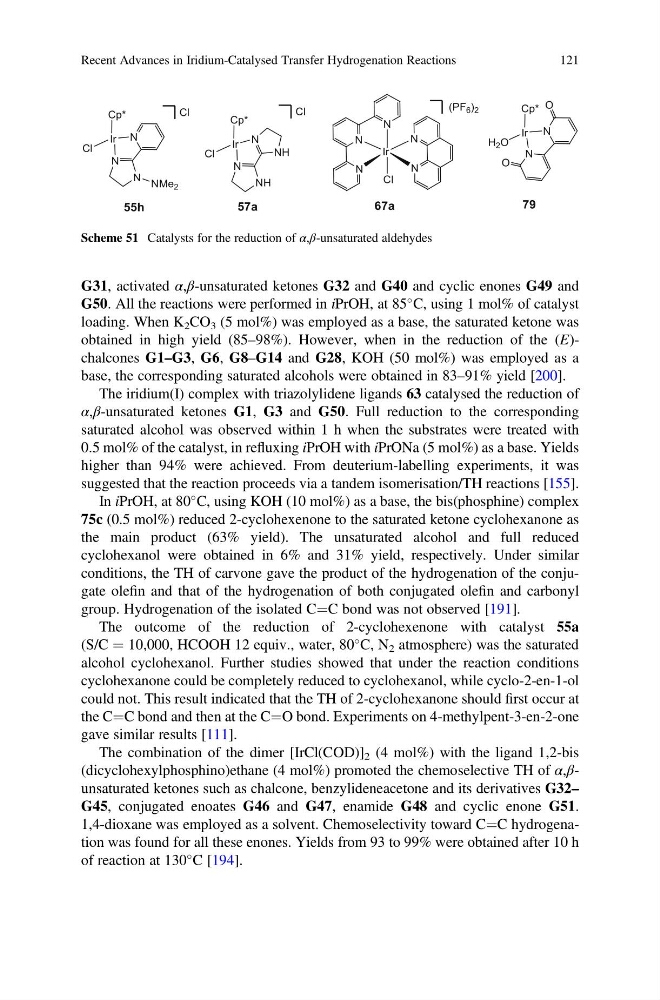
Scheme 51 Catalysts for the reduction of α,β-unsaturated aldehydes
Recent Advances in Iridium-Catalysed Transfer Hydrogenation Reactions
121
G50. All the reactions were performed in iPrOH, at 85
C, using 1 mol% of catalyst
loading. When K 2 CO 3 (5 mol%) was employed as a base, the saturated ketone was
obtained in high yield (85–98%). However, when in the reduction of the (E)chalcones G1–G3, G6, G8–G14 and G28, KOH (50 mol%) was employed as a
base, the corresponding saturated alcohols were obtained in 83–91% yield [200].
The iridium(I) complex with triazolylidene ligands 63 catalysed the reduction of
α,β-unsaturated ketones G1, G3 and G50. Full reduction to the corresponding
saturated alcohol was observed within 1 h when the substrates were treated with
0.5 mol% of the catalyst, in refluxing iPrOH with iPrONa (5 mol%) as a base. Yields
higher than 94% were achieved. From deuterium-labelling experiments, it was
suggested that the reaction proceeds via a tandem isomerisation/TH reactions [155].
In iPrOH, at 80
C, using KOH (10 mol%) as a base, the bis(phosphine) complex
75c (0.5 mol%) reduced 2-cyclohexenone to the saturated ketone cyclohexanone as
the main product (63% yield). The unsaturated alcohol and full reduced
cyclohexanol were obtained in 6% and 31% yield, respectively. Under similar
conditions, the TH of carvone gave the product of the hydrogenation of the conjugate olefin and that of the hydrogenation of both conjugated olefin and carbonyl
group. Hydrogenation of the isolated C¼C bond was not observed [191].
The outcome of the reduction of 2-cyclohexenone with catalyst 55a
(S/C ¼ 10,000, HCOOH 12 equiv., water, 80
C, N 2 atmosphere) was the saturated
alcohol cyclohexanol. Further studies showed that under the reaction conditions
cyclohexanone could be completely reduced to cyclohexanol, while cyclo-2-en-1-ol
could not. This result indicated that the TH of 2-cyclohexanone should first occur at
the C¼C bond and then at the C¼O bond. Experiments on 4-methylpent-3-en-2-one
gave similar results [111].
The combination of the dimer [IrCl(COD)] 2 (4 mol%) with the ligand 1,2-bis
(dicyclohexylphosphino)ethane (4 mol%) promoted the chemoselective TH of α,βunsaturated ketones such as chalcone, benzylideneacetone and its derivatives G32–
G45, conjugated enoates G46 and G47, enamide G48 and cyclic enone G51.
1,4-dioxane was employed as a solvent. Chemoselectivity toward C¼C hydrogenation was found for all these enones. Yields from 93 to 99% were obtained after 10 h
of reaction at 130
C [194].
55h
Cl
Cl
Ir
Cp*
N
N
N NMe 2
Cl
Ir
Cp*
N
NH
NH
N
57a
Cl
Ir
Cl
N
N
N
N
N
(PF 6 ) 2
67a
79
H 2 O
Ir
Cp*
N
O
N
O
Scheme 51 Catalysts for the reduction of α,β-unsaturated aldehydes
Recent Advances in Iridium-Catalysed Transfer Hydrogenation Reactions
121