

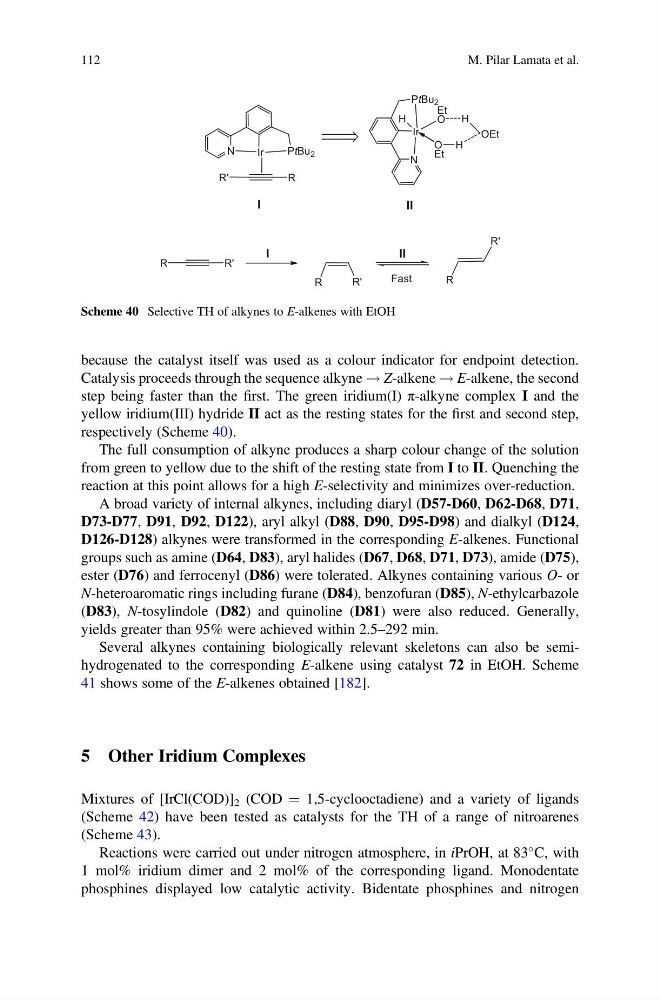
because the catalyst itself was used as a colour indicator for endpoint detection.
Catalysis proceeds through the sequence alkyne ! Z-alkene ! E-alkene, the second
step being faster than the first. The green iridium(I) π-alkyne complex I and the
yellow iridium(III) hydride II act as the resting states for the first and second step,
respectively (Scheme 40).
The full consumption of alkyne produces a sharp colour change of the solution
from green to yellow due to the shift of the resting state from I to II. Quenching the
reaction at this point allows for a high E-selectivity and minimizes over-reduction.
A broad variety of internal alkynes, including diaryl (D57-D60, D62-D68, D71,
D73-D77, D91, D92, D122), aryl alkyl (D88, D90, D95-D98) and dialkyl (D124,
D126-D128) alkynes were transformed in the corresponding E-alkenes. Functional
groups such as amine (D64, D83), aryl halides (D67, D68, D71, D73), amide (D75),
ester (D76) and ferrocenyl (D86) were tolerated. Alkynes containing various O- or
N-heteroaromatic rings including furane (D84), benzofuran (D85), N-ethylcarbazole
(D83), N-tosylindole (D82) and quinoline (D81) were also reduced. Generally,
yields greater than 95% were achieved within 2.5–292 min.
Several alkynes containing biologically relevant skeletons can also be semihydrogenated to the corresponding E-alkene using catalyst 72 in EtOH. Scheme
41 shows some of the E-alkenes obtained [182].
5 Other Iridium Complexes
Mixtures of [IrCl(COD)] 2 (COD ¼ 1,5-cyclooctadiene) and a variety of ligands
(Scheme 42) have been tested as catalysts for the TH of a range of nitroarenes
(Scheme 43).
Reactions were carried out under nitrogen atmosphere, in iPrOH, at 83
C, with
1 mol% iridium dimer and 2 mol% of the corresponding ligand. Monodentate
phosphines displayed low catalytic activity. Bidentate phosphines and nitrogen
H
R
R'
Ir
O
Et
N
PtBu 2
Et
O
R
R'
R
R'
Fast
I
II
I
II
OEt
H
H
Ir
N
PtBu 2
R'
R
Scheme 40 Selective TH of alkynes to E-alkenes with EtOH
112
M. Pilar Lamata et al.
Catalysis proceeds through the sequence alkyne ! Z-alkene ! E-alkene, the second
step being faster than the first. The green iridium(I) π-alkyne complex I and the
yellow iridium(III) hydride II act as the resting states for the first and second step,
respectively (Scheme 40).
The full consumption of alkyne produces a sharp colour change of the solution
from green to yellow due to the shift of the resting state from I to II. Quenching the
reaction at this point allows for a high E-selectivity and minimizes over-reduction.
A broad variety of internal alkynes, including diaryl (D57-D60, D62-D68, D71,
D73-D77, D91, D92, D122), aryl alkyl (D88, D90, D95-D98) and dialkyl (D124,
D126-D128) alkynes were transformed in the corresponding E-alkenes. Functional
groups such as amine (D64, D83), aryl halides (D67, D68, D71, D73), amide (D75),
ester (D76) and ferrocenyl (D86) were tolerated. Alkynes containing various O- or
N-heteroaromatic rings including furane (D84), benzofuran (D85), N-ethylcarbazole
(D83), N-tosylindole (D82) and quinoline (D81) were also reduced. Generally,
yields greater than 95% were achieved within 2.5–292 min.
Several alkynes containing biologically relevant skeletons can also be semihydrogenated to the corresponding E-alkene using catalyst 72 in EtOH. Scheme
41 shows some of the E-alkenes obtained [182].
5 Other Iridium Complexes
Mixtures of [IrCl(COD)] 2 (COD ¼ 1,5-cyclooctadiene) and a variety of ligands
(Scheme 42) have been tested as catalysts for the TH of a range of nitroarenes
(Scheme 43).
Reactions were carried out under nitrogen atmosphere, in iPrOH, at 83
C, with
1 mol% iridium dimer and 2 mol% of the corresponding ligand. Monodentate
phosphines displayed low catalytic activity. Bidentate phosphines and nitrogen
H
R
R'
Ir
O
Et
N
PtBu 2
Et
O
R
R'
R
R'
Fast
I
II
I
II
OEt
H
H
Ir
N
PtBu 2
R'
R
Scheme 40 Selective TH of alkynes to E-alkenes with EtOH
112
M. Pilar Lamata et al.