

TOF value of 2,222 h
À1 , at 10% conversion [178]. No relationship was observed
between the substitution of the acetophenones and the catalytic activity. The reduction rate of aliphatic ketones is higher than that of their aromatic counterparts.
Remarkably, the TH of benzaldehyde to benzyl alcohol was completed in 40 s.
Catalyst 66 showed good activity in the TH of imines. N-benzylideneaniline was
transformed into N-benzylaniline, using 1 mol% of catalyst, in 45 min with a TOF
value of 1,118 h
À1 at 10% conversion. Substituted imines 3-methoxy-Nbenzylideneaniline and 4-methoxy-N-benzylideneaniline were also converted into
their corresponding amines, under the same reaction conditions, featuring TOFs of
548 h
À1 and 110 h
À1 , respectively [178].
Polypyridyl iridium(III) compounds 67 and 68 (Scheme 37) were tested as
catalysts for the TH of a range of aromatic aldehydes, in aqueous ethanol, with
HCO 2 Na as a hydride source and using microwave-assisted heating. The best results
were obtained with catalyst 67a. Catalytic reactions were performed at 100
C, at a
catalyst loading of 0.2 mol%, with 4.5 equiv. of HCO 2 Na, in an EtOH/H 2 O mixture,
70/30 (v/v). Under these reaction conditions, yields from 68 to 99% were obtained
within 5–90 min. Reaction tolerates a wide range of substituents including halogens
(A5-A7, A14-A16, A29-A31), phenols (A11, A22, A49), alkoxy (A3, A12, A24,
A40, A48, A49), ketones (A18, A34), carboxylic acids (A9, A20, A36), cyano (A19,
A35) and nitro (A21) groups, as well as heteroarenes (A66, A68-A71). Under the
same conditions, catalysts 67a and 67b (Scheme 37) also reduced alkyl aldehydes
A54, A56, A58–A60 in 82–97% yield within 25–90 min [179].
PHAr 2
N
Ir
Cl
H
H N
H
Ar =
tBu
tBu
65b
HCO 2 Cs + EtOH
Ph
O
CF 3
Ph
OH
CF 3
H
EtOCO 2 Cs
Me
65b
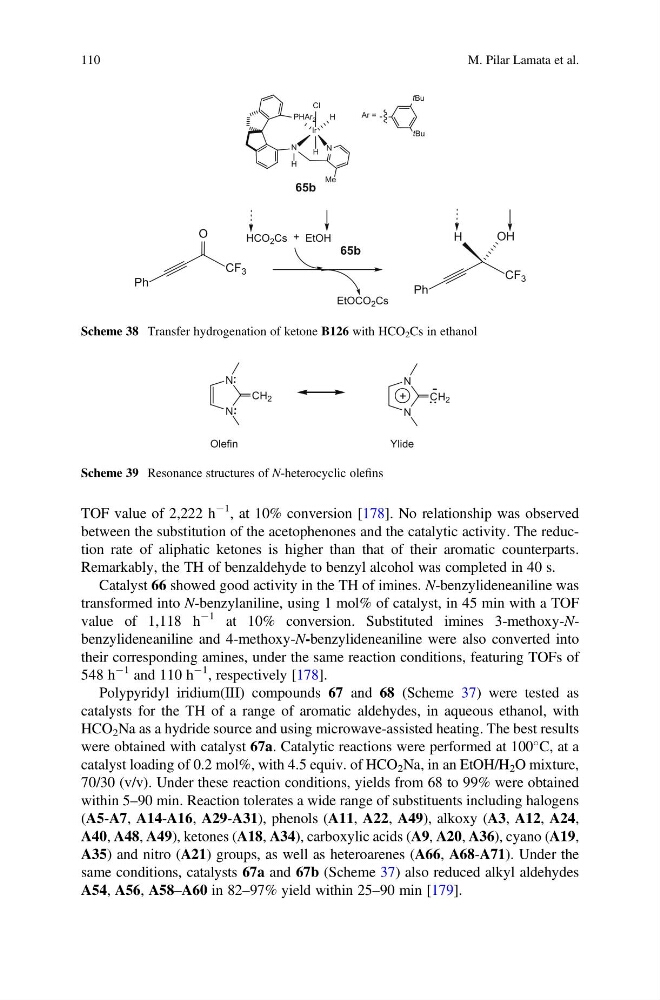
Scheme 38 Transfer hydrogenation of ketone B126 with HCO 2 Cs in ethanol
N
N
CH 2
-
N
N
CH 2
+
Olefin
Ylide
Scheme 39 Resonance structures of N-heterocyclic olefins
110
M. Pilar Lamata et al.
À1 , at 10% conversion [178]. No relationship was observed
between the substitution of the acetophenones and the catalytic activity. The reduction rate of aliphatic ketones is higher than that of their aromatic counterparts.
Remarkably, the TH of benzaldehyde to benzyl alcohol was completed in 40 s.
Catalyst 66 showed good activity in the TH of imines. N-benzylideneaniline was
transformed into N-benzylaniline, using 1 mol% of catalyst, in 45 min with a TOF
value of 1,118 h
À1 at 10% conversion. Substituted imines 3-methoxy-Nbenzylideneaniline and 4-methoxy-N-benzylideneaniline were also converted into
their corresponding amines, under the same reaction conditions, featuring TOFs of
548 h
À1 and 110 h
À1 , respectively [178].
Polypyridyl iridium(III) compounds 67 and 68 (Scheme 37) were tested as
catalysts for the TH of a range of aromatic aldehydes, in aqueous ethanol, with
HCO 2 Na as a hydride source and using microwave-assisted heating. The best results
were obtained with catalyst 67a. Catalytic reactions were performed at 100
C, at a
catalyst loading of 0.2 mol%, with 4.5 equiv. of HCO 2 Na, in an EtOH/H 2 O mixture,
70/30 (v/v). Under these reaction conditions, yields from 68 to 99% were obtained
within 5–90 min. Reaction tolerates a wide range of substituents including halogens
(A5-A7, A14-A16, A29-A31), phenols (A11, A22, A49), alkoxy (A3, A12, A24,
A40, A48, A49), ketones (A18, A34), carboxylic acids (A9, A20, A36), cyano (A19,
A35) and nitro (A21) groups, as well as heteroarenes (A66, A68-A71). Under the
same conditions, catalysts 67a and 67b (Scheme 37) also reduced alkyl aldehydes
A54, A56, A58–A60 in 82–97% yield within 25–90 min [179].
PHAr 2
N
Ir
Cl
H
H N
H
Ar =
tBu
tBu
65b
HCO 2 Cs + EtOH
Ph
O
CF 3
Ph
OH
CF 3
H
EtOCO 2 Cs
Me
65b
Scheme 38 Transfer hydrogenation of ketone B126 with HCO 2 Cs in ethanol
N
N
CH 2
-
N
N
CH 2
+
Olefin
Ylide
Scheme 39 Resonance structures of N-heterocyclic olefins
110
M. Pilar Lamata et al.