

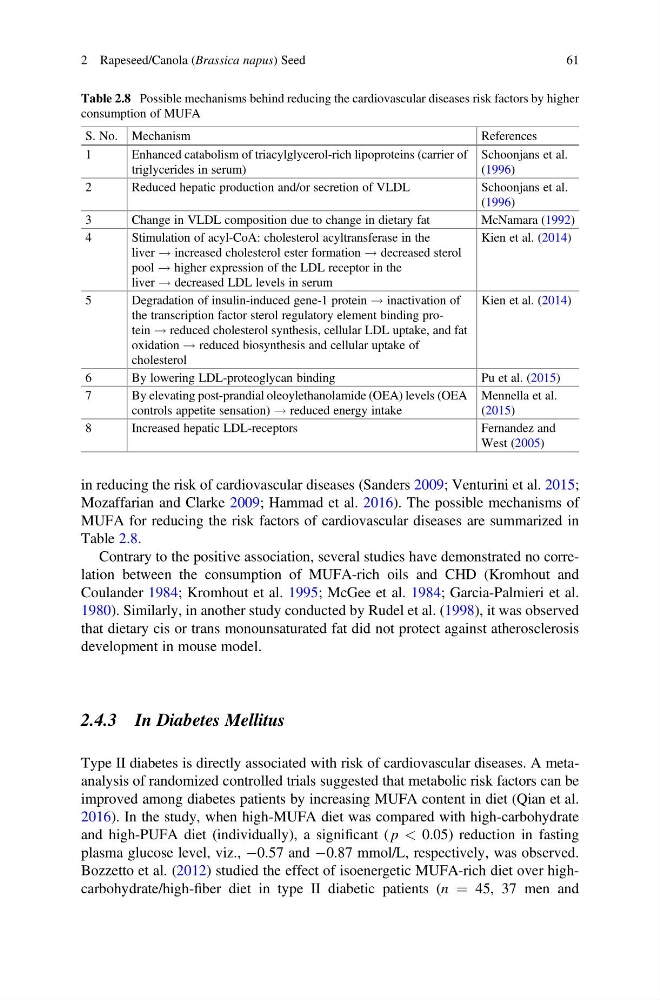
in reducing the risk of cardiovascular diseases (Sanders 2009; Venturini et al. 2015;
Mozaffarian and Clarke 2009; Hammad et al. 2016). The possible mechanisms of
MUFA for reducing the risk factors of cardiovascular diseases are summarized in
Table 2.8.
Contrary to the positive association, several studies have demonstrated no correlation between the consumption of MUFA-rich oils and CHD (Kromhout and
Coulander 1984; Kromhout et al. 1995; McGee et al. 1984; Garcia-Palmieri et al.
1980). Similarly, in another study conducted by Rudel et al. (1998), it was observed
that dietary cis or trans monounsaturated fat did not protect against atherosclerosis
development in mouse model.
2.4.3 In Diabetes Mellitus
Type II diabetes is directly associated with risk of cardiovascular diseases. A metaanalysis of randomized controlled trials suggested that metabolic risk factors can be
improved among diabetes patients by increasing MUFA content in diet (Qian et al.
2016). In the study, when high-MUFA diet was compared with high-carbohydrate
and high-PUFA diet (individually), a significant ( p < 0.05) reduction in fasting
plasma glucose level, viz., À0.57 and À0.87 mmol/L, respectively, was observed.
Bozzetto et al. (2012) studied the effect of isoenergetic MUFA-rich diet over highcarbohydrate/high-fiber diet in type II diabetic patients (n ¼ 45, 37 men and
Table 2.8 Possible mechanisms behind reducing the cardiovascular diseases risk factors by higher
consumption of MUFA
S. No. Mechanism
References
1
Enhanced catabolism of triacylglycerol-rich lipoproteins (carrier of
triglycerides in serum)
Schoonjans et al.
(1996)
2
Reduced hepatic production and/or secretion of VLDL
Schoonjans et al.
(1996)
3
Change in VLDL composition due to change in dietary fat
McNamara (1992)
4
Stimulation of acyl-CoA: cholesterol acyltransferase in the
liver ! increased cholesterol ester formation ! decreased sterol
pool ! higher expression of the LDL receptor in the
liver ! decreased LDL levels in serum
Kien et al. (2014)
5
Degradation of insulin-induced gene-1 protein ! inactivation of
the transcription factor sterol regulatory element binding protein ! reduced cholesterol synthesis, cellular LDL uptake, and fat
oxidation ! reduced biosynthesis and cellular uptake of
cholesterol
Kien et al. (2014)
6
By lowering LDL-proteoglycan binding
Pu et al. (2015)
7
By elevating post-prandial oleoylethanolamide (OEA) levels (OEA
controls appetite sensation) ! reduced energy intake
Mennella et al.
(2015)
8
Increased hepatic LDL-receptors
Fernandez and
West (2005)
2 Rapeseed/Canola (Brassica napus) Seed
61
Mozaffarian and Clarke 2009; Hammad et al. 2016). The possible mechanisms of
MUFA for reducing the risk factors of cardiovascular diseases are summarized in
Table 2.8.
Contrary to the positive association, several studies have demonstrated no correlation between the consumption of MUFA-rich oils and CHD (Kromhout and
Coulander 1984; Kromhout et al. 1995; McGee et al. 1984; Garcia-Palmieri et al.
1980). Similarly, in another study conducted by Rudel et al. (1998), it was observed
that dietary cis or trans monounsaturated fat did not protect against atherosclerosis
development in mouse model.
2.4.3 In Diabetes Mellitus
Type II diabetes is directly associated with risk of cardiovascular diseases. A metaanalysis of randomized controlled trials suggested that metabolic risk factors can be
improved among diabetes patients by increasing MUFA content in diet (Qian et al.
2016). In the study, when high-MUFA diet was compared with high-carbohydrate
and high-PUFA diet (individually), a significant ( p < 0.05) reduction in fasting
plasma glucose level, viz., À0.57 and À0.87 mmol/L, respectively, was observed.
Bozzetto et al. (2012) studied the effect of isoenergetic MUFA-rich diet over highcarbohydrate/high-fiber diet in type II diabetic patients (n ¼ 45, 37 men and
Table 2.8 Possible mechanisms behind reducing the cardiovascular diseases risk factors by higher
consumption of MUFA
S. No. Mechanism
References
1
Enhanced catabolism of triacylglycerol-rich lipoproteins (carrier of
triglycerides in serum)
Schoonjans et al.
(1996)
2
Reduced hepatic production and/or secretion of VLDL
Schoonjans et al.
(1996)
3
Change in VLDL composition due to change in dietary fat
McNamara (1992)
4
Stimulation of acyl-CoA: cholesterol acyltransferase in the
liver ! increased cholesterol ester formation ! decreased sterol
pool ! higher expression of the LDL receptor in the
liver ! decreased LDL levels in serum
Kien et al. (2014)
5
Degradation of insulin-induced gene-1 protein ! inactivation of
the transcription factor sterol regulatory element binding protein ! reduced cholesterol synthesis, cellular LDL uptake, and fat
oxidation ! reduced biosynthesis and cellular uptake of
cholesterol
Kien et al. (2014)
6
By lowering LDL-proteoglycan binding
Pu et al. (2015)
7
By elevating post-prandial oleoylethanolamide (OEA) levels (OEA
controls appetite sensation) ! reduced energy intake
Mennella et al.
(2015)
8
Increased hepatic LDL-receptors
Fernandez and
West (2005)
2 Rapeseed/Canola (Brassica napus) Seed
61