

(Roman-Ramos and Flores-Saenz 1995). Orally administered cumin to alloxaninduced diabetic rats reduced the body weight, tissue, and cholesterol in the plasma,
fatty acids, triglycerides, and phospholipids, decreases aspartate transferase, basic
enzyme (ALP) and gamma-glutamyl enzyme actions, and diminishes sterol, phospholipids, and triglycerides levels in the tissues of kidney and liver.
20.4 Adverse Effects and Individual Concerns
Cumin is an ancient and favored herb which has numerous benefits and curable
effects. However, it has shown some undesirable effects such as dermatitis, metabolic reactions, carcinoma (high dietary concentration), lowering glucose level, and
also increasing the risk of hemorrhage (Bennett et al. 1982).
A patient with liver problems and ulcer and lactating or pregnant women must use
cumin with attention. Cumin constituents may alter the activity when
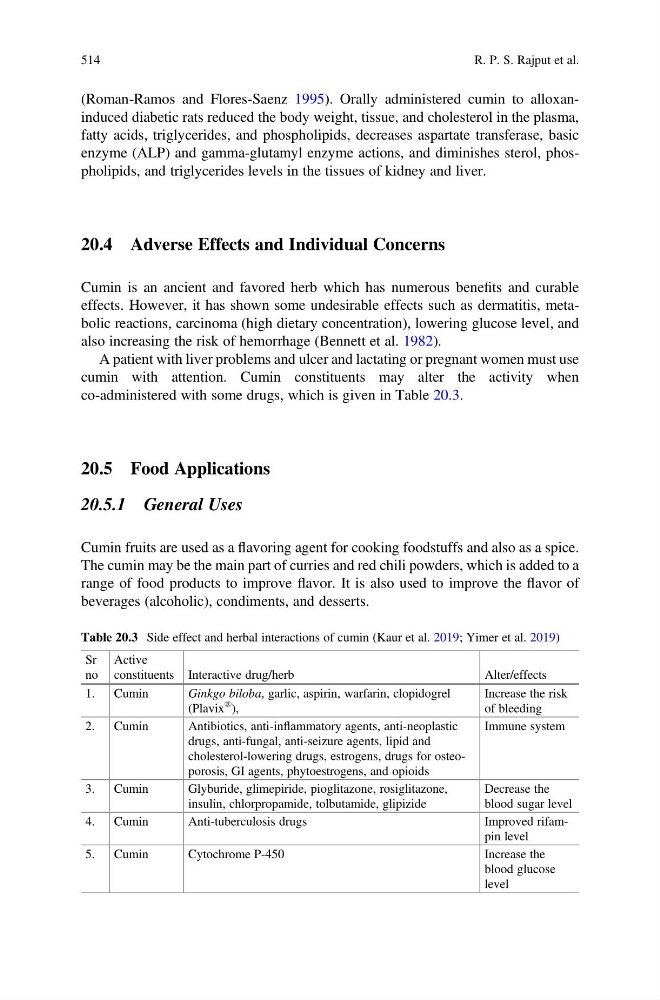
co-administered with some drugs, which is given in Table 20.3.
20.5 Food Applications
20.5.1 General Uses
Cumin fruits are used as a flavoring agent for cooking foodstuffs and also as a spice.
The cumin may be the main part of curries and red chili powders, which is added to a
range of food products to improve flavor. It is also used to improve the flavor of
beverages (alcoholic), condiments, and desserts.
Table 20.3 Side effect and herbal interactions of cumin (Kaur et al. 2019; Yimer et al. 2019)
Sr
no
Active
constituents Interactive drug/herb
Alter/effects
1.
Cumin
Ginkgo biloba, garlic, aspirin, warfarin, clopidogrel
(Plavix
®
),
Increase the risk
of bleeding
2.
Cumin
Antibiotics, anti-inflammatory agents, anti-neoplastic
drugs, anti-fungal, anti-seizure agents, lipid and
cholesterol-lowering drugs, estrogens, drugs for osteoporosis, GI agents, phytoestrogens, and opioids
Immune system
3.
Cumin
Glyburide, glimepiride, pioglitazone, rosiglitazone,
insulin, chlorpropamide, tolbutamide, glipizide
Decrease the
blood sugar level
4.
Cumin
Anti-tuberculosis drugs
Improved rifampin level
5.
Cumin
Cytochrome P-450
Increase the
blood glucose
level
514
R. P. S. Rajput et al.
fatty acids, triglycerides, and phospholipids, decreases aspartate transferase, basic
enzyme (ALP) and gamma-glutamyl enzyme actions, and diminishes sterol, phospholipids, and triglycerides levels in the tissues of kidney and liver.
20.4 Adverse Effects and Individual Concerns
Cumin is an ancient and favored herb which has numerous benefits and curable
effects. However, it has shown some undesirable effects such as dermatitis, metabolic reactions, carcinoma (high dietary concentration), lowering glucose level, and
also increasing the risk of hemorrhage (Bennett et al. 1982).
A patient with liver problems and ulcer and lactating or pregnant women must use
cumin with attention. Cumin constituents may alter the activity when
co-administered with some drugs, which is given in Table 20.3.
20.5 Food Applications
20.5.1 General Uses
Cumin fruits are used as a flavoring agent for cooking foodstuffs and also as a spice.
The cumin may be the main part of curries and red chili powders, which is added to a
range of food products to improve flavor. It is also used to improve the flavor of
beverages (alcoholic), condiments, and desserts.
Table 20.3 Side effect and herbal interactions of cumin (Kaur et al. 2019; Yimer et al. 2019)
Sr
no
Active
constituents Interactive drug/herb
Alter/effects
1.
Cumin
Ginkgo biloba, garlic, aspirin, warfarin, clopidogrel
(Plavix
®
),
Increase the risk
of bleeding
2.
Cumin
Antibiotics, anti-inflammatory agents, anti-neoplastic
drugs, anti-fungal, anti-seizure agents, lipid and
cholesterol-lowering drugs, estrogens, drugs for osteoporosis, GI agents, phytoestrogens, and opioids
Immune system
3.
Cumin
Glyburide, glimepiride, pioglitazone, rosiglitazone,
insulin, chlorpropamide, tolbutamide, glipizide
Decrease the
blood sugar level
4.
Cumin
Anti-tuberculosis drugs
Improved rifampin level
5.
Cumin
Cytochrome P-450
Increase the
blood glucose
level
514
R. P. S. Rajput et al.