

with 5 tiny sepals, 5 stamens, and 5 petals. Cumin or Cuminum cyminum are the only
living species in their genus.
It is a little perennial herb having a thin branched stem and 20-30 cm height. The
leaves of the cumin are 5–10 cm in length, bipinnate/pinnate and with leaflets like
threads. The flowers of cumin are tiny, pink or white, and bear in umbels. The fruit
(normally referred to as seed) could be a lateral cigar-shaped or ovoid, 4–5 mm in
length, consisting of one seed in it. These seeds almost look like fennel seeds,
however are dark in color and small in length (Singh et al. 2017).
20.2.2 Cultivation Areas
The key producers of cumin are the Asian nation and China, which produces around
70% of the global supply and consumes 90%, whereas India consumes around 63%
of the world’s cumin. The other major producer is Mexico. In general, around
300,000 ton of cumin is annually produced worldwide.
20.3 Chemical Composition
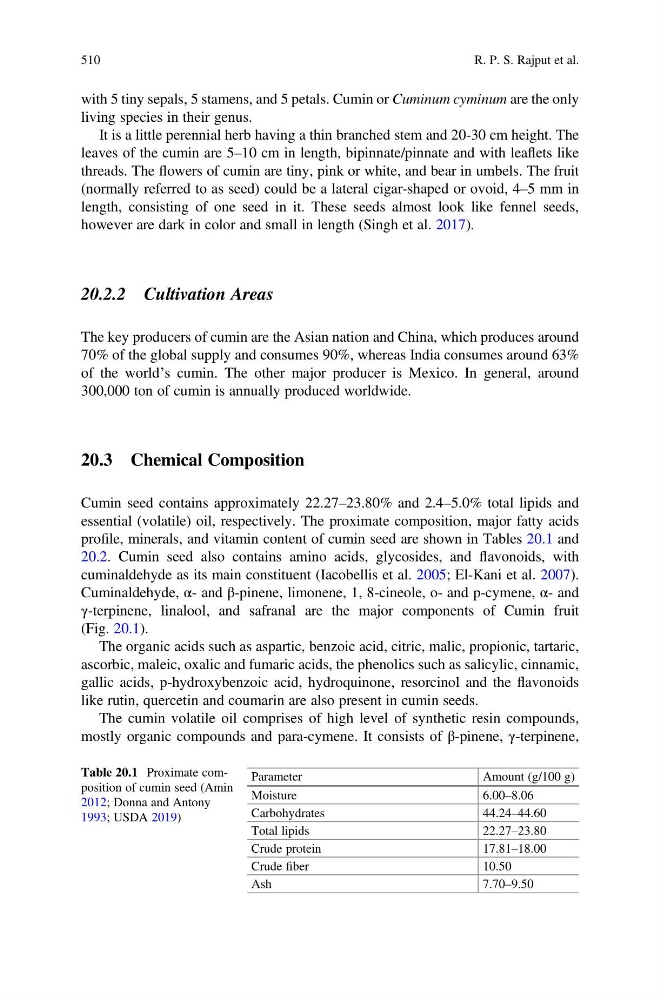
Cumin seed contains approximately 22.27–23.80% and 2.4–5.0% total lipids and
essential (volatile) oil, respectively. The proximate composition, major fatty acids
profile, minerals, and vitamin content of cumin seed are shown in Tables 20.1 and
20.2. Cumin seed also contains amino acids, glycosides, and flavonoids, with
cuminaldehyde as its main constituent (Iacobellis et al. 2005; El-Kani et al. 2007).
Cuminaldehyde, α- and β-pinene, limonene, 1, 8-cineole, o- and p-cymene, α- and
γ-terpinene, linalool, and safranal are the major components of Cumin fruit
(Fig. 20.1).
The organic acids such as aspartic, benzoic acid, citric, malic, propionic, tartaric,
ascorbic, maleic, oxalic and fumaric acids, the phenolics such as salicylic, cinnamic,
gallic acids, p-hydroxybenzoic acid, hydroquinone, resorcinol and the flavonoids
like rutin, quercetin and coumarin are also present in cumin seeds.
The cumin volatile oil comprises of high level of synthetic resin compounds,
mostly organic compounds and para-cymene. It consists of β-pinene, γ-terpinene,
Table 20.1 Proximate composition of cumin seed (Amin
2012; Donna and Antony
1993; USDA 2019)
Parameter
Amount (g/100 g)
Moisture
6.00–8.06
Carbohydrates
44.24–44.60
Total lipids
22.27–23.80
Crude protein
17.81–18.00
Crude fiber
10.50
Ash
7.70–9.50
510
R. P. S. Rajput et al.
living species in their genus.
It is a little perennial herb having a thin branched stem and 20-30 cm height. The
leaves of the cumin are 5–10 cm in length, bipinnate/pinnate and with leaflets like
threads. The flowers of cumin are tiny, pink or white, and bear in umbels. The fruit
(normally referred to as seed) could be a lateral cigar-shaped or ovoid, 4–5 mm in
length, consisting of one seed in it. These seeds almost look like fennel seeds,
however are dark in color and small in length (Singh et al. 2017).
20.2.2 Cultivation Areas
The key producers of cumin are the Asian nation and China, which produces around
70% of the global supply and consumes 90%, whereas India consumes around 63%
of the world’s cumin. The other major producer is Mexico. In general, around
300,000 ton of cumin is annually produced worldwide.
20.3 Chemical Composition
Cumin seed contains approximately 22.27–23.80% and 2.4–5.0% total lipids and
essential (volatile) oil, respectively. The proximate composition, major fatty acids
profile, minerals, and vitamin content of cumin seed are shown in Tables 20.1 and
20.2. Cumin seed also contains amino acids, glycosides, and flavonoids, with
cuminaldehyde as its main constituent (Iacobellis et al. 2005; El-Kani et al. 2007).
Cuminaldehyde, α- and β-pinene, limonene, 1, 8-cineole, o- and p-cymene, α- and
γ-terpinene, linalool, and safranal are the major components of Cumin fruit
(Fig. 20.1).
The organic acids such as aspartic, benzoic acid, citric, malic, propionic, tartaric,
ascorbic, maleic, oxalic and fumaric acids, the phenolics such as salicylic, cinnamic,
gallic acids, p-hydroxybenzoic acid, hydroquinone, resorcinol and the flavonoids
like rutin, quercetin and coumarin are also present in cumin seeds.
The cumin volatile oil comprises of high level of synthetic resin compounds,
mostly organic compounds and para-cymene. It consists of β-pinene, γ-terpinene,
Table 20.1 Proximate composition of cumin seed (Amin
2012; Donna and Antony
1993; USDA 2019)
Parameter
Amount (g/100 g)
Moisture
6.00–8.06
Carbohydrates
44.24–44.60
Total lipids
22.27–23.80
Crude protein
17.81–18.00
Crude fiber
10.50
Ash
7.70–9.50
510
R. P. S. Rajput et al.