

et al. 2007). Around 1 L of oil can be recovered from 2.5 kg of dried seeds (GAIN
2004).
19.3 Processing of Pumpkin Seeds
19.3.1 Seed
The types of seeds desired from pumpkins can be broken down into two types:
confectionery seeds for snacks application and oilseeds for oil extraction. Seeds are
sorted based on size and color, it can further be roasted, salted, sugar coated, or can
be used as spices or flavorings to enhance the acceptability of the supplemented food
products in the market (Baxter et al. 2012).
19.3.2 Oil Pressing
In the traditional method of hot press process for extracting oil, pumpkin seeds are
milled through a stone mill, with the addition of water and salt, followed by roasting
in pans at a temperature of 100–130
C. The hot seed mixture is then passed through
the press to extract oil. The amount of salt and water are added with particular timetemperature combinations in order to extract pumpkin seed oil. In Central Europe,
pumpkin seeds oil is extracted using a hot pressing method. However, in cold
pressing, dry seeds are mechanically pressed without thermal processing (Bavec
et al. 2007).
Oil yield and quality are vital to determine the viability of commercial production.
Traditionally solvent extraction method is used with n-hexane as the most widely
used solvent owing to its efficacy and availability (Prámparo et al. 2003).
40%
27%
7%
6%
5%
3%
3%
3% 3% 3%
Share of pumpkin production
China
India
Russia
Ukraine
USA
Iran
Mexico
Italy
Cuba
Spain
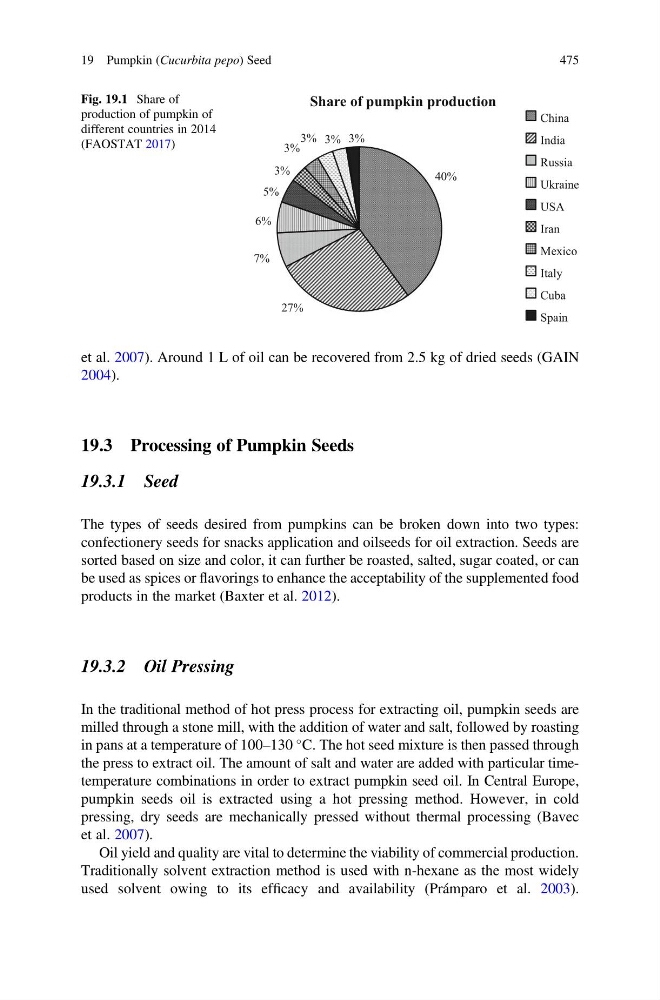
Fig. 19.1 Share of
production of pumpkin of
different countries in 2014
(FAOSTAT 2017)
19 Pumpkin (Cucurbita pepo) Seed
475
2004).
19.3 Processing of Pumpkin Seeds
19.3.1 Seed
The types of seeds desired from pumpkins can be broken down into two types:
confectionery seeds for snacks application and oilseeds for oil extraction. Seeds are
sorted based on size and color, it can further be roasted, salted, sugar coated, or can
be used as spices or flavorings to enhance the acceptability of the supplemented food
products in the market (Baxter et al. 2012).
19.3.2 Oil Pressing
In the traditional method of hot press process for extracting oil, pumpkin seeds are
milled through a stone mill, with the addition of water and salt, followed by roasting
in pans at a temperature of 100–130
C. The hot seed mixture is then passed through
the press to extract oil. The amount of salt and water are added with particular timetemperature combinations in order to extract pumpkin seed oil. In Central Europe,
pumpkin seeds oil is extracted using a hot pressing method. However, in cold
pressing, dry seeds are mechanically pressed without thermal processing (Bavec
et al. 2007).
Oil yield and quality are vital to determine the viability of commercial production.
Traditionally solvent extraction method is used with n-hexane as the most widely
used solvent owing to its efficacy and availability (Prámparo et al. 2003).
40%
27%
7%
6%
5%
3%
3%
3% 3% 3%
Share of pumpkin production
China
India
Russia
Ukraine
USA
Iran
Mexico
Italy
Cuba
Spain
Fig. 19.1 Share of
production of pumpkin of
different countries in 2014
(FAOSTAT 2017)
19 Pumpkin (Cucurbita pepo) Seed
475