

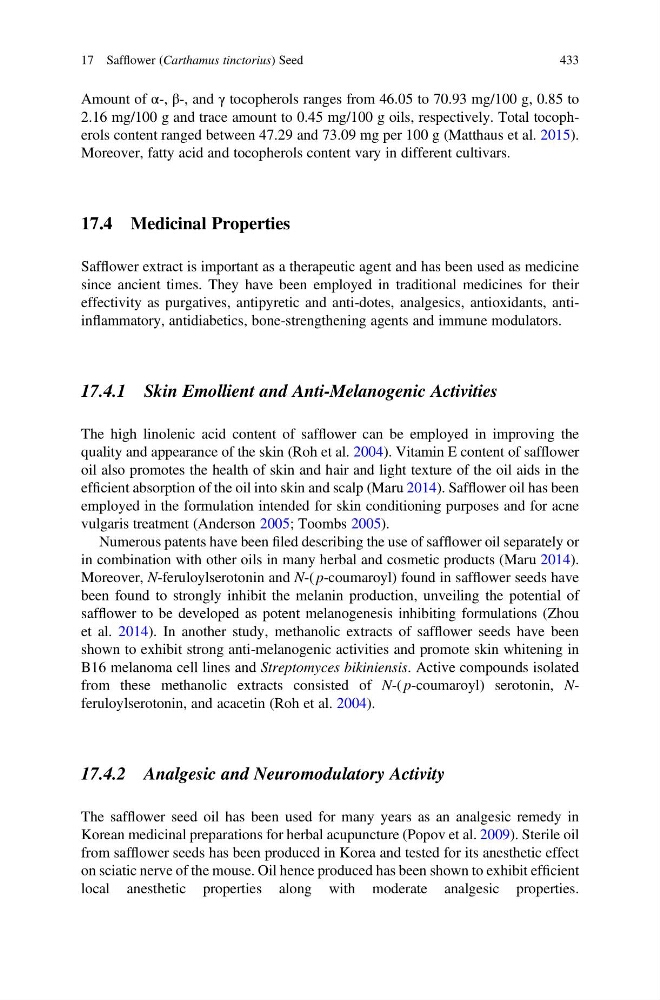
Amount of α-, β-, and γ tocopherols ranges from 46.05 to 70.93 mg/100 g, 0.85 to
2.16 mg/100 g and trace amount to 0.45 mg/100 g oils, respectively. Total tocopherols content ranged between 47.29 and 73.09 mg per 100 g (Matthaus et al. 2015).
Moreover, fatty acid and tocopherols content vary in different cultivars.
17.4 Medicinal Properties
Safflower extract is important as a therapeutic agent and has been used as medicine
since ancient times. They have been employed in traditional medicines for their
effectivity as purgatives, antipyretic and anti-dotes, analgesics, antioxidants, antiinflammatory, antidiabetics, bone-strengthening agents and immune modulators.
17.4.1 Skin Emollient and Anti-Melanogenic Activities
The high linolenic acid content of safflower can be employed in improving the
quality and appearance of the skin (Roh et al. 2004). Vitamin E content of safflower
oil also promotes the health of skin and hair and light texture of the oil aids in the
efficient absorption of the oil into skin and scalp (Maru 2014). Safflower oil has been
employed in the formulation intended for skin conditioning purposes and for acne
vulgaris treatment (Anderson 2005; Toombs 2005).
Numerous patents have been filed describing the use of safflower oil separately or
in combination with other oils in many herbal and cosmetic products (Maru 2014).
Moreover, N-feruloylserotonin and N-( p-coumaroyl) found in safflower seeds have
been found to strongly inhibit the melanin production, unveiling the potential of
safflower to be developed as potent melanogenesis inhibiting formulations (Zhou
et al. 2014). In another study, methanolic extracts of safflower seeds have been
shown to exhibit strong anti-melanogenic activities and promote skin whitening in
B16 melanoma cell lines and Streptomyces bikiniensis. Active compounds isolated
from these methanolic extracts consisted of N-( p-coumaroyl) serotonin, Nferuloylserotonin, and acacetin (Roh et al. 2004).
17.4.2 Analgesic and Neuromodulatory Activity
The safflower seed oil has been used for many years as an analgesic remedy in
Korean medicinal preparations for herbal acupuncture (Popov et al. 2009). Sterile oil
from safflower seeds has been produced in Korea and tested for its anesthetic effect
on sciatic nerve of the mouse. Oil hence produced has been shown to exhibit efficient
local anesthetic properties along with moderate analgesic properties.
17 Safflower (Carthamus tinctorius) Seed
433
2.16 mg/100 g and trace amount to 0.45 mg/100 g oils, respectively. Total tocopherols content ranged between 47.29 and 73.09 mg per 100 g (Matthaus et al. 2015).
Moreover, fatty acid and tocopherols content vary in different cultivars.
17.4 Medicinal Properties
Safflower extract is important as a therapeutic agent and has been used as medicine
since ancient times. They have been employed in traditional medicines for their
effectivity as purgatives, antipyretic and anti-dotes, analgesics, antioxidants, antiinflammatory, antidiabetics, bone-strengthening agents and immune modulators.
17.4.1 Skin Emollient and Anti-Melanogenic Activities
The high linolenic acid content of safflower can be employed in improving the
quality and appearance of the skin (Roh et al. 2004). Vitamin E content of safflower
oil also promotes the health of skin and hair and light texture of the oil aids in the
efficient absorption of the oil into skin and scalp (Maru 2014). Safflower oil has been
employed in the formulation intended for skin conditioning purposes and for acne
vulgaris treatment (Anderson 2005; Toombs 2005).
Numerous patents have been filed describing the use of safflower oil separately or
in combination with other oils in many herbal and cosmetic products (Maru 2014).
Moreover, N-feruloylserotonin and N-( p-coumaroyl) found in safflower seeds have
been found to strongly inhibit the melanin production, unveiling the potential of
safflower to be developed as potent melanogenesis inhibiting formulations (Zhou
et al. 2014). In another study, methanolic extracts of safflower seeds have been
shown to exhibit strong anti-melanogenic activities and promote skin whitening in
B16 melanoma cell lines and Streptomyces bikiniensis. Active compounds isolated
from these methanolic extracts consisted of N-( p-coumaroyl) serotonin, Nferuloylserotonin, and acacetin (Roh et al. 2004).
17.4.2 Analgesic and Neuromodulatory Activity
The safflower seed oil has been used for many years as an analgesic remedy in
Korean medicinal preparations for herbal acupuncture (Popov et al. 2009). Sterile oil
from safflower seeds has been produced in Korea and tested for its anesthetic effect
on sciatic nerve of the mouse. Oil hence produced has been shown to exhibit efficient
local anesthetic properties along with moderate analgesic properties.
17 Safflower (Carthamus tinctorius) Seed
433