

the larger amount of unsaturated fatty acids and medicinal properties of safflower
(Pearl and Burke 2014; Khalid et al. 2017).
Land cultivating safflower has grown at a rate of 4.9% per annum. With an annual
growth rate of 0.97%, the average global yield is 805–872 kg per hectare. Safflower
production reached 867,659 tons in 2014 and is increasing at a rate of 5.6% per
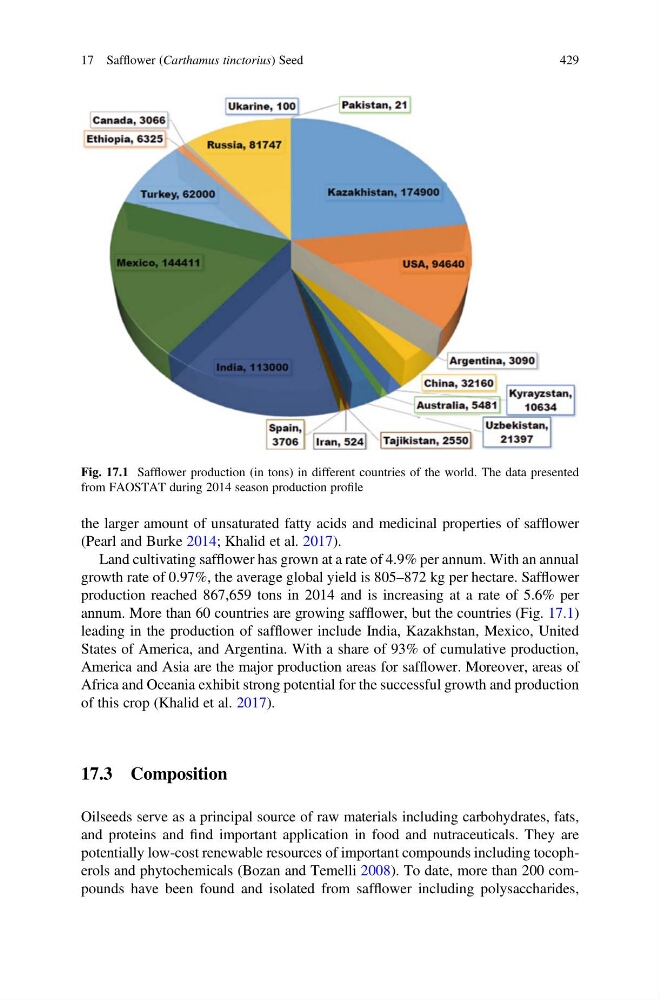
annum. More than 60 countries are growing safflower, but the countries (Fig. 17.1)
leading in the production of safflower include India, Kazakhstan, Mexico, United
States of America, and Argentina. With a share of 93% of cumulative production,
America and Asia are the major production areas for safflower. Moreover, areas of
Africa and Oceania exhibit strong potential for the successful growth and production
of this crop (Khalid et al. 2017).
17.3 Composition
Oilseeds serve as a principal source of raw materials including carbohydrates, fats,
and proteins and find important application in food and nutraceuticals. They are
potentially low-cost renewable resources of important compounds including tocopherols and phytochemicals (Bozan and Temelli 2008). To date, more than 200 compounds have been found and isolated from safflower including polysaccharides,
Fig. 17.1 Safflower production (in tons) in different countries of the world. The data presented
from FAOSTAT during 2014 season production profile
17 Safflower (Carthamus tinctorius) Seed
429
(Pearl and Burke 2014; Khalid et al. 2017).
Land cultivating safflower has grown at a rate of 4.9% per annum. With an annual
growth rate of 0.97%, the average global yield is 805–872 kg per hectare. Safflower
production reached 867,659 tons in 2014 and is increasing at a rate of 5.6% per
annum. More than 60 countries are growing safflower, but the countries (Fig. 17.1)
leading in the production of safflower include India, Kazakhstan, Mexico, United
States of America, and Argentina. With a share of 93% of cumulative production,
America and Asia are the major production areas for safflower. Moreover, areas of
Africa and Oceania exhibit strong potential for the successful growth and production
of this crop (Khalid et al. 2017).
17.3 Composition
Oilseeds serve as a principal source of raw materials including carbohydrates, fats,
and proteins and find important application in food and nutraceuticals. They are
potentially low-cost renewable resources of important compounds including tocopherols and phytochemicals (Bozan and Temelli 2008). To date, more than 200 compounds have been found and isolated from safflower including polysaccharides,
Fig. 17.1 Safflower production (in tons) in different countries of the world. The data presented
from FAOSTAT during 2014 season production profile
17 Safflower (Carthamus tinctorius) Seed
429