

(a) Soluble fibre: Constituting around 20% of the fibres in hempseed, these are
soluble in water and can form a gel-like substance in the gut. These are a
valuable source of nutrients for the beneficial digestive bacteria and may also
reduce spikes in blood sugar and regulate cholesterol levels (Matthäus and Brühl
2008; Matthäus et al. 2006).
(b) Insoluble fibre: Constituting around 80% of the fibres, they cannot be dissolved
and instead adds bulk to faecal matter and may help food and waste pass through
the gut. Consuming insoluble fibre has also been linked with a reduced risk of
diabetes (de Munter et al. 2007; Weickert and Pfeiffer 2008). However, due to
the removal of the fibre-rich shell in de-hulled or shelled hempseeds, the fibre
content is substantially reduced (Callaway 2004).
15.3.5 Vitamins
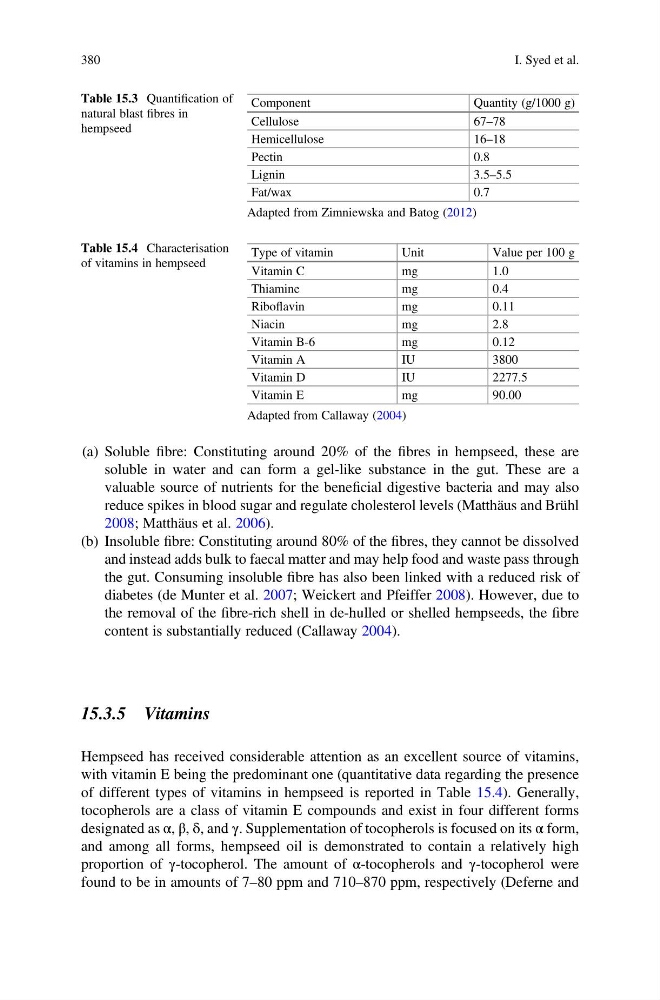
Hempseed has received considerable attention as an excellent source of vitamins,
with vitamin E being the predominant one (quantitative data regarding the presence
of different types of vitamins in hempseed is reported in Table 15.4). Generally,
tocopherols are a class of vitamin E compounds and exist in four different forms
designated as α, β, δ, and γ. Supplementation of tocopherols is focused on its α form,
and among all forms, hempseed oil is demonstrated to contain a relatively high
proportion of γ-tocopherol. The amount of α-tocopherols and γ-tocopherol were
found to be in amounts of 7–80 ppm and 710–870 ppm, respectively (Deferne and
Table 15.3 Quantification of
natural blast fibres in
hempseed
Component
Quantity (g/1000 g)
Cellulose
67–78
Hemicellulose
16–18
Pectin
0.8
Lignin
3.5–5.5
Fat/wax
0.7
Adapted from Zimniewska and Batog (2012)
Table 15.4 Characterisation
of vitamins in hempseed
Type of vitamin
Unit
Value per 100 g
Vitamin C
mg
1.0
Thiamine
mg
0.4
Riboflavin
mg
0.11
Niacin
mg
2.8
Vitamin B-6
mg
0.12
Vitamin A
IU
3800
Vitamin D
IU
2277.5
Vitamin E
mg
90.00
Adapted from Callaway (2004)
380
I. Syed et al.
soluble in water and can form a gel-like substance in the gut. These are a
valuable source of nutrients for the beneficial digestive bacteria and may also
reduce spikes in blood sugar and regulate cholesterol levels (Matthäus and Brühl
2008; Matthäus et al. 2006).
(b) Insoluble fibre: Constituting around 80% of the fibres, they cannot be dissolved
and instead adds bulk to faecal matter and may help food and waste pass through
the gut. Consuming insoluble fibre has also been linked with a reduced risk of
diabetes (de Munter et al. 2007; Weickert and Pfeiffer 2008). However, due to
the removal of the fibre-rich shell in de-hulled or shelled hempseeds, the fibre
content is substantially reduced (Callaway 2004).
15.3.5 Vitamins
Hempseed has received considerable attention as an excellent source of vitamins,
with vitamin E being the predominant one (quantitative data regarding the presence
of different types of vitamins in hempseed is reported in Table 15.4). Generally,
tocopherols are a class of vitamin E compounds and exist in four different forms
designated as α, β, δ, and γ. Supplementation of tocopherols is focused on its α form,
and among all forms, hempseed oil is demonstrated to contain a relatively high
proportion of γ-tocopherol. The amount of α-tocopherols and γ-tocopherol were
found to be in amounts of 7–80 ppm and 710–870 ppm, respectively (Deferne and
Table 15.3 Quantification of
natural blast fibres in
hempseed
Component
Quantity (g/1000 g)
Cellulose
67–78
Hemicellulose
16–18
Pectin
0.8
Lignin
3.5–5.5
Fat/wax
0.7
Adapted from Zimniewska and Batog (2012)
Table 15.4 Characterisation
of vitamins in hempseed
Type of vitamin
Unit
Value per 100 g
Vitamin C
mg
1.0
Thiamine
mg
0.4
Riboflavin
mg
0.11
Niacin
mg
2.8
Vitamin B-6
mg
0.12
Vitamin A
IU
3800
Vitamin D
IU
2277.5
Vitamin E
mg
90.00
Adapted from Callaway (2004)
380
I. Syed et al.