

addition to GLA, borage oil contains minor quantity of tocopherols, phytosterols and
squalene and, thus, used frequently in cosmetic products also.
Keywords Borage seed oil · Borago officinalis · Gamma-linolenic acid · GLA ·
Atopic dermatitis (eczema) · Starflower · Pyrrolizidine alkaloids · Rheumatoid
arthritis
14.1 History and Introduction
Borage, also known as burrage, boretsch (Greek), bourrache (French), bugloss,
borragine (Italy), bee bread, bee plant, burage, ox’s tongue, cool tankard or starflower,
is botanically equivalent to Borago officinalis L. belonging to the family Boraginaceae
(De Smet 1993; Osborne 1999). It is an annual herb believed to be originated in
Aleppo (Syria) but now widely distributed in Europe, North Africa, minor Asia and
several Mediterranean countries. The word ‘borage’ is thought to be originated from
the Latin borago, which is a corruption of the word corrago, indicating cor, heart and
ago, I lead, because of its ‘cordial’ effect (strengthening effect on the heart) (Mifsud
2004). The species officinalis is supposed to be derived from its ‘official’ use in
pharmaceutical and healing applications (Mifsud 2004). In the past, this epithet was
given to the plants with well-known medicinal properties. There are several other
theories also for the origin of the name of borage. Italian borra, French bourra and
Latin burra signify ‘hair’ or ‘wool’, as the plant is characterised to have numerous
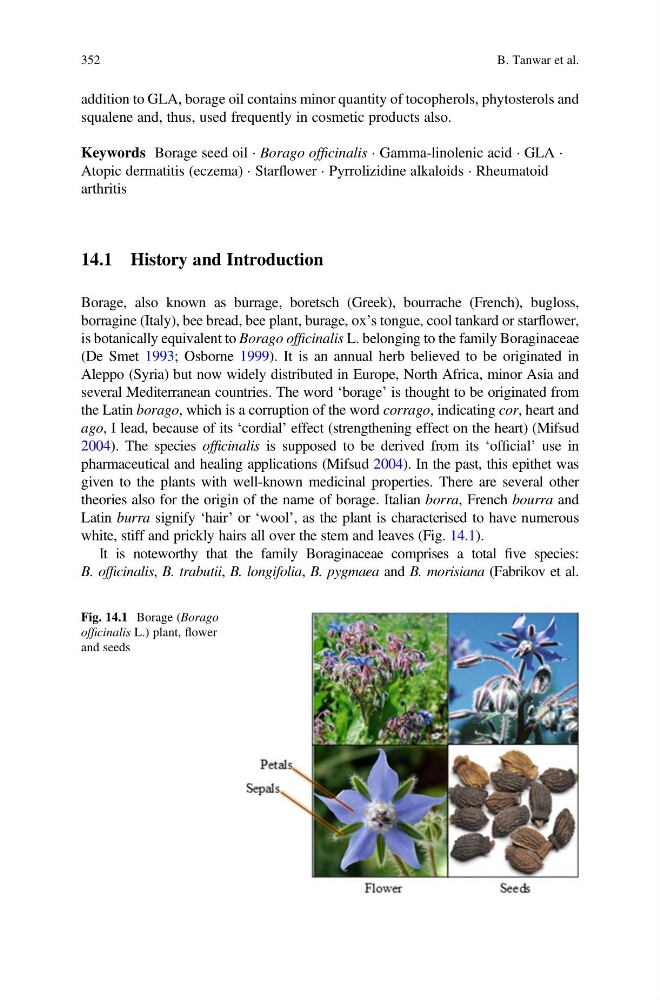
white, stiff and prickly hairs all over the stem and leaves (Fig. 14.1).
It is noteworthy that the family Boraginaceae comprises a total five species:
B. officinalis, B. trabutii, B. longifolia, B. pygmaea and B. morisiana (Fabrikov et al.
Fig. 14.1 Borage (Borago
officinalis L.) plant, flower
and seeds
352
B. Tanwar et al.
squalene and, thus, used frequently in cosmetic products also.
Keywords Borage seed oil · Borago officinalis · Gamma-linolenic acid · GLA ·
Atopic dermatitis (eczema) · Starflower · Pyrrolizidine alkaloids · Rheumatoid
arthritis
14.1 History and Introduction
Borage, also known as burrage, boretsch (Greek), bourrache (French), bugloss,
borragine (Italy), bee bread, bee plant, burage, ox’s tongue, cool tankard or starflower,
is botanically equivalent to Borago officinalis L. belonging to the family Boraginaceae
(De Smet 1993; Osborne 1999). It is an annual herb believed to be originated in
Aleppo (Syria) but now widely distributed in Europe, North Africa, minor Asia and
several Mediterranean countries. The word ‘borage’ is thought to be originated from
the Latin borago, which is a corruption of the word corrago, indicating cor, heart and
ago, I lead, because of its ‘cordial’ effect (strengthening effect on the heart) (Mifsud
2004). The species officinalis is supposed to be derived from its ‘official’ use in
pharmaceutical and healing applications (Mifsud 2004). In the past, this epithet was
given to the plants with well-known medicinal properties. There are several other
theories also for the origin of the name of borage. Italian borra, French bourra and
Latin burra signify ‘hair’ or ‘wool’, as the plant is characterised to have numerous
white, stiff and prickly hairs all over the stem and leaves (Fig. 14.1).
It is noteworthy that the family Boraginaceae comprises a total five species:
B. officinalis, B. trabutii, B. longifolia, B. pygmaea and B. morisiana (Fabrikov et al.
Fig. 14.1 Borage (Borago
officinalis L.) plant, flower
and seeds
352
B. Tanwar et al.